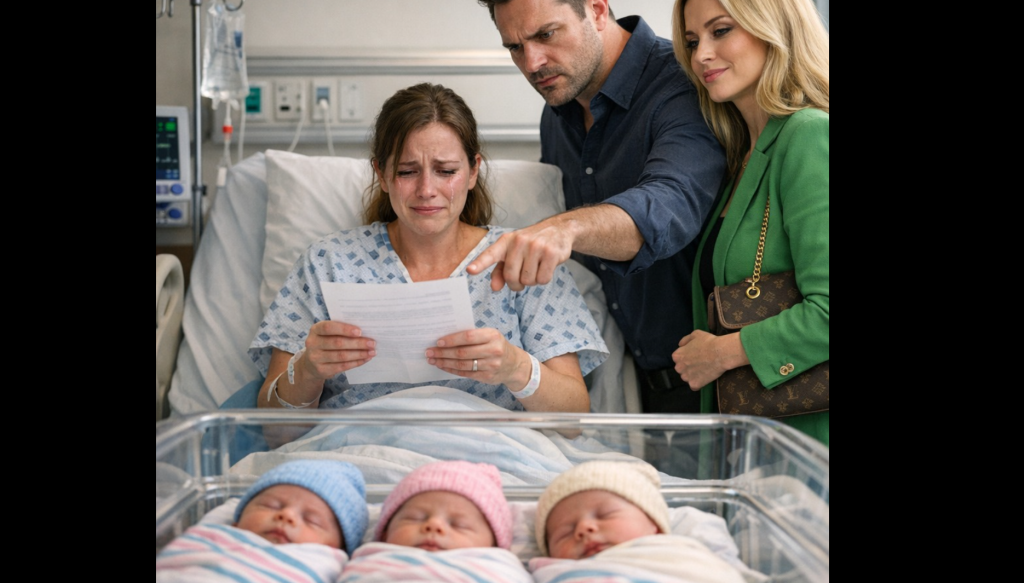
The day I delivered our triplets felt like crossing a finish line with no air left in my lungs.
I remember the ceiling tiles above the operating lights, white and too bright. I remember the tugging sensation, the metallic scent of antiseptic, the doctor saying, “Baby one—strong cry.” Then another voice, “Baby two—breathing.” Then softer, “Baby three—she’s small.”
Two boys. One girl.
Three lives I had carried for thirty-four weeks while my back screamed and my ankles swelled and my body shifted into something unfamiliar.
They wheeled me into recovery while my babies went straight to the NICU.

The beeping of monitors became the rhythm of my world.
Through the glass walls downstairs, I watched them beneath wires and blinking machines. Tiny fists, translucent skin, lungs learning how to be lungs.
I thought that was the hardest part.
I was wrong.
Connor arrived that afternoon.
He didn’t rush in like a worried father. He walked in like a man entering a meeting he didn’t want to attend.
Behind him stood a woman I had never seen before.
Cream blazer.
Glossy dark hair.
A Birkin bag hanging from her arm like a statement.
She looked at the room the way someone looks at a hotel suite—temporary, impersonal.
Connor didn’t introduce her.
He didn’t have to.
He dropped a manila folder onto my hospital bed. It slid across the blanket and bumped against my IV line.
“Sign the divorce papers,” he said flatly.
My brain lagged behind the words.
“I just had surgery,” I whispered. “Our babies are downstairs.”
He gave a short laugh, humorless.
“Exactly. Three premature infants. Endless bills. And you…” He gestured vaguely at my body, swollen and bandaged. “You’re not the woman I married.”
The woman beside him shifted slightly.
“This will be easier for everyone,” she said softly, as if offering condolences at a funeral.
I reached for the call button on instinct.
Connor leaned closer, lowering his voice so only I could hear.
“If you don’t cooperate,” he murmured, “you’ll leave with nothing.”
Nothing.
The word hit harder than the surgery.
I stared at him.
“I carried your children,” I said.
“And I’m done,” he replied.
He left before I could answer.
The woman followed.
Her perfume lingered longer than his presence.
Two days later, I left the hospital with three car seats and a heart that felt stitched together poorly.
My body ached with every step. The nurses had shown me how to hold two carriers at once. A volunteer helped with the third.
I expected Connor to be at the curb.
He wasn’t.
I took a rideshare home.
When we reached the driveway, I noticed the first change immediately.
The lock on the front door gleamed.
New.
Untouched.
Unfamiliar.
I tried my key.
It didn’t turn.
I tried again, panic rising.
Nothing.
The door opened from inside.
And there she stood.
The woman from the hospital.
Inside my house.
Holding a stack of mail addressed to me.
“Oh,” she said lightly, lips curving into something that wasn’t quite a smile. “Didn’t Connor explain?”
My mind struggled to process.
“Explain what?” I asked, my voice trembling as one of the babies began to fuss.
“This home belongs to me now,” she replied.
The world tilted.
I stepped backward down the driveway, gripping the diaper bag straps.
“You can’t—” I began.
She raised a hand.
“You should’ve signed,” she said. “That would’ve been cleaner.”
Cleaner.
As if eviction were a stain.
I turned away and called the only two people whose warnings I had ignored years ago.
My parents.
“I was wrong,” I sobbed when my mother answered. “Everything you said about him.”
“Where are you?” she asked calmly.
“In the driveway.”
“Stay there,” she said. “We’re coming.”
Then she added quietly, “Connor just made a very expensive mistake.”
They arrived in under twenty minutes.
My father stepped out first, eyes scanning the house like he was assessing a crime scene.
My mother walked straight to the door and examined the new lock.
The woman reappeared.
“This is private property,” she snapped.
My mother smiled politely.
“That’s exactly why the police will clarify it.”
My father was already scrolling through county property records on his phone.
“It was transferred yesterday,” he said. “Quitclaim deed. No payment listed.”
My stomach dropped.
“You have no right to question it,” the woman scoffed.
“Not when it’s marital property,” my mother replied coolly. “Not during medical incapacity. And certainly not with a forged signature.”
Forged.
I hadn’t signed anything.
My father enlarged the deed on his screen.
The signature resembled mine.
But it wasn’t.
The curve of the ‘E’ was wrong.
The slant of the ‘l’ too sharp.
“You didn’t sign this,” he said.
“No,” I whispered.
“Good,” my mother replied. “That makes this simple.”
Simple.
It didn’t feel simple.
It felt catastrophic.
Things moved fast after that.
My mother made three phone calls within minutes.
My father contacted the hospital for visitor logs and surgical documentation.
I sat in the passenger seat of their car, staring at my babies sleeping in their carriers.
“How are you doing this so quickly?” I asked weakly.
My mother looked at me, her expression steady.
“I’m a litigation partner,” she said gently.
My father added, “And I prosecuted financial fraud for twenty years.”
The pieces fell into place.
The calm.
The precision.
The speed.
Connor had underestimated the wrong people.
He returned to the house that evening.
His confidence faltered when he saw my parents in the driveway.
“This is unnecessary,” he insisted.
“It became necessary when fraud entered the picture,” my mother replied evenly.
“I signed nothing,” I said, louder than I had in days.
“You were under anesthesia,” my father added. “Any document executed under incapacity is voidable.”
Connor’s jaw tightened.
“You’re blowing this out of proportion.”
“No,” my mother said calmly. “You are.”
The next morning, we were in court.
Emergency hearing.
Temporary injunction.
The timeline was undeniable.
Hospital admission.
Surgery.
Recovery.
Deed filed while I was sedated.
The judge reviewed the evidence quietly.
Then looked at Connor.
“Temporary access to the marital home is restored to the petitioner,” she said. “Restrictions are placed on further transfers.”
Connor’s expression cracked.
The woman was not present.
Outside the courthouse, he tried once more.
“Let’s handle this privately,” he said.
I looked at my babies sleeping peacefully.
“We are,” I replied. “Privately. And legally.”
The settlement came quickly after that.
Full custody.
Supervised visitation.
Financial support.
Restoration of property rights.
The forged deed was invalidated.
The companion disappeared the moment consequences arrived.
I moved back into the house.
It didn’t feel like victory.
It felt like reclamation.
That night, sitting in the nursery, watching three tiny chests rise and fall, I realized something important.
Connor thought vulnerability made me weak.
He mistook stitches and swelling for surrender.
He believed humiliation would silence me.
Instead, he triggered something older than fear.
Resolve.
If you had been in my place—exhausted, betrayed, holding three fragile lives—what would you have done?
I know what I did.
I stopped being afraid.
And I started being protected.
For a few weeks after the emergency hearing, Connor went quiet.
No calls.
No messages.
No surprise appearances.
Silence, I learned, was his reset button.
He believed pressure had to be strategic.
He believed he was still ahead.
He was wrong.
The house felt different when I stepped back inside it for the first time after the lock was changed.
It didn’t feel like home.
It felt like a crime scene.
The kitchen counters were wiped clean. My framed photos were gone from the living room. The hallway mirror had been replaced.
Erased.
But not legally erased.
My mother walked through each room like she was mapping damage.
“Inventory everything,” she told me. “Photograph every alteration. We document before we react.”
My father crouched by the front door, examining the new lock.
“He hired a locksmith without notice,” he muttered. “That’ll matter.”
I sat at the dining table with my laptop, babies asleep upstairs in bassinets, and began the quiet process of rebuilding.
Not emotionally.
Legally.
Connor’s attorney filed his first retaliation a week later.
Emergency petition for primary custody.
Claim: I was “emotionally unstable” postpartum and unfit to care for three premature infants.
I stared at the paperwork and felt something almost like admiration.
He moved fast.
He counted on exhaustion.
He counted on hormones.
He counted on shame.
But he hadn’t accounted for my parents.
Or the NICU records.
Or the lactation consultant notes.
Or the home nurse visits.
My mother read the petition once.
Then smiled faintly.
“He’s reaching,” she said.
In court, his argument unraveled within minutes.
The pediatrician testified by affidavit.
The home nurse confirmed consistent care.
The hospital documented my stable mental evaluation.
The judge did not look impressed.
“Mr. Whitmore,” she said coolly, “weaponizing postpartum recovery will not be entertained.”
Connor’s jaw tightened.
He was used to intimidating rooms.
This one wasn’t impressed.
The second attempt came through money.
He tried to freeze joint accounts.
Attempted to block access to investment holdings.
Filed motions to delay support payments pending “clarification.”
But the forged deed had already damaged his credibility.
The court ordered full financial disclosure.
Every account.
Every transfer.
Every “gift.”
The Birkin wasn’t invisible anymore.
Neither were the wire transfers to his companion.
Under oath, Connor shifted in his chair.
“I was under stress,” he said.
“Yes,” my mother replied evenly from counsel’s table. “You were.”
The difference between us was simple.
I had been recovering from surgery.
He had been planning exits.
Meanwhile, the triplets grew stronger.
Ethan and Lucas gained weight steadily. My daughter, Isla, was smaller but fierce. The NICU nurses had called her “the quiet fighter.”
At home, the nights were brutal.
Three babies meant three feeding schedules.
Three cries overlapping.
Three tiny bodies needing everything at once.
But exhaustion felt different now.
It wasn’t fear-driven.
It was purposeful.
My father installed security cameras around the house without asking.
My mother updated the estate plan in my name.
“You protect what they can’t threaten,” she said.
Connor requested supervised visitation after the custody petition failed.
The first session took place in a sterile room at a family services center.
He walked in wearing a tailored suit.
The babies didn’t recognize him.
Isla cried immediately.
Ethan turned his face away.
Lucas slept.
Connor held Isla awkwardly.
“She doesn’t like strangers,” the supervisor noted calmly.
“I’m not a stranger,” he snapped.
But presence cannot be retroactive.
The final attempt came three months later.
It arrived not through court—but through a quiet financial maneuver.
Connor tried to leverage business contacts against me.
He contacted a senior partner at Hartman & Lowe—the law firm my mother belonged to—implying conflict of interest.
He suggested ethics violations.
Nepotism.
Improper advantage.
He underestimated something fundamental.
My mother had disclosed her representation immediately.
Every filing was transparent.
Every step documented.
The ethics board responded within forty-eight hours.
No conflict.
No breach.
No leverage.
Connor had overplayed his hand.
Again.
The divorce settlement came sooner than expected.
He was cornered.
Not emotionally.
Procedurally.
Full custody to me.
Supervised visitation until further review.
Child support structured and enforced.
Property restored entirely.
The judge looked at him one final time.
“Mr. Whitmore,” she said, “your conduct surrounding this dissolution has been noted.”
That was all.
No drama.
No shouting.
Just record.
Outside the courthouse, reporters waited.
They wanted a story.
A betrayed wife.
A wealthy husband.
A scandal.
I gave them nothing.
No tears.
No rage.
Just three babies in a stroller and a steady walk to my car.
Connor didn’t follow.
The Birkin woman was nowhere in sight.
Consequences have a way of thinning loyalty.
The first night alone in the restored house felt quiet.
Not hollow.
Not triumphant.
Just quiet.
I stood in the nursery, watching Ethan, Lucas, and Isla breathe.
My body still ached.
My stitches still tugged.
But I wasn’t fragile.
I was anchored.
Connor had believed humiliation would weaken me.
He believed surgery would silence me.
He believed postpartum meant powerless.
What he didn’t understand was this:
I had carried three lives simultaneously.
Pain did not intimidate me.
And neither did he.
If you had been in my place—betrayed, exhausted, holding everything fragile in your arms—what would you have done?
I didn’t choose revenge.
I chose structure.
I chose documentation.
I chose law.
I chose myself.
And that choice changed everything.
Years later, when people ask about that week—the hospital, the forged deed, the courtroom—I tell them the truth.
The hardest part wasn’t what he did.
It was realizing I had never been powerless.
I had simply been unaware of my protection.
He thought bringing a mistress into my recovery room would humiliate me.
Instead, it revealed him.
And once someone shows you who they are that clearly—
You never unsee it.
Leave a Reply