The following morning unfolded with a clarity so sharp it felt staged.
As if reality had decided to mock me with precision.
I sat at a small café across the street from the townhouse, hidden behind a wide newspaper I wasn’t actually reading. My coffee cooled untouched in front of me, thin spirals of steam disappearing into the early Australian air.
I hadn’t slept.
Not after what I’d seen the night before.
Adrian Smith—my husband, whose death certificate I once held with shaking hands—was alive.

Not hiding.
Not trembling.
Not scrambling.
Alive.
And living well.
At precisely 8:12 a.m., the townhouse door opened.
He stepped outside with the ease of a man beginning an ordinary workday.
Pale blue button-down.
Pressed slacks.
Polished leather briefcase.
No paranoia.
No hesitation.
No guilt.
He leaned down and kissed the woman beside him—softly, familiarly—then crouched to speak to the three children gathered near the doorway.
“Be good for your mother,” he said warmly.
Be good for your mother.
The phrase hit like a knife.
That had been his line with our daughter.
The woman—Claire Smith, I’d learned—smiled and rested her hand against his chest.
They looked like a family.
Settled.
Rooted.
Permanent.
I lowered the newspaper slightly.
The children clung to him with easy affection. Not strangers. Not props.
Real.
He walked down the street and turned the corner without once looking back.
I waited a few seconds.
Then stood.
My legs felt hollow as I followed at a distance, every step amplifying the truth forming inside me.
He entered a mid-sized financial consulting firm ten blocks away. He greeted the receptionist by name.
I remained outside for nearly an hour, steadying my breathing.
If Adrian was alive and living openly under his own name, then the plane crash that had supposedly killed him had never happened.
Or it had been something far darker than an accident.
Three years earlier, I had buried a man.
Or at least I thought I had.
There had been debris.
There had been grief counselors.
There had been closed caskets and condolences and casseroles from neighbors who meant well.
Adrian’s body had never been recovered.
The storm that night had swallowed the aircraft over open water.
“They likely didn’t suffer,” the investigator had said gently.
Likely.
I had clung to that word.
Now it tasted bitter.
By noon, I returned to the café.
Claire emerged from the townhouse with the children and guided them into a black SUV.
I followed discreetly.
They drove through quiet suburban streets until they reached a private academy.
The children spilled out laughing, greeting teachers and classmates with practiced familiarity.
This was not a temporary arrangement.
This was years.
Years of routine.
Years of birthdays.
Years of lies.
When Claire left the school, she didn’t return home.
She drove to a discreet medical clinic south of the city.
The sign read: Genetic Counseling & Maternal Health Services.
My stomach tightened.
I waited in the parking lot until she entered.
Then I followed.
Inside, the air smelled faintly of disinfectant and lavender.
Claire approached the reception desk.
“Name?” the nurse asked.
“Claire Smith,” she replied smoothly.
Smith.
My surname.
The nurse accidentally handed me a clipboard before realizing her mistake.
“Sorry,” she said quickly.
But my eyes caught one line before I returned it.
Patient: Claire Smith
Purpose: Follow-up for prenatal concerns
Prenatal.
I stepped outside into harsh sunlight.
They were expecting another child.
The nausea rose fast and violent.
He hadn’t just survived.
He had replaced.
That evening, I returned to the townhouse.
I didn’t know what I expected.
Confession.
Fear.
An apology whispered into the dark.
Instead, I found tension.
Through the kitchen window, I saw Adrian and Claire arguing in hushed voices.
Claire handed him a document.
His jaw tightened.
“What is this?” he demanded.
“They contacted me today,” she said.
“Who?”
“The auditors.”
The word landed like a second earthquake.
Auditors.
Adrian went pale.
He locked the back door.
Pulled the curtains.
Turned off the lights.
A creeping unease moved through my veins.
This wasn’t just betrayal.
This was something criminal.
An hour later, Adrian slipped out alone, folder clutched under his arm.
I followed.
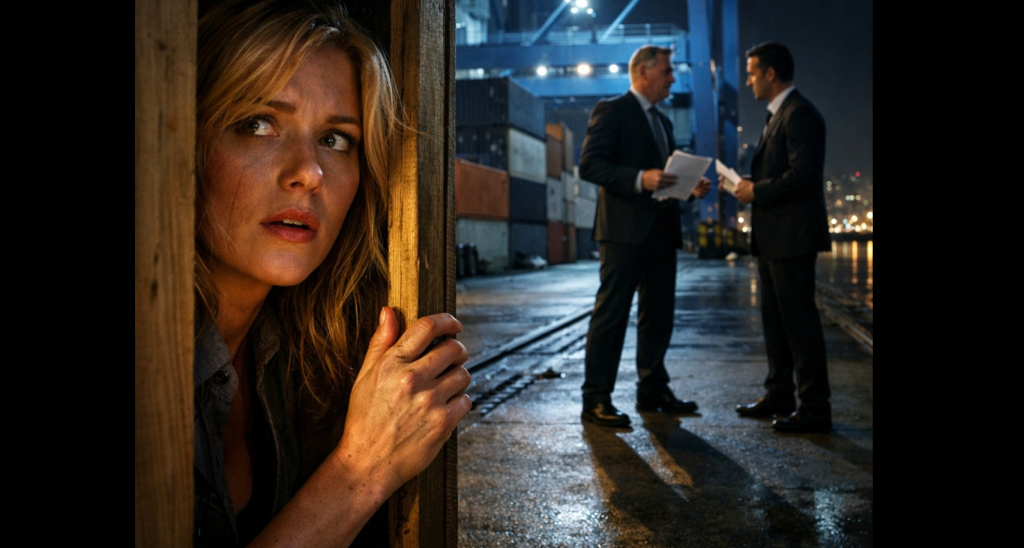
The harbor stretched ahead in dim light.
He moved quickly toward the far end of the wharf where shadows swallowed detail.
Then I saw him.
Evan Smith.
Adrian’s brother.
Also declared dead in the crash.
They stood close, voices low.
“She went to the clinic,” Adrian said tensely.
“It was inevitable,” Evan replied.
“It accelerates everything.”
Accelerates what?
“Is she suspicious?” Evan asked.
“No,” Adrian muttered. “But we need it finalized before the audit. If they trace the discrepancies back to me—”
Discrepancies.
My heart pounded violently.
“Relax,” Evan said. “We planned for this.”
“And Claire?” Adrian whispered.
Silence.
“She doesn’t need to know.”
“She’s pregnant.”
“That changes nothing.”
My breath froze.
This wasn’t about escaping me.
It was about escaping investigation.
The plane crash had been a cover.
Fraud.
Embezzlement.
Financial crimes hidden beneath tragedy.
“What about your wife?” Evan asked suddenly.
My blood turned to ice.
“She’s irrelevant,” Adrian said quickly. “No one knows she’s here.”
Evan laughed softly.
“If she becomes a problem, resolve it properly.”
“I won’t harm her,” Adrian snapped.
“Then pray she remains silent.”
My shoe scraped against metal.
Both men froze.
“Did you hear that?” Adrian whispered.
“Someone’s there,” Evan said.
I ran.
Footsteps thundered behind me.
Crates.
Nets.
Shadows.
“Madison?” Adrian’s voice cut through the dark.
Hearing my name shattered something fragile inside me.
I stayed silent.
“If she heard us, we move now,” Evan said.
“I’ll handle it,” Adrian replied.
They retreated.
I remained hidden until the harbor emptied.
By the time I returned to my hotel, one truth pulsed with terrifying clarity.
Adrian hadn’t just faked his death.
He had committed to a new life built on lies.
And he now knew I was within reach of that lie.
That night, sleep never came.
Fear pressed hard against my ribs.
But beneath it, something steadier formed.
Not panic.
Strategy.
Running would not save me.
Silence would not protect me.
Evidence would.
I didn’t pack that night.
I didn’t call anyone.
I sat on the edge of the hotel bed with my laptop open and my phone in my hand, replaying the harbor conversation until the words etched themselves into certainty.
Audit. Discrepancies. Finalize before they trace it back.
The plane crash hadn’t been an escape from grief.
It had been an escape from accountability.
And I had mourned him.
I had worn black. Accepted condolences. Stood beside a photograph in a polished frame and thanked people for coming.
I had held my daughter while she cried herself to sleep.
He had chosen that.
At 3:14 a.m., I stopped shaking.
Fear gave way to precision.
I transferred every photo and recording to encrypted cloud storage. I emailed copies to myself under a new secure account. I set up timed backups.
Then I dialed a federal reporting hotline from a prepaid phone I’d purchased earlier that week.
“This is regarding a large-scale financial fraud,” I said evenly. “The subjects faked their deaths in a plane crash three years ago.”
There was silence on the other end.
Then: “Ma’am, I’m going to connect you with someone immediately.”
By dawn, I had a name.
Special Agent Daniel Mercer.
We met in a neutral conference room inside the Sydney office of an American consulate branch.
I handed him everything.
The video of Adrian waking up.
The recording of Evan at the harbor.
Screenshots of business filings under Adrian’s name.
Mercer watched in silence.
When he finished, he leaned back slowly.
“Mrs. Carter,” he said, “if this is legitimate—and it appears to be—this isn’t just insurance fraud. This is federal evasion, wire fraud, and obstruction.”
He paused.
“You understand this may take time.”
“I’m not here for speed,” I replied. “I’m here for record.”
He nodded once.
“You did the right thing.”
For the first time in three years, someone said that to me without pity.
Two days later, the machinery moved.
Unmarked vehicles appeared near the townhouse.
Agents entered discreetly.
No sirens.
No spectacle.
Claire opened the door, confusion etched across her face.
“What’s happening?” she demanded.
Adrian stepped forward immediately, smile tight.
“There must be a mistake.”
Special Agent Mercer held up a warrant.
“We have reason to believe you are operating under a false death certificate and engaged in financial fraud.”
The children stood frozen in the hallway.
Claire’s face drained of color.
“Adrian?” she whispered.
He didn’t answer.
Evan tried to slip toward the back exit.
He was intercepted before he reached it.
Handcuffs clicked.
Reality shifted.
Not dramatically.
Methodically.
Neighbors watched from behind curtains.
Claire’s composure cracked.
“You told me it was a legal restructuring,” she said to Adrian, voice shaking. “You said the crash paperwork was a clerical error.”
He remained silent.
Because lies unravel fastest under documentation.
The indictment was filed within a week.
Insurance fraud.
Conspiracy.
Embezzlement.
Falsification of federal records.
The plane crash investigation reopened.
There had never been a body.
Never been verified passenger confirmation.
Only burned debris and an unverified manifest.
Adrian and Evan had bribed a ground operations employee.
Altered records.
Collected life insurance.
Then disappeared under new financial fronts in Australia.
Claire had not known the full story.
She had believed she married a widower.
A man escaping heartbreak.
A man reinventing himself.
She was another casualty.
I did not feel satisfaction watching her collapse in court when the truth was read aloud.
I felt recognition.
She had believed a story.
So had I.
The courtroom proceedings stretched for months.
Forensic accountants detailed shell companies.
Money transfers routed through Caribbean accounts.
Properties acquired under aliases.
The prosecution built their case like architecture—beam by beam, document by document.
The defense tried to argue necessity.
Economic pressure.
Fear of failure.
But desperation does not justify deceit.
The moment that broke whatever sympathy remained came when the prosecution played Madison’s video.
The room watched Adrian open his eyes in that hospital bed.
Watched him smile.
Watched the nurse lean in.
There is something uniquely destructive about a performance exposed.
It strips not just credibility, but humanity.
When the verdict came, it was unanimous.
Guilty on all major counts.
Sentencing followed.
Years.
Restitution.
Asset seizure.
Adrian did not look at me when the judge read the sentence.
He stared straight ahead.
The man who once controlled rooms through charm now sat reduced to consequence.
After the hearing, I stepped outside into crisp afternoon air.
I had imagined feeling triumphant.
I didn’t.
I felt quiet.
Mercer approached.
“You handled this with restraint,” he said.
“I handled it with evidence,” I corrected gently.
He nodded.
“That’s rare.”
Madison stood beside me on the courthouse steps.
She was thirteen now.
Older in ways she shouldn’t have been.
“Is it over?” she asked.
“Yes,” I said.
She looked at the sky for a long moment.
“Did he ever love us?” she asked quietly.
I considered the question.
“He loved the idea of us,” I said. “But he loved control more.”
She nodded slowly.
“I don’t miss him,” she admitted.
“That’s okay,” I said.
Children are allowed to outgrow illusions.
We returned home—back to the house that had once felt like a mausoleum of grief.
I sold it.
Not because I had to.
Because I didn’t want walls that remembered lies.
We moved to a smaller home on the edge of town.
Madison painted her room soft blue.
I planted rosemary and lavender in the yard.
Life became ordinary again.
School drop-offs.
Grocery lists.
Quiet evenings.
I returned to consulting work full-time.
Not because I needed money.
Because I needed identity.
One evening, Madison brought home a school essay.
“Write about someone who saved you.”
She handed it to me without comment.
The first sentence read:
My mom didn’t just survive something scary. She made sure it couldn’t hurt us again.
I sat on her bed and read it twice.
Then looked at her.
“You saved us first,” I said.
She smiled faintly.
“I just noticed,” she replied.
Years later, when people ask how it felt to discover my husband alive with a new family, I tell them the truth.
The shock lasted a moment.
The clarity lasted longer.
Betrayal didn’t end my life.
It revealed what I was capable of when I stopped pretending everything was fine.
Adrian chose to vanish.
I chose to confront.
And in the end, I didn’t lose everything.
I lost illusion.
And illusion was never love.
If you were in my place, would you have run?
Would you have confronted?
I chose record over rage.
Evidence over hysteria.
Truth over fear.
And that choice rebuilt everything.
Leave a Reply