Every January, I wired forty thousand dollars to my son-in-law.
Not because he ever asked nicely, and not because I had money to burn. I did it because my daughter used to press her palm against my forearm when she wanted me to listen, really listen, and she’d say, Dad, promise me something. Promise me Ivy will be okay no matter what happens.
Willow Harper was my only child. She was the kind of kid who apologized to trees if she bumped into them, and then she grew into the kind of woman who brought soup to sick neighbors and felt guilty if she forgot to text back within an hour. If anyone deserved a long, ordinary life with scraped knees and gray hair and grandkids running through her yard, it was Willow.
Seven years ago, she died on Route 9.
That’s the sentence I’d been living inside. That’s what the state trooper said at three in the morning on my porch. That’s what the funeral director said when he explained why the casket had to stay closed. That’s what my son-in-law, Brad Wallace, confirmed when he stood beside me and my wife, Gloria, with his face set in that hard, polite mask men wear when they’re trying to appear steady for everyone else.
The car fire, they told us, was so severe there wasn’t enough left for an open viewing. We received an urn a week later, brass and heavy and cold. It sat on our mantle like an altar to grief.
Gloria lasted six months after that.
The doctor called it cardiac arrest. I called it what it was. You can watch a person die of a broken heart. It doesn’t happen like the movies. No dramatic final speech. It happens in small disappearances. They stop eating. They stop laughing. They stop caring whether the sun comes up. Then one morning they don’t get up at all.
After Gloria, my world shrank to three things: Harper Family Market, my granddaughter Ivy, and the ritual of sending money to the man raising her.
Harper Family Market is a small grocery store on Fifth and Chestnut. My father started it, and I took it over when he retired. It smells like bananas and deli meat and floor cleaner, the kind of place where people still pay with crumpled bills and tell you their business while you ring up their coffee.
The store kept my hands busy when my mind wanted to replay funeral hymns.
Ivy kept my heart beating when I didn’t always want it to.
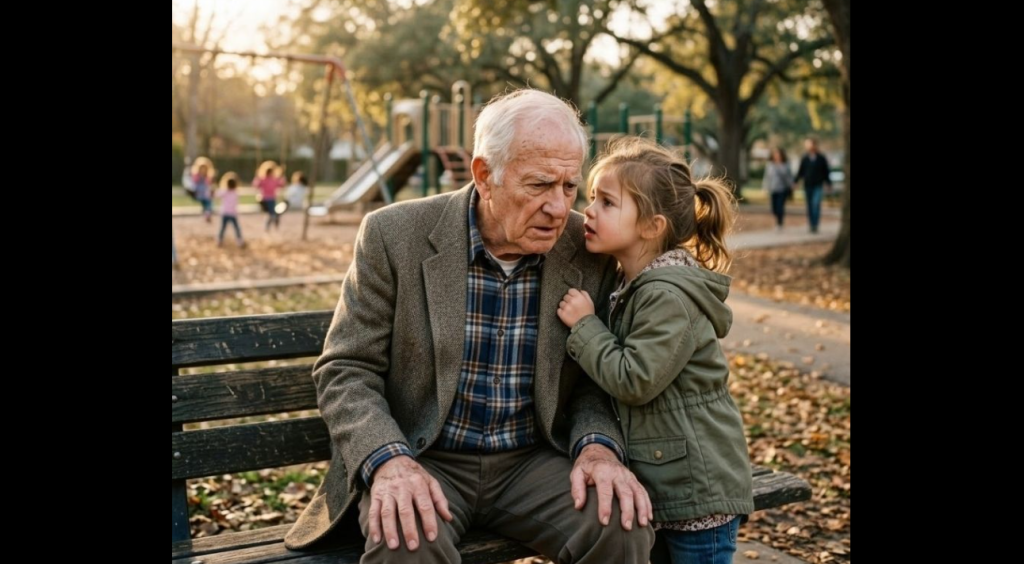
She was seven now, all elbows and quick questions, with Willow’s smile and a stubborn streak that reminded me of Gloria. Every other Saturday, I picked her up and took her to Riverside Park for ice cream. Chocolate chip for me, strawberry swirl for her. We’d sit on the same bench near the old oak tree, and she’d talk about spelling tests and recess drama and which kid got sent to the principal’s office for throwing a pinecone.
That September afternoon started like every other one.
Ivy swung her feet above the ground and told me she’d gotten an A on her spelling test. I told her I was proud. Her grin was bright, and for a moment it felt like the world had been put back together.
Then her smile slipped away so fast it startled me.
She leaned toward me, eyes darting toward the playground, and her voice dropped to a whisper.
“Grandpa, please stop sending him money.”
I blinked. “What?”
“The money to Dad.” Her small hand grabbed my sleeve like she was holding on to something. “Please. Don’t send it anymore.”
A cold tightness settled in my chest. “Ivy, what are you talking about? That money is for you. For school, for—”
“Just follow him,” she whispered, like the words hurt coming out. “Just watch him. You’ll see.”
Fear sat behind her eyes. Real fear. Not a kid afraid of the dark. The kind of fear that makes you quiet so you don’t get noticed.
“Ivy,” I said, keeping my voice gentle, “is your dad hurting you?”
Her grip tightened. “I can’t say. He’ll be mad if I say. Just watch him.”
She popped off the bench like she hadn’t said anything heavy at all. “We have to go. He gets mad if we’re late.”
The drive to Brad’s house was silent. Ivy stared out the window and clutched her backpack with both hands. I wanted to ask a thousand questions, but my instincts told me not to push her into saying something she wasn’t ready to say.
Brad’s house was a modest two-story on Maple Street. White siding, black shutters, a lawn always a week past needing a mow. I’d helped with the down payment four years earlier—another check written out of duty and memory.
Brad stood on the front steps as we pulled up, phone in his hand, his mouth already set.
“You’re late,” he said, flat as a board.
“Traffic,” I lied.
Ivy hopped out, head down, and hurried past him.
“Go inside and start your homework,” Brad said without looking at her.
She didn’t even turn back to wave at me. She disappeared into the house like she was trying to become invisible.
I stood on the sidewalk, watching through the window as Ivy sat at the dining room table. Brad walked right past her, still on his phone, not even glancing down at his own kid.
Something twisted in my stomach.
I called out, “Is everything okay with Ivy?”
Brad shrugged. “She’s fine. Kids get moody.”
He shifted his phone to his shoulder and finally looked at me. “Hey, while you’re here… any chance you could send next year’s payment early? I’ve got some expenses coming up.”
Next year’s payment. In September.
“What kind of expenses?” I asked.
“House stuff,” he said, eyes sliding away. “You know how it is.”
The door closed before I could answer.
I sat in my car with the engine running, hands clenched around the steering wheel, Ivy’s whisper replaying like a siren.
Stop sending him money. Follow him. You’ll see.
I drove home under a sky streaked orange and purple and realized something I hadn’t let myself think in seven years.
Maybe I hadn’t been helping my granddaughter.
Maybe I’d been funding something I never would’ve agreed to if I’d known the truth.
I tried to convince myself Ivy had misunderstood something.
Kids hear pieces of adult conversations. They invent reasons. They get spooked by things that aren’t real. That’s what I told myself while I opened Harper Family Market at six the next morning and stocked the milk and chatted with Mrs. Patterson about her arthritis.
But the image wouldn’t leave me: Ivy’s fingers wrapped around my sleeve like she was afraid to let go.
That week, I drove past Brad’s house twice and parked down the street like a fool. I watched him leave for work and come home. Nothing looked strange. No yelling. No police. No obvious signs of trouble.
Then Tuesday morning, the trouble walked into my store.
She wasn’t a regular. Mid-thirties, dark hair pulled into a ponytail, expensive leather jacket like she belonged in a different zip code. She moved with purpose, straight to the coffee aisle. I noticed because I’ve been behind that register for thirty-five years; strangers stand out.
She set a bag of ground coffee and a jar of cinnamon on the counter.
“That all?” I asked.
“Yes,” she said, clipped, eyes not meeting mine.
I rang her up. She handed me a twenty, took her change, and turned to leave.
Something in the shape of her face tugged at my memory—like a song you recognize but can’t name.
“Ma’am,” I called, and she paused.
“Have we met before?”
Her expression stayed flat. “I don’t think so.”
“You just remind me of someone.”
“I hear that a lot,” she said, and walked out.
Twenty minutes later, I stepped outside to adjust the sandwich board.
The woman stood across the street beside a silver sedan.
Brad stood with her.
He leaned against the car like a man without a care in the world. He laughed at something she said. She touched his arm. Then she got into the driver’s seat and he climbed into the passenger side.
They drove away.
I stood there holding the sandwich board like I’d forgotten how to move.
Brad had never mentioned a woman. Not in seven years. He’d said once, early on, that he’d “gone out a couple times” and it “wasn’t serious.” Nothing else. No introductions. No updates. No mention of anyone being around Ivy.
And now he was riding off with a woman who had bought coffee and cinnamon and avoided my eyes.
The knot in my gut tightened until it hurt.
I locked the front door of the store, flipped the sign to CLOSED, and called Roger Stevens.
Roger and I had been friends for forty years. We met when our daughters were in middle school. He’d spent three decades as a detective before retiring. Even in retirement, he had the kind of calm that made other people confess just to fill the silence.
He showed up twenty minutes later in jeans and a flannel, gray hair cut short, reading glasses hanging from a cord.
“You look like hell,” he said.
“Thanks,” I replied, and told him everything. Ivy’s whisper. Brad’s coldness. The early payment request. The mystery woman. The coffee and cinnamon.
Roger didn’t interrupt. He just listened and wrote notes in the little pocket notebook he always carried.
When I finished, he tapped his pen once against the page.
“Steven,” he said, “a seven-year-old doesn’t whisper something like that unless she’s scared.”
“I know.”
“And if Brad’s asking for money early,” Roger continued, “we need to know why.”
I swallowed. Saying the next part out loud felt like betraying the man who married my daughter.
“I’ve sent him forty grand every year for seven years,” I said. “Two hundred eighty thousand total.”
Roger’s eyes sharpened. “And he’s ever shown you receipts? Updates? Proof it’s going to Ivy?”
“No,” I admitted. “Just… a quick thank you sometimes.”
Roger leaned back on the stool. “Then we start with what we can verify.”
That evening, I spread seven years of bank statements across my kitchen table. The house was quiet in the way it only is when you’ve lost everyone who used to fill it.
January after January, the same transfer: $40,000 to Bradley Wallace.
I went through old texts. Most were from me asking about Ivy. Brad’s replies were always short.
She’s fine.
Busy.
Sure.
Okay.
Then I checked his social media, which I’d never bothered to do before because grief makes you avoid extra pain. His page was locked down. But I could see one thing: two years ago his relationship status had changed to in a relationship, then later disappeared again.
No name. No photo.
Roger came by again the next morning and flipped through the folder of statements and notes I’d assembled.
“We can watch him,” he said.
“Like surveillance?” I asked, the word tasting wrong.
“Public street,” Roger replied. “Legal. We’re not breaking into anything. We’re observing. Seeing where he goes, who he meets, what patterns show up.”
I looked at the picture of Ivy on my fridge—missing front tooth, smile huge—and heard her whisper again.
Follow him.
My stomach turned as I realized what mattered more: Brad’s comfort, or Ivy’s safety.
“Okay,” I said. “We watch.”
Roger nodded like he’d expected that answer all along.
“One more thing,” he said, and his voice dropped. “Steven… sometimes the truth is uglier than you think. You need to be ready for whatever we find.”
I stared at the mantle where Willow’s urn sat, brass catching the light like a warning.
I thought I’d already lived through the ugliest thing possible.
I was wrong.
We started watching before sunrise.
Roger’s sedan blended into the neighborhood like every other commuter car. He parked three houses down from Brad’s place, just far enough not to look obvious, close enough to see the driveway and front door.
Brad left at 7:45 a.m. exactly. Came home at 6:02 p.m. exactly.
On day two, the silver sedan pulled into Brad’s driveway at 2:30 p.m.
The woman got out, walked to the front door, and unlocked it.
“She has a key,” I murmured.
Roger snapped photos through the telephoto lens. “We get the plate.”
She stayed two hours. When she left, Brad walked her to the car and held her at the waist like he wasn’t worried about a neighbor seeing.
That weekend, I picked up Ivy for ice cream. Brad acted normal. Distant, but normal. No mention of the woman. Ivy stayed quiet and kept glancing at her father like she was measuring his mood.
After ice cream, Ivy got in my car and leaned toward me just enough that Brad couldn’t see.
“You watched him?” she whispered.
“Not yet,” I lied, because I didn’t want to scare her.
She nodded like she didn’t believe me anyway.
“Please,” she said. “Before January.”
January. The next payment.
That night, I went home and stood in front of Willow’s urn for a long time.
I’d never opened it. Not once. I told myself it was because I couldn’t bear to. Because twisting that lid would make her death real all over again.
But Ivy’s fear had changed something. Brad’s secrecy had changed something. The woman’s coffee and cinnamon had changed something.
My hands lifted the urn off the mantle. Brass cold against my palms.
I carried it to the kitchen table and set it under the light like evidence.
“I’m sorry,” I whispered, not sure if I was apologizing to Willow or Gloria.
The lid twisted off too easily. Like it had been opened before.
Inside was a plastic bag tied at the top. Dark powder visible through it.
I untied the bag and poured a small amount into my palm.
It wasn’t fine like ash. It was coarse.
Then I smelled it.
Coffee.
I inhaled again, sharp and undeniable.
Coffee and cinnamon.
My knees went weak. I dumped the bag onto the table.
Ground coffee spilled out in a heap, speckled with cinnamon. No bone fragments. No pale ash. Just grocery store ingredients.
For seven years, Gloria had kissed that urn and whispered goodbye to our daughter.
For seven years, I’d stared at it like it contained sacred remains.
It contained a lie.
My throat tightened with rage so hard it felt like choking. I swept the urn off the table. It clanged on the floor, hollow and useless.
I called Roger with shaking hands.
“The urn,” I managed. “Roger… it’s fake.”
“What do you mean fake?”
“It’s coffee grounds. And cinnamon. That’s what’s in it.”
Silence on the line, then Roger’s voice sharpened. “Don’t touch anything else. Don’t clean it up. I’m coming over.”
He arrived in ten minutes and photographed everything like a crime scene: the spilled grounds, the cinnamon flecks, the empty bag, the urn on its side.
He crouched beside the pile and sniffed once, grim.
“This is deliberate,” he said.
My hands were trembling. “Gloria died thinking—”
“I know,” Roger cut in, softer now. “Steven, listen to me. If the urn is fake, then your daughter’s death was… at minimum mishandled. And Brad is involved.”
I swallowed hard. “I don’t understand. Why would—”
“Because,” Roger said, voice steady, “someone benefited from you believing she was dead.”
The room felt colder.
My mind flashed to Brad asking for the next payment early. To his indifferent eyes. To the woman with the expensive jacket and the coffee and cinnamon.
I remembered Ivy’s whisper.
Don’t send Dad any more money.
Follow him. You’ll see.
Roger straightened, looked me dead in the eye.
“We need law enforcement,” he said. “Not later. Now.”
And for the first time since Willow’s funeral, a different kind of fear took root in me.
Not grief.
Alarm.
Because if my daughter’s urn was a lie, I had to face the terrifying possibility that everything else I’d accepted for seven years could be a lie too.
Detective Kevin Walsh didn’t smile when Roger introduced him.
He was mid-forties, sharp-eyed, the kind of man who looked like he’d slept in his clothes in the past. Roger told him the basics. I told him the rest. Ivy’s whisper. The payments. The fake urn. The mystery woman. The surveillance.
Walsh listened without interrupting. When I finished, he asked one question that made my stomach turn.
“Mr. Harper,” he said, “did you ever see your daughter’s body?”
“No,” I admitted. “Closed casket. The fire was—”
“Severe,” Walsh finished, tone neutral. “Dental records. Identified by the husband. Correct?”
“Yes.”
Walsh’s mouth tightened. “All right. Here’s what we do next.”
We went back to watching Brad, but now we weren’t just curious old men with a camera.
Walsh ran the mystery woman’s plate the moment Roger captured it.
Natalie Hughes.
The name hit me like a slap.
Willow’s best friend since college.
The woman Willow had been supposedly driving home from the night of the accident.
Walsh dug deeper. Natalie wasn’t grieving. Natalie wasn’t missing a friend. Natalie had been seen in town multiple times. Alive. Fine. Living her life.
Walsh didn’t say it out loud yet, but his eyes did.
Something about the original story didn’t hold.
On day four of surveillance, Brad broke routine. He left mid-morning and drove to an industrial warehouse off East Industrial Avenue. He stayed forty-five minutes and left.
We returned at night, parked across the street, and waited.
A single light glowed in an upper window.
Walsh’s team set up quietly, unmarked vehicles tucked into shadows, plainclothes officers ready.
Roger and I stayed in the car, hands cold on our knees.
“You sure about this?” I asked Walsh through the window when he checked in.
Walsh’s voice was low. “Your granddaughter’s scared. The urn is fake. And Brad’s meeting Natalie Hughes in secret. We’re past sure.”
At 8:47 p.m., the silver sedan pulled in.
Brad and Natalie got out together and entered the warehouse with a key.
Walsh nodded once. “Move.”
They didn’t rush in like a movie. They waited for the right moment. Officer safety. Evidence. Procedure.
Then the audio feed crackled through the earpiece Walsh handed Roger.
At first, just footsteps on concrete.
Then a woman’s voice.
Thin. Tired. Familiar.
I leaned forward, breath caught.
“Brad,” the woman said, and my skin went electric. “Why are you here?”
Walsh’s eyes flicked to me.
Roger’s mouth fell open slightly.
Because I knew that voice.
Even after seven years, even after grief had tried to bury it, I knew it the way you know a song that raised you.
“Willow,” I whispered.
Walsh held up a hand, focused. “Listen.”
Brad spoke, casual, like he owned the air. “I brought Natalie. You’ve been asking questions.”
A pause. A shaky inhale.
“You promised,” Willow’s voice said. “You promised I could go home when it was safe.”
Natalie’s voice cut in, cool and hard. “It’s never going to be safe. That was the point.”
My vision blurred. My chest hurt like someone was sitting on it.
Walsh’s jaw tightened.
Inside the warehouse, Willow spoke again, and it sounded like she was trying not to cry.
“I want to see Ivy.”
Brad laughed once. “Ivy doesn’t need you.”
I surged forward before I could stop myself. Walsh gripped my shoulder through the window frame.
“Mr. Harper,” he hissed, “stay in the car.”
“That’s my daughter,” I choked.
“I know,” Walsh said. “But if you blow this, we lose them.”
The audio continued.
Willow’s voice, small. “I didn’t do anything wrong. I didn’t—”
Brad’s tone sharpened. “You pushed Natalie. You remember? You did this to yourself.”
My blood ran cold.
So that was the story they’d built. A trap. A false guilt.
Natalie spoke, almost bored. “If you behave, we’ll keep bringing you pictures. That’s what you want, right? Pictures of Ivy?”
A sound like paper rustling. Then Willow made a broken noise, half sob, half gasp.
Walsh’s eyes narrowed. “That’s unlawful imprisonment,” he muttered. “Clear as day.”
Roger’s hands were shaking on the earpiece. Mine were shaking everywhere.
And then, through the audio, Willow whispered something that terrified me more than anything so far.
“Dad,” she said, voice cracking. “If he ever finds out you’re watching… he’ll hurt Ivy.”
Walsh moved immediately. “Go,” he ordered into his radio.
Officers poured toward the warehouse door.
But I barely registered the movement, because all I could think was this:
My daughter wasn’t dead.
My daughter was alive.
And someone had been holding her somewhere cold and hidden while I sent them money and mourned her in my living room.
Seven years of grief turned, in an instant, into seven years of fury.
And now, the truth was opening its mouth wide.
The warehouse door swung open under a flood of flashlights and shouted commands.
“Police! Hands where we can see them!”
The audio in my ear exploded into chaos—footsteps, a startled gasp, Brad shouting, Willow crying out.
I didn’t wait for permission. I got out of the car, but Walsh caught my arm before I could run straight into danger.
“Stay behind me,” he said, firm enough that I obeyed.
Inside, the warehouse smelled like dust and metal and cold concrete. A battery lamp glowed in a back corner where someone had tried to make a life: a twin bed, a folding table, a hot plate, and a wall covered in photos of Ivy. Every school portrait. Every missing tooth grin. Every piece of my granddaughter’s childhood, taped up like a prisoner’s calendar.
Willow sat on the edge of the bed, thinner than I could comprehend, hair pulled back, eyes wide with fear and disbelief as officers fanned out.
Brad stood in front of her like a guard, one hand lifted as if he could talk his way out of anything. Natalie was near the side door, keys in her hand, expression flat.
Willow’s eyes found mine.
“Dad?” she whispered.
That one word collapsed seven years of sorrow into a single moment. My knees nearly buckled.
I stepped forward, and Willow flinched—not from me, but from the idea that someone could touch her without permission.
Walsh moved fast, cuffing Brad while another officer took Natalie. Brad tried to twist toward Willow.
“She’s lying!” he barked. “She’s unstable! She wanted to disappear!”
Walsh shoved him forward. “Save it for your attorney.”
I reached Willow and knelt, keeping my voice low, gentle, the way it used to be when she was little and woke from nightmares.
“It’s me,” I said. “You’re safe.”
Willow’s face cracked. She started to sob, whole-body shaking, and I pulled her into my arms. She felt like bone and fabric. Too light. Too fragile. Like someone had been surviving on fear and scraps.
“I’m sorry,” she gasped. “I’m so sorry. About Mom. About Ivy. About—”
“Later,” I said into her hair. “We’ll talk later. Right now, you’re coming home.”
Walsh turned to me after securing the scene. “Mr. Harper, we’re taking them in. Fraud. Conspiracy. Unlawful imprisonment. We’ll add charges as we uncover the full scope.”
“What about my daughter?” I asked, my voice raw.
“Victim,” Walsh said, clear and certain. “Not suspect. Not today. Not ever, based on what we’ve heard.”
Outside, Willow squinted at the night air like it was too bright, like she’d forgotten the world could be open. Walsh offered her a blanket. She wrapped it around herself and leaned into me, trembling.
“Where’s Ivy?” she whispered.
“In bed,” I said. “At Brad’s house. She’s safe. I swear to you.”
Tears streamed down Willow’s cheeks. “She told you,” she breathed. “She knew something was wrong.”
“She did,” I said. “She saved us.”
The investigation moved quickly after that because lies built on paperwork leave fingerprints everywhere.
Walsh obtained warrants. They pulled financial records, emails, burner phones. They found offshore accounts and transfers—money I’d sent, money Brad had siphoned, money Natalie had helped move.
They uncovered the ugliest part: Brad had leveraged Willow’s panic with a staged “accident” in her apartment, a fake scenario designed to make her believe she’d harmed Natalie. Then he’d used a contact at the morgue—his cousin—to manufacture a death record and a cremation. Coffee grounds and cinnamon in a brass urn to seal the deception.
Willow’s “death” was paperwork, staged fire damage, and my own grief doing the rest.
Brad and Natalie thought they’d built a perfect scam.
They didn’t account for a seven-year-old who loved her grandpa enough to risk whispering the truth.
In court, the wire recording and warehouse evidence crushed them. The jury heard Brad’s arrogance, Natalie’s coldness, their plans to flee, their control tactics. The verdict came back guilty.
Brad received a long federal sentence. Natalie received one, too. The cousin from the morgue took a plea and went down for his part.
Then came family court.
Brad’s parental rights were terminated.
I was granted custody of Ivy.
And Willow—alive, shaken, determined—was given what she hadn’t had for seven years: the chance to rebuild.
We did it slowly, because you don’t stitch a torn life back together in a weekend.
At first, Ivy met Willow in a therapist’s office with soft pillows and careful words. Ivy stared at Willow like she was looking at a ghost made real. Willow cried quietly but didn’t rush. She let Ivy lead.
When Ivy finally crawled into Willow’s lap, it wasn’t dramatic. It was small. Like a bird deciding it was safe to land.
“Mom?” Ivy whispered, as if trying the word on for size.
Willow pressed her face into Ivy’s hair and breathed like she’d been underwater for years.
“Yes,” she said. “I’m here.”
Harper Family Market became our anchor again. Willow started working mornings with me, relearning ordinary life: ringing up coffee, laughing with Mrs. Patterson, stocking shelves. Ivy did homework at the little table in the back office where Gloria used to sit and drink tea.
On Sundays, we visited Gloria’s grave.
Willow brought white roses. Ivy brought drawings. I stood between them and told my wife out loud what I’d wanted to scream at the sky for years.
She’s home.
Our girl is home.
One evening, months after the trial, I took the fake urn off the mantle for the last time. I cleaned it out, scrubbed the brass until it shone, and then I put it in a box in the closet—empty, harmless, done.
In its place, I framed a photo: Willow, Ivy, and me in the store doorway, all three of us squinting into sunlight, all three of us alive.
Willow’s voice still shakes sometimes when she talks about those seven years. Ivy still has nightmares some nights. I still wake up reaching for Gloria before remembering.
But the story changed.
It isn’t the story of a daughter who died and a family that survived without her.
It’s the story of a granddaughter who told the truth, a grandfather who finally listened, and a mother who came back from the dead to find her child.
And every January now, I don’t send forty thousand dollars into a lie.
I spend that month making sure the people I love are safe in the same house, eating at the same table, laughing at the same dumb jokes.
Because after what I discovered, I learned the hard way that love isn’t a payment.
Love is showing up, staying close, and never letting anyone turn your family into a transaction again.
The first time Willow tried to walk into a grocery store after the warehouse, she froze in the doorway.
Not because of the noise or the lights. Because of the ordinary.
People grabbing baskets. A kid whining for cereal. A cashier laughing at something a customer said. Normal life moved around her like a river, and Willow stood on the bank like she wasn’t sure she was allowed to step in.
I’d driven her to a small market on the other side of town, not mine, because I didn’t want our regulars crowding her with questions. We’d parked, walked up, and then she stopped so abruptly I nearly bumped into her.
“Dad,” she whispered, eyes wide. “What if someone recognizes me?”
“You’ve been ‘dead’ for seven years,” I said gently. “Most people won’t.”
“But what if they do?” Her breathing sped up. “What if they think I’m… lying? What if they think I’m crazy?”
I put a hand on her back, steady, the way Gloria used to do when Willow spiraled.
“We’re going to take this one step at a time,” I said. “And if it’s too much, we leave. No shame.”
She nodded, but I could see how hard she was fighting. She took one breath, then another, and finally stepped inside.
She lasted three minutes.
A man walked past with a cart and said, “Excuse me,” politely, nothing threatening at all—and Willow flinched like he’d raised his hand. Her whole body tightened, and she whispered, “I can’t,” and turned around so fast her hair swung across her face.
Back in the car, she cried with her forehead against the steering wheel.
“I feel stupid,” she said.
“You’re not stupid,” I replied. “Your body learned survival in a cage. It’s going to take time for your body to believe you’re free.”
Time. That’s what everyone said, like it was a medication you could take on schedule.
The world outside the warehouse didn’t understand the kind of time Willow had lived in. Her days there weren’t hours. They were endurance. Waiting for Brad’s footsteps. Waiting for food. Waiting for permission to exist. Waiting for the next lie to be reinforced.
And now she had to do something even harder than surviving.
She had to become alive again.
Legally, she was dead.
A death certificate existed. A cremation record existed. Insurance claims had been filed and closed. There were tax documents tied to her “estate.” Even small things like her library card were locked behind a status the system considered final.
Detective Walsh helped with what he could, but the bureaucracy was a beast. We met with a state attorney who specialized in identity restoration for people falsely declared dead. He said words that made me want to throw a chair.
“Administrative resurrection,” he called it.
Willow sat beside me in his office, hands folded tight in her lap.
“It happens more than you’d think,” the attorney said, almost casually. “Clerical errors, fraud, mistaken identities.”
Fraud, yes. That word fit like a glove.
But hearing it in a clean office with framed diplomas didn’t match the reality of a warehouse bed and photos taped to concrete walls.
The attorney laid out steps: court orders, fingerprinting, affidavits, DNA confirmation. We needed to prove she was Willow Harper without relying solely on a face that had changed.
The DNA test was simple. The emotional part was not.
They swabbed Willow’s cheek in a sterile clinic, then swabbed mine.
Willow stared at the little cotton tip like it could bite.
“This is real,” she whispered.
I squeezed her hand. “It’s real.”
Two weeks later, results came back confirming parent-child relationship with the kind of certainty grief had stolen from us.
The judge signed a document declaring Willow Harper alive.
Willow cried when she held it. Not from joy exactly—more like exhaustion. Like she’d been holding her breath for seven years and finally got permission to exhale.
The local paper found out within days.
They ran a story with a headline that made me sick: WOMAN DECLARED DEAD FOUND ALIVE AFTER YEARS.
Reporters showed up at Harper Family Market asking for interviews. Customers whispered. People stared.
I wanted to protect Willow from all of it, but you can’t put someone back into hiding because the world is noisy.
So we decided, together, what we would do.
We didn’t tell every detail. Ivy’s privacy mattered. Willow’s trauma mattered. But we didn’t hide the truth either.
We told enough to shut down rumors and stop people from filling the silence with imagination.
The truth was strong enough. It didn’t need decoration.
Still, attention brought danger.
Brad’s attorney filed motions. He claimed Willow “consented” to hiding. He claimed I’d manipulated her. He claimed my money was a “gift,” not fraud.
Walsh and the prosecutors swatted those arguments down with evidence: recordings, financial trails, the warehouse itself.
But the most unsettling thing came in the mail a month after Brad’s arrest.
A letter.
No return address.
Inside was a single line written in blocky, angry pen:
YOU TOOK EVERYTHING FROM ME. I’LL TAKE SOMETHING BACK.
My hands went cold. I showed Walsh immediately. He took it, bagged it, and assigned a patrol unit to increase drive-bys near my house and the store.
Willow saw the change in my face.
“What is it?” she asked.
“Nothing you need to worry about,” I lied.
She stared at me, and I realized she’d spent seven years reading lies like weather.
“It’s him,” she said quietly.
I didn’t answer. Didn’t have to.
That night, Ivy came over for dinner and chattered about school while Willow stirred spaghetti sauce like she was trying to remember how ordinary life worked. Ivy’s laughter filled my kitchen, and for a moment I almost forgot we were still being hunted by the echoes of Brad’s choices.
After Ivy went to bed, Willow sat at the table and looked at me.
“Dad,” she said, “I need to tell Ivy the truth.”
I swallowed. “She’s seven.”
“She’s seven and she already knows something was wrong,” Willow replied. “She warned you. She’s not fragile. She’s confused.”
Confused was an understatement. Ivy had lived half her life believing her mother died in a fire. Now her mother was sitting in her grandfather’s kitchen making sauce.
The therapist suggested we tell Ivy in pieces, like building a bridge instead of throwing her across a canyon.
So we did.
The first conversation happened on my living room couch, with Ivy between us and a box of tissues on the coffee table.
Willow’s voice shook. “Ivy, sweet pea… the story you were told about me isn’t true.”
Ivy’s brow furrowed. “But Dad said—”
“I know,” Willow whispered. “And Dad was wrong.”
Ivy stared hard at Willow, like she was trying to solve a puzzle.
“You’re my mom?” she asked.
Willow nodded slowly. “Yes.”
Ivy’s eyes filled with tears, and then she did something that made my heart break and heal at the same time.
She reached out and touched Willow’s wrist like she was checking if she was real.
“Why didn’t you come?” Ivy whispered.
Willow’s face crumpled. “I wanted to. I tried. But I was trapped, and I didn’t know how to get out.”
Ivy’s chin trembled. “I was scared.”
“I know,” Willow said, pulling Ivy gently into her lap. “I’m so sorry. I’m here now. I’m not going anywhere.”
I watched them hold each other, mother and daughter meeting for the first time in the same timeline, and I realized the ending of this story wasn’t going to be a courtroom sentence.
It was going to be the long, difficult work of making home safe again.
And that, in some ways, was harder than catching the criminals.
Because you can arrest a man.
You can’t arrest the damage he leaves behind.
When the trial date was set, Brad tried to bargain through his attorney.
Not with remorse. With leverage.
He offered to “cooperate” if the state reduced charges. He offered to “provide additional names,” like he was doing everyone a favor. He offered to “make a statement” about being “misunderstood.”
Walsh didn’t look impressed when he told us.
“He’s fishing,” Walsh said. “He wants control.”
“Control is his addiction,” Willow muttered.
And then, two days later, control took a new shape.
I was closing Harper Family Market when I noticed a car idling across the street. Dark SUV, windows tinted. Not a customer. Not anyone I recognized.
My instincts—old, sharpened by grief and years of being too trusting—went rigid.
I locked the door, flipped the sign, and stood behind the glass watching.
The SUV didn’t move.
I pulled out my phone and called Walsh.
“Stay inside,” Walsh said. “Do not go out. I’m sending a unit.”
I watched the SUV in the window reflection as I pretended to clean the counter. Ten minutes later, a patrol car rolled by slowly. The SUV turned on its signal and pulled away like it had been waiting for permission to disappear.
Walsh took my statement, wrote it down, and sighed.
“This is intimidation,” he said. “It may not be Brad directly, but it’s connected.”
That night, I didn’t sleep.
Willow didn’t either.
We sat at my kitchen table with mugs of tea neither of us drank, Ivy asleep down the hall, and the house full of the kind of silence that feels like a threat.
“He’s going to come after Ivy,” Willow whispered.
“No,” I said firmly. “We’re not going to let that happen.”
But the truth was, the fear made sense. Brad had already used Ivy as a leash. He’d used her photos to keep Willow obedient. He’d used my love for Ivy to keep money flowing.
Why wouldn’t he try again?
Walsh helped us get a protective order and arranged for extra security measures: cameras at my home, cameras at the store, a safe drop-off plan for Ivy’s school that kept her routine predictable but protected.
I hated that it came to that. Hated that normal life required planning like a military operation.
But I’d learned something the hard way.
Bad people don’t stop being bad just because they got caught. They just change tactics.
In the middle of all this, Ivy’s teacher called me.
“Mr. Harper,” she said carefully, “Ivy seems… distracted.”
My throat tightened. “How so?”
“She startles easily,” the teacher said. “She flinched when a boy slammed his locker. And she asked me today if people can ‘pretend to be dead.’”
I squeezed my eyes shut.
The therapist warned us this would happen. Ivy’s brain was trying to make sense of the impossible. Her fear was looking for patterns.
When I picked her up that day, she climbed into my car and stared out the window.
“Grandpa,” she said softly, “if Mom was alive… does that mean Dad lied?”
I didn’t answer quickly. I wanted to say something neat and simple. But there was no neat and simple.
“Yes,” I said at last. “Your dad lied about big things.”
Ivy’s voice went smaller. “Did he lie about loving me?”
That question hit my chest like a fist.
I pulled into a parking lot and turned off the engine so I could look at her.
“Listen to me,” I said. “You are lovable. You are loved. Nothing your dad did changes your value.”
Ivy’s eyes filled with tears.
“But did he love me?” she asked again, because kids don’t accept comfort when they want truth.
I swallowed.
“I think,” I said carefully, “your dad loves himself more than he loves other people. And that’s not your fault.”
Ivy wiped her cheeks with her sleeve. “Mom loves me.”
“Yes,” I said, voice rough. “Your mom loves you so much it almost destroyed her.”
That night, Willow sat with Ivy on the couch and braided her hair while Ivy watched cartoons. It was such a small scene—two bodies close, hands moving, Ivy leaning into the contact like a plant leaning into sun.
I walked into the kitchen, opened the fridge, and stared blankly at leftovers because I didn’t know what to do with the ache in my chest.
I thought about Gloria again.
I thought about how she would’ve reacted to this truth—relief mixed with rage, grief mixed with joy. I pictured her face when she realized the urn was fake, and the thought made me nauseous.
So I did something I’d avoided for seven years.
I drove to Lake Rayburn alone.
It was a cold evening, and the water was flat and dark. I stood on the dock where Willow used to jump in every summer, hair flying, laughing like the world couldn’t touch her.
In my jacket pocket, I carried a small jar of coffee grounds and cinnamon I’d kept from the fake urn. Walsh had returned it after it was entered into evidence.
It wasn’t sacred.
But it represented the lie that had stolen Gloria’s last months.
I unscrewed the jar, held it over the water, and whispered, “I’m sorry, Gloria.”
Then I poured it out.
The grounds scattered over the surface and sank. The cinnamon caught in the wind for a second like dust, then disappeared.
It wasn’t closure. Not really.
But it felt like throwing a stone through a frozen lake. It made a crack.
On the drive home, my phone buzzed with a message from Walsh.
They found another offshore account. Larger. Brad moved money again. We’re freezing it tonight.
My hands tightened on the wheel.
“How much?” I typed back at a stoplight.
Walsh replied: More than you sent. He was taking from other people too.
That’s when the full terror of it landed.
Brad hadn’t just scammed me.
He’d built a life on lies, and my family was only one chapter.
And if we were only one chapter, it meant two things.
One: there would be more victims.
Two: Brad had practiced.
The trial wasn’t just about justice for my family anymore.
It was about stopping a man who’d perfected the art of stealing love and turning it into a paycheck.
And as the court date approached, I realized the scariest part of what I’d discovered wasn’t the warehouse, or the fake urn, or even the money.
It was how easily Brad had worn the mask of a grieving husband while he did it.
Because if a man can lie that well, the truth isn’t just hidden.
The truth is hunted.
Brad’s trial began in January, and the courthouse smelled like old paper and stale coffee.
Willow wore a plain blue sweater and kept her hands clasped tightly in her lap, like if she let go she might float apart. Ivy stayed home with a family friend and her therapist; the courtroom wasn’t a place for a child, no matter how much of this story belonged to her.
When I took the stand, I expected my voice to shake.
It didn’t.
I surprised myself.
I told the jury about the phone call at three a.m., the closed casket, the urn. I told them about Gloria’s decline and death. I told them about the yearly transfers and the way Brad never offered proof. I told them about Ivy’s whisper in the park, the surveillance, the fake ashes, the warehouse.
Brad’s attorney tried to paint me as a grieving old man who’d misunderstood things, who was confused, who “jumped to conclusions.”
Walsh’s evidence made that impossible.
The prosecution played the recordings. They showed photos of the warehouse setup. They entered the fake urn contents as evidence. They presented bank records, offshore transfers, messages between Brad and Natalie that talked about “keeping her compliant” and “milk him in January.”
Milk him.
I stared at that phrase on the screen and felt my jaw tighten until it hurt.
Then Willow took the stand.
She didn’t look at Brad when she sat down.
She looked at the jury, at the judge, at the truth.
Her voice shook at first, then steadied as she spoke. She explained how she’d been manipulated into believing she’d hurt someone. How Brad had framed “hiding” as protection, then turned it into imprisonment. How Natalie had participated, how they’d used Ivy’s photos as leverage.
When she described the wall of pictures in the warehouse, her voice broke.
“She grew up without me,” Willow whispered. “And I watched her grow up through tape and printer paper.”
A woman on the jury wiped her eyes.
Brad stared at his hands.
Not remorseful. Just irritated.
Like Willow’s pain was inconvenient.
When the prosecution showed proof Natalie Hughes had been alive and well the whole time, Willow’s shoulders shook.
She didn’t cry loudly. She cried like someone mourning not a death, but a theft.
Seven years stolen.
In the hallway during a break, Willow leaned against the wall and pressed her knuckles to her mouth.
“I’m scared,” she whispered.
“Of what?” I asked.
“That they’ll make me look stupid,” she said. “That they’ll say I chose it. That I wanted to run away.”
I took her shoulders gently. “You didn’t choose captivity. You chose survival.”
Willow’s eyes met mine, shining. “Mom would’ve hated this,” she murmured. “The attention. The ugliness.”
“I know,” I said. “But Mom would’ve hated you being trapped more.”
The verdict came back guilty on all major counts.
Brad was sentenced to a long federal term.
Natalie, too.
The cousin at the morgue took a plea and went down.
The judge ordered restitution.
But money wasn’t the part that mattered.
Family court terminated Brad’s parental rights.
The judge looked at Willow and said something I’ll never forget.
“This child deserves stability,” she said. “And stability begins with truth.”
I was granted custody.
Willow was given supervised visitation at first, not because anyone doubted her love, but because Ivy’s mind had been through too much to handle a sudden, full shift. The court wanted transitions that protected Ivy’s nervous system, not just adult emotions.
Willow accepted it with a nod.
Afterward, in the parking lot, she whispered, “I’ll do whatever it takes.”
And she did.
She showed up to every therapy session.
She learned how to answer Ivy’s questions without flooding her with adult pain.
She asked permission before hugging. She didn’t take it personally when Ivy pulled away. She didn’t demand the title Mom. She let Ivy decide when it felt safe.
Some days were hard.
Ivy would say, “Dad used to do it this way,” and Willow would flinch like she’d been slapped.
Other days were miraculous.
Ivy would run into the room after school and shout, “Mom, look!” like she’d always had the word in her mouth, waiting.
One afternoon, months after the trial, Ivy grabbed Willow’s sleeve the same way she’d grabbed mine in the park.
“Mom,” she whispered, “are you gonna disappear again?”
Willow’s whole face crumpled. She knelt until she was at Ivy’s level and spoke with a steadiness that came from deep determination.
“No,” she said. “Never. Even when I’m scared, I’m staying.”
Ivy stared at her like she was testing the promise.
Then she nodded once, solemn, and climbed into Willow’s arms.
It wasn’t smooth from there. Healing never is.
Willow had nightmares. Sometimes she woke up thinking she was back on that warehouse bed, listening for keys in the door.
I had my own ghosts. I’d wake up hearing Gloria’s voice, feeling the empty space beside me, and I’d sit in the dark and wonder how I was supposed to forgive myself for not opening that urn sooner.
Willow caught me staring at it once, the empty space on the mantle where it used to sit.
“You couldn’t have known,” she said quietly.
“I should’ve questioned,” I replied. “I should’ve—”
“Dad,” she interrupted gently, “you loved me. That’s what he used against you. Don’t punish yourself for loving.”
That sentence changed something in me.
Because it was true.
Brad had weaponized love.
And now, our job was to reclaim it.
In the spring, we held a small memorial at Lake Rayburn.
Not for Willow—she was alive.
For the years we lost. For the lies. For Gloria.
We brought flowers. We brought a framed photo of Gloria laughing, taken the summer before everything shattered. Ivy held the frame carefully like it was fragile.
We stood on the dock, and Willow spoke into the wind.
“Mom,” she whispered, “I’m here. I’m sorry. I’m going to live a life you’d be proud of. I’m going to be the mother Ivy deserves.”
Ivy looked up at the sky and said, “Hi, Grandma.”
And I felt it then—something like peace trying to enter the cracks.
Not complete peace. Not yet.
But enough.
Enough to breathe.
Enough to keep going.
Enough to believe that our story could be more than terror.
It could be a rebuilding.
And we were building.
Five years later, Harper Family Market has a café.
It sounds small when you say it out loud, like adding a coffee bar is the big happy ending. But if you’d told me back when I was staring at a brass urn full of coffee grounds that one day I’d watch my daughter run a business while my granddaughter made muffins in the back, I would’ve thought you were cruel for teasing me with something impossible.
The café sits in what used to be our storage corner. Willow designed it herself—warm lights, mismatched chairs, a chalkboard menu Ivy rewrites whenever she’s bored. We sell cinnamon rolls on Saturdays.
Real cinnamon.
Every time the smell hits the air, Willow pauses for half a second, eyes distant, then she keeps moving. Trauma doesn’t vanish. It learns to live beside you.
I’m seventy-three now. My hands ache more. I don’t lift heavy boxes anymore; Willow yells at me if I try. Ivy, twelve and tall, carries them instead with the swagger of someone who thinks adulthood is a destination and not a million tiny responsibilities.
She calls me Grandpa like it’s a title, not a relationship.
Willow is legally restored in every way that matters. She has her birth certificate, her Social Security number, her name back on a driver’s license. The first time she held that plastic card, she cried in the parking lot.
“Look,” she whispered, as if she couldn’t believe it. “I exist.”
You don’t appreciate existence until it’s been stolen.
Willow rebuilt herself in layers.
Therapy. Support groups. Night classes at community college. Then a degree in business administration because she said, bluntly, “I refuse to ever be powerless again.”
Ivy rebuilt too.
The nightmares faded. The flinching got rarer. But some scars stayed invisible and sharp.
She doesn’t like closed doors. She hates surprises. She watches adult faces like she’s reading weather.
When she was ten, she asked me, “Do you ever miss Dad?”
I didn’t answer fast, because you don’t lie to a child who’s learned what lies cost.
“I miss the idea,” I said carefully. “The idea of a dad who would’ve done right by you.”
Ivy nodded once, like she understood the difference.
Brad’s name still comes up sometimes because the legal system moves slowly and because evil doesn’t stop trying to negotiate.
Brad appealed twice. Denied.
He requested a parole hearing early. Denied.
He tried to send a letter to Ivy through the court. The judge denied contact again.
Natalie tried to bargain for reduced time by offering information on other scams Brad had been involved in. Walsh told me quietly, “He had other victims.” It made my stomach turn, but it also made something else click.
This wasn’t an accident of grief.
This was a pattern.
Sometimes I think about how close we came to never finding Willow. If Ivy hadn’t whispered. If I hadn’t believed her. If I’d kept sending money like a faithful fool.
That thought still terrifies me.
But it also reminds me of what saved us.
Not law enforcement first. Not luck first. Not money first.
A child’s truth.
On the anniversary of Gloria’s death each year, we go to the cemetery in the morning and Lake Rayburn in the afternoon. It’s become a ritual that feels like stitching.
At the cemetery, Ivy brings fresh flowers and tells Gloria about school—tests, friends, the boy who keeps trying to impress her by skateboarding badly.
At the lake, Willow sits on the dock with her shoes off and lets the water touch her toes like she’s reminding herself she’s here, she’s free.
One summer evening, Ivy asked Willow a question that made time stop.
“Mom,” she said, “do you forgive Dad?”
Willow stared at the water for a long moment.
“I don’t forgive what he did,” she said finally. “But I don’t let him live inside me anymore.”
Ivy frowned. “What does that mean?”
“It means,” Willow said, turning to look at her daughter, “I don’t carry him like a weight. I carry you.”
Ivy’s eyes filled. She leaned into Willow’s shoulder.
Then she looked at me and said, “Grandpa… do you forgive him?”
I thought of Gloria’s hollow eyes in those last months. I thought of coffee grounds in a brass urn. I thought of Willow’s whisper through a wire in a warehouse.
“No,” I said honestly. “I don’t forgive him.”
Ivy watched my face carefully.
“But,” I added, “I also don’t let him decide who I become.”
Ivy nodded slowly.
That night, back at home, I opened a drawer and pulled out a small envelope I’d kept for years. Inside was a letter I’d written to Willow when I believed she was dead. I’d never sent it anywhere. There was nowhere to send it.
It was messy, full of apologies and memories and love.
I handed it to Willow.
“I wrote this when I thought you were gone,” I said quietly. “You don’t have to read it if you don’t want.”
Willow took it with careful hands like it might burn.
Later, I found her in the café after closing, sitting alone at a table, the letter open in front of her. Tears ran down her face.
“You loved me so much,” she whispered when she saw me. “Even when you thought I was ashes.”
“I love you now,” I said. “More, because you’re here.”
Willow laughed softly through tears. “I’m really here.”
“Yes,” I said. “You’re really here.”
That’s the ending I never thought I’d get.
Not a perfect ending. Not a clean one. Life doesn’t hand those out often.
But a clear one.
My granddaughter is safe.
My daughter is alive.
The man who exploited our grief is behind bars.
And the money I used to send into a lie now goes into Ivy’s future—college savings, therapy, vacations, the kind of ordinary joys that make a childhood feel secure.
Sometimes, on Saturdays at Riverside Park, Ivy and I still get ice cream. Chocolate chip for me, strawberry swirl for her. We sit on that same bench under the old oak tree.
Last week, she bumped my sleeve and leaned in, just like she did the day she changed everything.
“Grandpa,” she whispered, smiling this time, “I’m glad you followed him.”
I looked at her—this brave, stubborn kid who saved a family with a whisper—and my throat tightened.
“Me too,” I said.
And for the first time in a long time, the memory of terror didn’t lead the story.
Love did.
Leave a Reply