The text came on a Wednesday afternoon, wedged between a medication reminder and a hospital group chat about someone leaving donuts in the break room.
It was from my mother, sent to the family group chat where my name usually felt like an afterthought. No emojis. No follow-up messages. Just that.
I read it three times, my thumb hovering over the screen like maybe more words would appear if I stared long enough.
Big news.
That word stuck with me more than anything else. Not dinner, not Delino’s, not even that everyone else was already responding with excited thumbs-up and heart emojis. Big. It felt… deliberate. Like bait.
Tessa: Ooooh, what is it? 
Dad: I’ll be there.
Grandpa Walter: Ok.
I watched the little bubbles pop up and disappear. No one tagged me. No one said, “Can you make it, Alina?” The assumption, as always, was that I would adjust my life around theirs.
And I did.
Because no matter how distant things had become, no matter how many times I’d left their house feeling like I’d been hollowed out and set back on the shelf, they were still my family.
Right?
I could hear the monitors beeping faintly down the hall as I rang up the last medication in my cart. I was at the nurses’ station, my hair frizzy from twelve hours under fluorescents, my scrub top wrinkled from being tugged and leaned on by half my patients that day. My feet ached. My brain felt like it was running on fumes and lukewarm coffee.
But somewhere underneath all that exhaustion, something small and stubborn lit up.
Maybe this is it, I thought. Maybe this is the moment they finally include me in something that matters.
Big news.
I typed back, fingers moving automatically.
Me: I’ll be there. Might be in scrubs. Late shift.
Mom reacted with a simple thumbs-up.
Not “Can’t wait to see you” or “We’ll save you a seat.” Just a digital thumb. Approval without warmth.
I locked my phone and forced my focus back to the chart in front of me. There was a blood pressure to recheck, discharge instructions to print, a patient’s daughter who wanted to ask “just one more question” that was never actually one. Life in the hospital existed in a tight bubble—vitals, meds, codes, paperwork. People lived whole lifetimes in the space between shift changes.
But that message sat in the back of my mind like a comma at the end of a sentence.
Dinner at Delino’s, 7:00 p.m. We have big news.
By the time I clocked out, my body felt like it weighed twice as much. Two codes that day. One we saved. One we didn’t. I carried both in the lines around my eyes as I walked through the staff exit into the fading light.
The hospital parking lot was a sea of cars glinting in the early evening sun. I sat behind the wheel for a minute, staring at my reflection in the rearview mirror. Dark hair pulled into a low ponytail. Faded navy scrubs. Faint half-moons under my eyes from too many night shifts and not enough sleep.
I rummaged through my bag and found a tube of lipstick, the cheap drugstore kind I always forgot I owned until moments like this. I swiped a bit on, blending it with my finger. It didn’t transform me, but it made me look slightly less like I’d just watched someone die.
“Don’t overthink it,” I muttered to myself. “It’s just dinner.”
I didn’t believe that for a second.
Delino’s sat on the edge of downtown, all warm brick and soft golden lighting. The kind of restaurant with white tablecloths and waiters who remember your usual drink. The kind of place you go to celebrate promotions and anniversaries and engagements.
I pulled into the parking lot, finding a spot under a crooked streetlamp. The sun was slipping down, casting long shadows across the asphalt, stretching everything thin and tall. I stepped out, locked my car, and took a breath that felt too big for my lungs.
Maybe Mom got a promotion. Maybe Dad was finally retiring. Maybe Tessa got another upgrade in her already charmed life—engagement, baby, something with sparkle and confetti. It always seemed to be about Tessa. I told myself I’d be happy for her. That I’d smile and clap and be the dependable one as always.
But then the other thought slipped in, the one I almost never let myself fully feel.
Maybe, just maybe, they’d include me in this good thing.
Maybe the big news would be ours instead of hers.
I straightened my scrub top, smoothed my ponytail, and walked through the glass doors into the cool hum of the restaurant’s lobby. The host looked up with a practiced smile.
“Good evening. Do you have a reservation?”
“My family should be here already,” I said. “Under Marlene… or Gerald. Thompson.”
The host’s smile brightened with recognition. “Private dining room. Right this way.”
Of course, I thought. Private dining room. For a big announcement. My heartbeat picked up as I followed him down the narrow hallway, past framed black-and-white photos of the city, past couples murmuring over wine, past clinking forks and soft laughter.
I could already hear them before we reached the room. My mother’s laugh—sharp and polished. Tessa’s higher, bubbling with easy confidence. The low rumble of my father’s voice, always just on the edge of the conversation, never at the center of it.
The host turned the corner and stepped aside so I could enter.
I froze in the doorway.
They were all there. My mother, Marlene, sat near the middle of the long table, a glass of white wine in hand, posture perfect, hair smooth and styled like she’d stepped out of a commercial for “effortless elegance.” My father, Gerald, sat beside her, arms crossed loosely, nodding as Tessa talked. He wore the same neutral expression he always did, as if emotional reactions were a luxury he couldn’t quite afford.
And Tessa… Tessa glowed.
Her blonde hair was curled and shiny, makeup flawless, dress obviously new. She sat in the center of attention like she’d been born there, like the world was a stage and she was just gracious enough to let everyone else stand near the spotlight.
Even Grandpa Walter was there, at the far end of the table, hands folded neatly, gaze steady. He was the only one whose presence surprised me in a way that felt almost like relief. The oldest person in the room and somehow the only one who had ever really felt like he saw me.
They were all there.
Except me.
No empty chair with a folded napkin. No plate waiting. No spot held.
For a second, I thought maybe I was early. That I’d misread the time or rushed too much. Then my eyes traveled upward, past the line of wineglasses, past the bouquets, to the back wall.
A banner hung there. Big. White. Glittery.
“CONGRATULATIONS TO OUR REAL DAUGHTER”
The words crashed into me like a physical thing. Like someone had swung a door wide open and slammed it into my chest.
My brain tried to rearrange the letters into something else. A joke. A misprint. A word missing. A word added.
Our real daughter.
The clink of glass brought my attention back to the table. My mother was lifting her wine in my direction as if I’d simply taken the scenic route to my chair.
“Oh, good. You made it,” she said, her voice light, casual, utterly unbothered. “We’ve already started.”
No apology for the lack of a place set. No flicker of discomfort at the banner screaming the thing I’d spent my whole life pushing down.
Tessa glanced at me, her eyes dragging from my scrub top to my hospital badge, to my sensible shoes. A slow smirk curved her mouth.
“Didn’t have time to change?” she asked.
I swallowed, my tongue suddenly thick.
“Got off work late,” I said. “Came straight here.”
She shrugged, already half turned back toward my parents. The conversation swelled again, the brief pause of my arrival smoothed over like a scratch on a record.
The waiter appeared like he’d been summoned by my discomfort and slid a spare chair to the very edge of the table, near the corner. No one moved to make room. No one shifted plates or glasses or chairs so I could be part of the curve of the group. The chair sat there, jutting out, like a punctuation mark at the end of a sentence that had nothing to do with me.
I pulled it out and sat down carefully, trying not to bump anyone, trying to make myself small.
From here, the banner was directly in my line of sight.
CONGRATULATIONS TO OUR REAL DAUGHTER.
Someone had chosen that font. Someone had ordered it, approved it, hung it. This wasn’t a last-minute accident made out of duct tape and printer paper.
My hands rested in my lap, fingers pressed so tightly together my knuckles ached.
My mother lifted her glass again with the kind of theatrical timing that made me think she’d practiced this moment in her head all afternoon.
“To Tessa,” she said, smiling so wide it almost looked painful. “Our real daughter. We finally have something to celebrate.”
There was a chorus of clinking glasses, overlapping congratulations, the soft pop of a champagne cork being opened at the next table over like background music to a play I hadn’t been cast in.
I didn’t raise my glass. I didn’t trust myself not to shatter it.
Real daughter, the words echoed in my skull. Real, real, real.
Tessa laughed, flipping her hair over one shoulder. “Okay, okay, I’ll explain,” she said, as if this were all some elaborate prank reveal and not my identity being gutted in public.
She leaned in, elbows on the table, eyes shining. “So, you guys know those DNA kits? I did one. Just for fun, right? I wanted to see if I was secretly, like, 20% Scandinavian or something.” She giggled. “But when I got the results, it turns out… I’m not adopted. I’m actually their biological child. Like, fully, completely theirs.”
The table reacted like this was the twist ending of the year’s biggest blockbuster. My father cleared his throat, his eyes watering just a little as he smiled at her. My mother placed a hand over her heart like she’d just watched Tessa cure cancer on live TV.
“After everything,” she said, voice trembling theatrically, “to find out she’s really ours…”
I sat there, my throat burning.
Wait.
“I don’t—” I started, then stopped. My voice sounded too loud in my own ears, but apparently not loud enough to disrupt the bubble of joy around them.
I tried again, forcing air past the tightness in my chest. “I don’t understand. I thought you had Tessa through surrogacy.”
Marlene glanced in my direction as if she were acknowledging a question from a mildly interesting audience member.
“We did,” she said. “At least, that’s what we thought. It was complicated. Fertility treatments, transfers… everything was such a blur back then.”
“Turns out there was a mix-up,” Tessa said breezily. “Mom and Dad thought there was a donor involved, but nope.” She spread her arms like she was unveiling herself. “All theirs.”
The table chuckled. Someone joked about miracles. Someone else mentioned how science was wild these days. There was a strange sharpness in the laughter that made my skin prickle.
I swallowed.
“Wait,” I said. “So… what does that mean about me?”
The question hung in the air, heavier than the banner, heavier than the room.
For a second, no one spoke.
My dad took a sip of water he didn’t need. My mother shifted, straightened her napkin. Tessa checked her reflection in her phone screen.
Then Marlene gave the smallest shrug, the kind of gesture you use when your takeout order is wrong, not when your daughter’s entire existence is in question.
“Well, honey,” she said, “you were part of the same process. Back when we did all of this, clinics didn’t tell you much. We didn’t ask too many questions. Mistakes happen.”
She laughed a little at the end of that sentence, and a couple of people at the table laughed with her.
Mistakes happen.
Heat crawled up my neck. I stared at her, not sure if I was more stunned by the words or by how casually she delivered them.
“So I’m… what, exactly?” I asked. “Who am I to you?”
The laughter thinned. No one wanted to touch that question.
“You’re still family,” my mother said, pouring herself more water, her tone light, dismissive. “That doesn’t really change anything.”
It changed everything. I could feel everything changing in that moment—the shape of my life tilting on its axis.
Still family.
She said it like she was talking about a dog someone had given away but still liked to ask about. Still family. Still around. Still… something.
Tessa’s glossed lips tilted into a sympathetic half smile that didn’t reach her eyes. “Honestly, this kind of explains a lot,” she said. “You’ve always been… different.”
She meant it as a joke. I heard it as a verdict.
I stared down at the tablecloth, focusing on the faint pattern in the fabric so I wouldn’t cry. The edge of my hospital badge dug into my chest. My name—Alina Thompson—pressed against my skin like a label that might peel off at any moment.
I thought, absurdly, about my last twelve-hour shift. About the man who had died with my hand on his, and his wife who had clung to me afterward like I was a lifeline. About how, in that building, I knew exactly who I was and what I was worth.
Here, I wasn’t sure I was anything.
“Excuse me.”
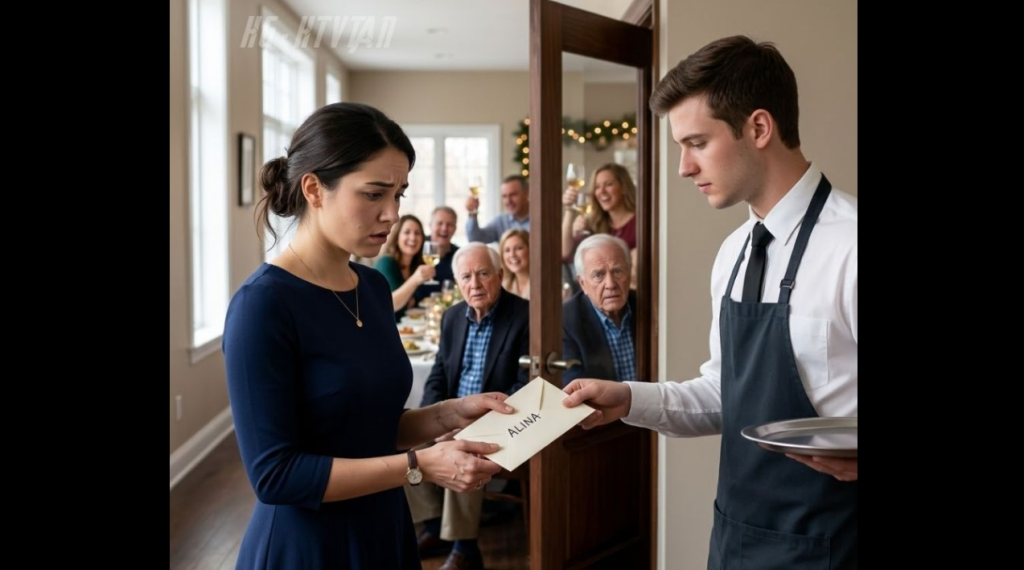
I looked up. The waiter was standing beside me, holding a small sealed envelope on a tray like it was something delicate and important.
“The owner asked me to give this to you,” he said. “Personally.”
He placed the envelope in front of me, just within reach.
Every head turned in my direction. For the first time all night, I was at the center of their attention—though only because something strange had landed in front of me.
My name was written on the front in neat, deliberate handwriting.
Alina.
No last name. Just that.
My heart stuttered.
“Who’s it from?” Mom asked, skeptical, her gaze flicking between the envelope and my face.
The waiter shook his head. “No idea, ma’am. He just said it was for her.” He nodded at me. “Enjoy your evening.”
He walked away, leaving the envelope sitting there like a dropped match between us.
I touched it lightly. The paper was thick, slightly rough under my fingertips, not the cheap kind you buy in bulk. The ink looked almost like it had been pressed into the page, not just written on.
Someone had taken their time with this.
I knew in that instant that whatever this was, it hadn’t come from my parents. They weren’t the type to do anything quietly, privately, or with this much care. If they’d had something to tell me, they would’ve done it with a speech and a centerpiece.
“Are you going to open it?” Tessa asked, eyes bright with curiosity, already angling her body as if she had a right to see its contents.
“Not right now,” I said, voice flat.
The room shifted around me. Conversations restarted, forks scraped against plates, someone made a toast about fate and miracles. The bubble of celebration closed up again, and I was left sitting on the outside of it, the envelope burning like a coal in my hand.
I slipped it into my coat pocket.
Whatever was inside, I wasn’t going to open it in front of them. Not when my heart was already cracking. Not when the words “our real daughter” were still screaming from the wall behind Tessa’s head.
I sat there a little longer, listening to them talk about the DNA test like it was the plot twist of a romantic comedy instead of a fault line running through my life. Tessa described the app interface, the graphs, the percentage breakdowns of her ancestry, passing her phone around so everyone could marvel at how “basically pure” her results were.
“Isn’t that crazy?” she said. “Like, no donor, no weird mix-up, nothing. Just me. The real deal.”
Even Grandpa Walter gave a small nod, though his eyes didn’t match his expression. There was something guarded there, something waiting.
I felt my phone buzz in my pocket.
A reminder from work: “Overnight shift next week confirmed. Be there at 6 p.m.”
Even my job, with its understaffing and chaos and endless demands, spelled things out clearly. Be here. Do this. You matter because people’s lives depend on you.
Here, I was a mistake that had “just happened.”
My chest tightened. The edges of my vision blurred slightly, like my body was warning me I was nearing some breaking point.
“I’m going to step outside for some air,” I said, pushing my chair back carefully so it wouldn’t scrape too loudly.
No one told me to stay. No one asked if I was okay. No one offered to come with me.
The conversation flowed on, smooth and unbroken, as I walked away from the table.
The hallway felt colder on the way out. The restaurant’s warm lighting suddenly seemed harsh. I pushed open the side door and stepped into the night.
The air hit me like a shock. Crisp, biting, real.
I moved away from the windows, away from where they might see me, and sat down on a stone bench near the side of the building. The traffic hummed in the distance. The sky was a dull navy, caught between day and full night.
My hands were shaking as I pulled the envelope from my coat pocket.
For a moment, I just stared at my name.
Alina.
Growing up, I’d never seen it written on birthday banners or little chalkboard welcome signs at home. It was on school forms, on medical records, on the mail that came addressed “To the Parents or Guardians of Alina Thompson.” At home, I was more likely to be “Hey” or “Can you—” than my actual name.
Seeing it written like this, deliberately, carefully, felt like being recognized by a stranger who somehow knew me.
I thought about not opening it.
I thought about throwing it away, about going back inside, about swallowing this whole night like I had swallowed every small hurt before it.
But I was so, so tired of swallowing.
I slid my thumb under the flap and tore it open.
Inside, there was a single folded sheet of paper.
The handwriting on it made my breath catch.
Slanted, elegant cursive. Ink slightly faded at the edges. Familiar in a way that tugged at something deep in my memory.
I frowned, tracing the first letters with my eyes.
Then it hit me.
This was Grandpa Walter’s handwriting.
I hadn’t seen it since I was a kid, back when he used to send me birthday cards with two crisp $2 bills tucked inside—something about luck and rarity. The cards had stopped coming years ago. Or maybe, I realized with a twist of my stomach, someone had made them stop.
My hands trembled as I unfolded the paper.
Alina,
If you’re reading this, it means they finally told you.
Or maybe they told you just enough to hurt you, and not enough to explain.
I’ve waited years for this moment.
There’s something I’ve needed to say for a long time, but I was asked not to, and I kept that promise until now.
I could barely breathe.
You were never supposed to end up with them.
My eyes blurred. I blinked hard, forcing myself to keep going.
Your mother—your real mother—was my daughter’s best friend.
Her name was Camila Cardinus.
She was strong, fierce, kind. She wanted you more than anything.
But she died in a car accident when you were just a baby.
No one talks about her anymore. They buried her memory to protect themselves, not you.
My vision tilted. The words seemed to slide on the page.
My mother.
My real mother.
Camila.
She had a name.
I read on, my heart thudding so loudly I could hear it in my ears.
After the accident, Marlene stepped in.
She offered to take you in.
She said it was the only way to keep you safe and cared for.
At the time, I believed her. She was my daughter. I wanted to trust her.
But the truth is, she didn’t take you out of love.
She took you out of guilt and pride.
She didn’t want to raise her best friend’s child.
She wanted to erase her.
The bench felt suddenly unsteady, like the earth had shifted under it. I remembered all the times my mother had bristled when people mentioned old friends. The way she always seemed irritated by other women’s successes. The way she never talked about anyone from “before.”
I tried, Alina.
I tried to keep you close.
But Marlene didn’t want me involved.
She said I confused things.
She said it was better for you if you just moved on.
My chest constricted. I thought of the way Grandpa had slowly been moved to the edges of our family gatherings—invited, but not included. How Tessa always rolled her eyes when he pulled me aside to talk. How Mom would say, “Don’t listen to all his old stories, they’ll just fill your head with nonsense.”
I kept Camila’s things—letters, journals, photos.
I have one of her holding you in the hospital, smiling so wide you’d think she was the luckiest woman alive.
She was.
You were her miracle.
You still are.
Come see me tonight.
I’m still here.
I’ll tell you everything.
Love,
Walter
The letter slipped slightly in my grip, landing more heavily in my lap.
For a long moment, I couldn’t move. I just sat there with the night humming around me, the restaurant’s muffled laughter pressing against the windows.
Camila.
My mother wasn’t a nameless shadow behind Marlene. She wasn’t a question mark in my medical history. She was real. She had a last name. She had a friend who had tried to keep her child from disappearing.
My whole life, I’d felt like I was standing just outside the edges of my own story, watching through a window as someone else’s life played out where mine should have been.
Now, for the first time, it felt like I’d been handed the first page of the real version.
My hands became steady.
I folded the letter carefully and slid it back into the envelope, then into my coat pocket. I stood up and looked back at the restaurant.
Through the window, I could see my family at the table—my mother’s animated gestures, my father’s rolled-up sleeves, Tessa holding court with her phone held up to show her DNA results, everyone leaning in to look.
If you didn’t know better, it would look like a happy family celebrating together. Like one of those stock photos used on ads for retirement funds and minivans.
From here, it looked very far away.
They hadn’t lost anything tonight. Their golden girl was confirmed as theirs. Their banner hung proudly. Their story still made sense to them.
But I had found something.
I turned away and walked to my car.
I did not go back to say goodbye. I did not send a text. I did not explain.
They’d had nearly thirty years to tell me the truth.
They had chosen silence.
Someone else had chosen not to.
The drive to Walter’s house was only fifteen minutes, but it felt like traveling through a tunnel between one life and another. Streetlights streaked past in soft blurs. My fingers gripped the steering wheel so tightly my knuckles hurt.
Every red light stretched into an eternity. The GPS directions were muscle memory; I’d been going to this house since I was little. But tonight, every turn felt weighty, deliberate, like a series of choices I couldn’t unmake.
When I pulled into the driveway, the porch light was already on.
For a moment, I just sat there in the car, staring at the front door. The house looked exactly the same as it always had—brick exterior, trimmed bushes, wind chimes tinkling faintly in the breeze. Familiar. Steady.
Then the screen door creaked open.
Walter stepped out onto the porch, shoulders slightly hunched, cardigan wrapped around him. He saw my car and paused, then walked down to the top of the steps, his eyes searching the shadows.
I stepped out, closing the door behind me. My feet crunched on the gravel path. When I came into the cone of porch light, his face softened.
“Alina,” he said, my name an exhale.
I didn’t know if I should apologize for coming so late or for taking so long to find my way to him. I didn’t know if I should say his name, or ask him why he hadn’t told me sooner, or demand to know everything at once.
He solved the problem for me.
He opened his arms.
I walked into them.
He hugged me like he had when I was small, when I would climb into his lap with a picture book and he would smell faintly of sawdust and peppermint. Only now his arms were thinner, his grip a little shaky—but it was still the safest I’d felt in years.
“I’m so sorry you had to find out like that,” he said into my hair.
My throat tightened. “They had a banner,” I managed. “It said ‘Congratulations to our real daughter.’”
Walter pulled back just enough to look at my face. His jaw clenched.
“Of course they did,” he muttered. “Marlene always did like a show.”
He stepped aside, gesturing me toward the door. “Come in. I made coffee. Thought you might need some.”
Inside, the house smelled like coffee and cedar and old books. The living room looked exactly as I remembered—crocheted blankets draped over the back of the couch, a slightly crooked lamp in the corner, photos on the walls in mismatched frames.
But it felt different now. Like a place I belonged instead of a place I visited.
On the coffee table sat a small wooden box, its lid already open.
Walter motioned for me to sit, then lowered himself into the armchair across from me with a soft sigh that spoke of age and too many years of carrying other people’s secrets.
He picked up the box and turned it toward me.
Inside were letters. Dozens of them. Some in plain envelopes, some bound together with fading ribbon, some loose. The handwriting on nearly all of them was the same—smooth, looping, distinct.
I reached out and picked one up carefully, like it might dissolve in my hands.
“Your mother wrote those while she was pregnant,” Walter said quietly. “And a few after you were born. She wrote to you even before you could read. Said she wanted you to have proof of how much you were loved, in case she ever couldn’t tell you herself.”
My eyes stung.
“Why didn’t—How did—” My voice fell apart.
He nodded toward the envelope still half visible in my coat pocket. “Read my letter?”
I nodded.
He sighed. “I should have told you sooner. I thought I was protecting you. And I promised Marlene that I wouldn’t interfere.” His eyes hardened. “But there’s a difference between not interfering and watching a child grow up feeling like she’s on the outside of her own life.”
I looked down at the letter in my hands. The envelope was addressed in neat cursive:
To my little bug, for when you’re old enough to read.
My chest ached.
“Why did she… Why did Camila give me to them?” The name felt new and familiar in my mouth at the same time.
“She didn’t,” Walter said, his voice firm. “That’s the lie Marlene tells herself.”
He leaned forward, resting his elbows on his knees.
“Camila was on her way to meet Marlene and Gerald when the accident happened. They were supposed to talk things through—about support, about how they could help. Not to give you away.” His gaze went distant for a moment, like he was seeing another room, another time. “Camila wasn’t the kind of woman who gave up on anything, especially not you. She wanted you more than I’ve ever seen anyone want anything.”
The room blurred. I blinked hard.
“The night she died,” Walter continued, his voice gentler now, “Marlene called me. She was hysterical. She said Camila would have wanted you to be with someone who knew her. She said they’d raise you like their own. And I… I believed her. She was my daughter. I thought she was doing the right thing.”
He looked down at his hands.
“It didn’t take long to realize that wasn’t what was happening. I’d come visit, and you’d be in the corner with a book while Tessa was spinning in the center of the room, and everything was always about Tessa. If I tried to talk about Camila, about your mother, Marlene would shut it down. Said it would confuse you. Said it was better if the past stayed buried.” His mouth twisted. “But the past doesn’t stay buried. It just sinks into people.”
Silence settled between us, thick and heavy. The clock on the mantle ticked steadily.
I looked at the letters in the box again.
“Can I…?” I asked, my voice small.
“They’re yours,” he said. “They’ve always been yours.”
I picked up one of the envelopes addressed simply to “Alina” in Camila’s handwriting. It was already opened, probably read by Walter years ago. My hands trembled as I unfolded the paper.
My dearest Alina,
If you’re reading this, it means I couldn’t stay as long as I wanted to.
I’m crying writing that, and you’re not even here yet. You’re still a little flutter inside me. The doctor says I should rest more, but I like walking. I like talking to you while I walk.
I need you to know something that no one can ever take from you.
You were wanted.
You were chosen.
You were loved before you took your first breath.
If anyone ever makes you feel like you’re too much or not enough, remember this: their feelings don’t erase the truth. You are my miracle. You are the best thing I have ever done.
If they try to make you feel small, it’s because they’re afraid of how big your heart can be.
Don’t let them dim your light to make themselves more comfortable.
You are mine, and I am yours, always.
Love,
Mom
The words blurred. A tear fell on the paper, and I brushed it away quickly, like I could somehow protect the ink.
I had never met this woman. She had been dead almost as long as I’d been alive.
And yet, reading her words, I felt seen in a way I hadn’t known was possible.
All the years of being the afterthought, the one who made her own birthday cake, the designated driver, the automatic helper, the one who cleaned up after everyone and watched from the corner of every family photo—suddenly, that wasn’t the whole story.
I’d spent so long wondering what was wrong with me that made my mother and father treat me like a polite obligation instead of a joy.
Now, the answer was simple.
Nothing was wrong with me.
Everything was wrong with the story I’d been told.
I looked up at Walter through my tears.
“Why didn’t they ever tell me about her?” I asked. “They could have… they could have said her name. Once.”
Walter’s eyes filled with his own tears, his hands curling into fists on his knees.
“Because loving you would have meant acknowledging what they took,” he said quietly. “And Marlene has never been good at sitting with her own guilt. She would rather rewrite the story than admit she hurt someone.”
I thought about my mother’s face at the restaurant, radiant with pride as she toasted “our real daughter,” as if the revelation washed away years of half-truths and omissions.
“Did she ever love me?” I asked.
Walter’s eyes closed briefly. “Not the way you deserved.”
He opened them again and looked at me steadily. “But her failings don’t define you. Camila’s love does. Mine does. And, if you let it, your own love for yourself will.”
We talked for hours.
He told me about Camila—how she’d met Marlene in high school and somehow they’d become inseparable despite being opposites. How Camila had taught music at the local school, how she’d played the violin at weddings and school concerts, how she’d lit up whenever children were around.
He told me how, when she found out she was pregnant with me, she’d been terrified and delighted all at once. How she’d gone back and forth about whether to raise me alone, whether to move closer to her family, whether to let Marlene help.
He told me how she’d argued with my mother about choices, about independence, about what “help” really meant.
He told me about the night of the accident. How Camila had been on her way to my parents’ house. How the roads had been wet. How a truck had run a light.
He told me how Marlene had walked into his house afterward with red eyes and wild words and a baby in her arms and said, “We’ll take care of her. It’s what Camila would have wanted.”
He told me how, at first, he had believed that.
As he spoke, pieces of my life rearranged themselves. Memories shifted in color and meaning.
The way my mother always stiffened when I asked about my birth, saying, “It was complicated; it doesn’t matter now.”
The way my father always looked away when people commented on how little I resembled them.
The way Grandpa had always watched me longer than anyone else at family gatherings, like he was looking for something only he could see.
At some point, I realized it was nearly three in the morning. My eyes felt raw. My head ached.
“You can sleep in the guest room,” Walter said. “Stay as long as you need. This is your home too.”
The words hit me somewhere tender.
I stayed.
In the morning, light filtered in through lace curtains. The guest room walls were lined with shelves—books, old photo albums, boxes labeled in neat handwriting. On the far wall, a framed photograph caught my eye.
A young woman with dark hair and deep brown eyes cradled a newborn, her face flushed and glowing. She looked tired and euphoric and utterly at peace. The baby’s face was barely visible, just a hint of dark hair and a tiny hand curled near her collarbone.
My throat tightened.
I stepped closer. The resemblance was undeniable. Not just in the features, but in something softer—something in the curve of her smile that matched mine in distant bathroom mirrors.
“That was taken in the hospital,” Walter said from the doorway. “Your first day.”
“Did they ever see this?” I asked. “Marlene and Gerald?”
“I showed it to them once,” he said. “Marlene told me to put it away. Said it would just confuse you.” His mouth pressed into a line. “I think it confused her more than anyone.”
I turned back to the photo. For the first time, I saw myself not as an extra piece tacked onto someone else’s family, but as the center of someone’s world, even if only for a brief time.
It changed something in me.
The decision not to go back to my parents’ house wasn’t made in a dramatic moment. It happened quietly, like a series of small doors closing in succession.
I didn’t drive by their street on my way home. I didn’t answer my mother’s terse text the next day—“We need to talk about last night.” I didn’t reply to my father’s “Your mother is upset.” I didn’t open the group chat, where I knew there would be pictures of Tessa under that banner, wine glasses raised, everyone smiling.
Instead, I went back to the hospital.
Nursing doesn’t pause for identity crises. Patients still needed meds and wound care and someone to sit with them when their world tilted. I moved through my shift with a strange, new clarity. My badge still said “Alina Thompson,” but when I caught my reflection in a screen or a window, I saw someone else there too.
Camila’s daughter.
There was a moment halfway through the day when one of the newer nurses, Kayla, pulled me aside.
“Hey,” she said softly. “You okay? You seem… different today.”
I thought about lying, the way I usually did.
“I’m fine,” I’d say. “Just tired.” It was always true, which made it an easy shield.
But today, the word “fine” felt like another small betrayal of myself.
“I found out something big about my family yesterday,” I said instead. “It’s… a lot.”
Her eyes softened. “Do you want to talk about it?”
I thought about trying to explain everything in the middle of the medication room, with the smell of alcohol wipes and saline around us.
“Someday,” I said. “Right now I just… I’m just trying to keep moving.”
She nodded and squeezed my arm. “Well, if you ever want to scream into the void together, I’m available.”
I laughed, a small, surprised sound. “Thanks.”
That night, back at Walter’s, I sat at the kitchen table with a stack of forms in front of me.
Petition for Name Change.
The words looked both terrifying and perfect.
“Are you sure?” Walter asked, sitting across from me with a mug of tea between his hands. “It’s a big step.”
“I’m sure,” I said.
I thought about every time I’d heard “Alina Thompson” called at doctor’s offices, at school, at the DMV. How it had never quite felt like it belonged to me, like I was wearing someone else’s jacket—functional, but a little too tight in the shoulders.
Thompson belonged to Marlene and Gerald. It belonged to banners about “our real daughter” and dinners where I was a footnote. It belonged to a story where I was the mistake they tried to fold into the margins.
Cardinus, on the other hand, made my chest feel strangely light.
“Alina Cardinus,” I said aloud, testing it. The syllables settled in my mouth like they’d been waiting there all along. “It feels… right.”
Walter’s eyes shone. “Camila would be so proud,” he said.
At the courthouse weeks later, when the judge asked why I wanted to change my name, I took a breath and told the truth.
“Because I found out my legal parents aren’t my biological parents,” I said. “And I’ve learned who my birth mother was. I’d like to carry her name.”
The judge nodded, looking over the paperwork. “You understand this is a permanent change?”
“Yes,” I said. “That’s why I’m doing it.”
When he stamped the documents and slid them back to me, something inside me clicked into place.
I walked out of the building as Alina Cardinus.
I didn’t call my parents to tell them.
They found out anyway.
Marlene’s message came two days later.
You changed your name without telling us? After everything we’ve done for you?
I stared at the screen for a long time. The old me would have started typing explanations. I would have apologized. I would have reassured her, told her the name change didn’t mean I didn’t appreciate them, didn’t mean I was abandoning them, didn’t mean they were bad people.
The new me—the one who had read her mother’s letters and seen her own face in a photograph held with love—felt no such obligation.
I deleted the notification without responding.
Tessa’s message came shortly after.
I didn’t know it would hurt you like that. I was just excited about the DNA thing. Can we talk?
I believed that she hadn’t intended to cut me open so publicly. But intention didn’t erase impact. And I’d bled enough for this family.
I let that message sit there too, unread beyond the preview.
Letting them back in now would have been like handing them a hammer after I’d finally finished gluing myself back together.
I chose not to.
Instead, I chose to build something else.
At Walter’s, life began to form around a new center of gravity. I took the guest room and made it mine—photos of Camila on the dresser, my scrubs folded in neat stacks, a keyboard against one wall that he insisted on buying for me after telling me how much my mother had loved music.
“Maybe you’ll like it too,” he said.
At first, my fingers felt clumsy on the keys. I’d never learned properly, just bits and pieces from YouTube videos and bored afternoons. But as I practiced, certain melodies felt familiar, like I’d heard them through a wall once, long ago.
“These were her favorites,” Walter said one evening, sitting in his chair while I stumbled my way through a simple lullaby. “She’d play them while she was pregnant. Said she wanted you to come into the world already knowing music.”
I kept playing, letting the notes fill the house. It felt like a conversation across time.
Work shifted too.
I started volunteering to mentor new nursing students. Showed them where things really were, taught them the shortcuts that aren’t in any manual, stood beside them during their first bad code and their first good save.
One of them, a shy girl named Priya, pulled me aside after a particularly rough day.
“How do you do it?” she asked. “How do you not take everything home with you?”
I thought about Tessa’s banner, about my mother’s indifference, about the weight I had been carrying for years without knowing why.
“I do take it home,” I said honestly. “I just… make sure I have somewhere to put it down.”
“Like what?” she asked.
I thought about the box of letters, the photo on my dresser, Walter waiting up for me with tea and questions that had nothing to do with work and everything to do with me.
“Like people who see you,” I said. “Who know your real name.”
Her shoulders relaxed a little. “I don’t think I have that,” she said.
“You will,” I told her. “And until then, you have me.”
I realized I meant it.
Time didn’t magically make everything easier. There were nights I lay awake staring at the ceiling, grief and anger jockeying for space in my chest. I grieved for the mother I never got to meet, for the life that might have been if Camila had lived, for all the years I’d spent trying to earn a love that was never going to be given freely.
I also grieved for the little version of me who had tried so hard to be the “good” daughter—taking out the trash without being asked, pretending not to be disappointed when my birthdays were forgotten, never complaining when Tessa took the window seat and the bigger bedroom and the nicer gifts.
But underneath the grief, something steady grew.
I began to understand that family isn’t just the people who share your last name or your DNA. It’s the ones who tell you the truth even when it’s messy. It’s the ones who leave the porch light on for you, literally and figuratively. It’s the ones who write you letters before you’re even born just so you’ll never have to doubt that you were wanted.
It’s also the one you build with yourself.
For so long, I had looked at my reflection and seen a collection of not-enoughs. Not pretty enough, not interesting enough, not charming like Tessa, not brilliant in a way my parents recognized. Always just enough to be useful, never enough to be cherished.
Now, when I looked in the mirror, I saw someone who had walked away from a table where she was never going to be served anything but scraps. Someone who had chosen truth over performance. Someone who was learning to offer herself the kind of fierce, unshakable love that Camila had written about in her letters.
On the anniversary of the dinner at Delino’s, I took the night off work.
Walter and I ate takeout on the couch—no banners, no speeches. Afterward, I pulled out one of Camila’s journals. The cover was worn, the pages filled with her looping handwriting, little doodles in the margins.
I read aloud.
“Today she kicked for the first time,” I read. “I was in the middle of teaching ‘Twinkle, Twinkle’ to the first graders, and suddenly—bam. I almost cried in front of twenty six-year-olds. They’d probably still be talking about it at graduation.”
Walter chuckled softly.
I kept reading. Camila wrote about morning sickness and cravings, about fears and hopes, about money worries and job stress and the way she’d sit at night with her hand on her stomach, humming songs and imagining my face.
At the bottom of one page, she’d written:
If she ever doubts it, if anyone ever makes her feel like she’s not enough, I hope someone puts this in her hands and tells her: “Here. This is who you really are.”
I closed the journal, my throat tight.
“I wish I could have met her,” I said quietly.
“You’d have driven each other crazy,” Walter said fondly. “You’re very alike.”
I smiled, a real smile that reached my eyes. “Good.”
We sat there for a while in comfortable silence, the kind I’d never had with my parents. No performance. No roles to play. Just presence.
My phone buzzed on the coffee table.
I glanced at it. Tessa’s name.
I didn’t pick it up.
Maybe someday I’d be ready to have whatever conversation she wanted to have. Maybe I never would. Either way, I was no longer responsible for holding together a story that had been built on someone else’s lies.
I had my own story now.
It started with a woman named Camila Cardinus, who had loved me before I was born.
It moved through a man named Walter who had waited decades to hand me back the truth.
It wound through hospital corridors and late-night shifts and quiet moments at keyboards and kitchen tables.
It no longer revolved around a banner hanging in a restaurant, declaring who counted and who didn’t.
If someone had told me a year ago that I’d willingly step away from the only family I’d ever known, I would have laughed. I would have said, “They’re difficult, but they’re still my family. What else is there?”
Now I knew the answer.
There is the family you’re handed, and there is the family you build.
There is the legacy of silence, and there is the choice to speak.
There is the role of the leftover daughter, the almost, the mistake—
and there is the woman who looks at all of that and says, “No. That’s not my name.”
My name is Alina Cardinus.
I am not their real daughter.
I am Camila’s real daughter.
I am Walter’s real granddaughter.
I am my own real person.
And that, I’ve learned, is more than enough.
Leave a Reply