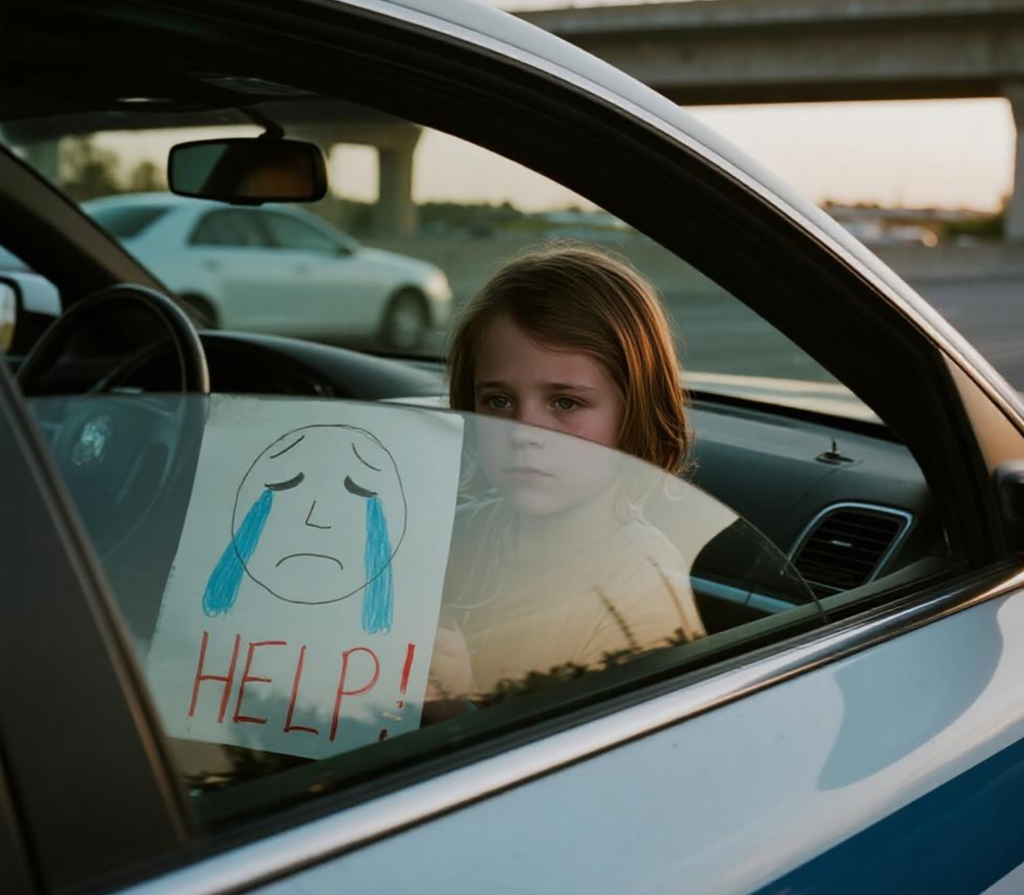
Officer Daniel Brooks had seen a lot in his twelve years on the force—enough to know that true danger rarely announced itself with loud alarms. Sometimes it whispered. Sometimes it came in the form of a shaky crayon drawing pressed against the backseat window of a moving car.
It was a little after 6 p.m. when he spotted it:
A child’s drawing—a round, sad face, tears streaming down in thick blue streaks. And beneath it, in uneven red letters, one word: HELP.

Daniel’s heartbeat didn’t spike, but his senses sharpened instantly. The sedan was turning onto the highway, windows slightly fogged from the inside. He couldn’t see the child clearly—just a silhouette.
He radioed nothing in. Not yet.
Sometimes the smallest details turned out to be misunderstandings. But Daniel had learned to trust the quiet tug in his gut. That tug had saved lives before.
So he followed.
The car kept a steady speed, never swerving, never breaking laws. The driver didn’t appear to notice Daniel behind them. But the child—whoever had held up the drawing—didn’t reappear. The paper was gone.
Daniel switched off his lights, staying just close enough.
Easy, Brooks, he told himself. Don’t jump to conclusions.
But he also couldn’t shake the image of that sad face and the word HELP written in a child’s desperate handwriting.
After ten minutes, the sedan turned off the main road toward a quieter neighborhood—one Daniel knew well. Lots of old houses, poor lighting, few witnesses.
His internal alarms started ringing.
He reported his location to dispatch, requesting quiet backup. “Possible welfare concern,” he said. Nothing more.
He didn’t want to panic the driver.
The sedan finally pulled into the driveway of a faded two-story house with peeling paint. A single porch light flickered. The car engine shut off.
Daniel parked a house away. Backup was still minutes out.

He saw movement—small, fearful. A child’s head ducking behind the backseat.
Then the driver got out.
A tall man, maybe late forties. His shoulders were tense. He walked quickly toward the back door of the house without opening the back car door for the child.
Daniel stepped out of his cruiser.
“Sir!” he called calmly. “Evening. Mind if I have a word?”
The man froze. For half a second, something flashed across his face—panic, irritation, fear? Daniel couldn’t tell. The porch light flickered again, casting strange shadows.
“What’s this about?” the man asked, trying to sound casual.
Daniel nodded toward the car. “I noticed a child in your backseat. Everything alright?”
The man swallowed hard. “My niece. She’s tired. Long day.”
Daniel kept his tone friendly. “Mind if I say hello?”
That’s when the man snapped.
“She’s fine. She’s sleeping,” he said sharply. “You can leave.”
No parent or uncle Daniel had ever met reacted like that.
Daniel stepped closer. “Sir, I’m just making sure everyone is safe.”
Now the man’s voice rose. “I said she’s fine!”
He reached for the house door.
Daniel’s instincts screamed.
“Sir, I need you to stop right—”
A sudden thud cut him off.
Daniel’s heart dropped.
It was coming from inside the car.
A small, frantic thud.
Followed by a child’s muffled sob.
Daniel drew a breath—then drew his flashlight.
“Step away from the house,” he ordered, voice firm, controlled.
The man spun toward him. “This is my property!”
Daniel didn’t move. “Backup is en route. Step away. Now.”

For a moment, the world froze.
Then the man bolted.
Not toward Daniel.
But toward the backyard.
Daniel sprinted after him, calling it in. The man was fast—faster than most his age—but fear can make even tired legs fly.
Two houses down, backup arrived, cutting off escape. Within seconds, the man was restrained, breathing heavily, eyes wild.
“I didn’t hurt her!” he yelled. “I was just trying to help!”
His words made no sense. Daniel didn’t waste another second on him.
He ran back to the car and yanked the back door open.
Inside, curled up in a ball with her knees to her chest, was a little girl—maybe seven years old—with tangled brown hair and tear-streaked cheeks.
Her small fists were clenched around crumpled paper and crayons.
“Hi there,” Daniel said softly, crouching down. “I’m Officer Daniel. You’re safe now.”
The girl looked up, trembling. “He… he said he was taking me home… but… but that isn’t my home.”
Daniel swallowed hard.
“Can you tell me your name?”
“Lily,” she whispered.
“And where’s home, Lily?”
Her chin quivered. “With my mom.”
Daniel gently took the paper from her hands—it was the same drawing he had seen earlier. The sad face. The word HELP.
“You did a very brave thing,” he told her.
“Will you… take me to my mommy?” she asked, voice cracking.
“Absolutely.”

Later, after social services arrived, after Lily was wrapped in a soft blanket and given hot chocolate, the full story came out.
The man was not her uncle.
He was her mother’s ex-boyfriend—someone the mother had cut contact with months earlier. He had picked Lily up from school, lying that her mom had asked him to.
But Lily sensed something was wrong.
She didn’t dare scream. She didn’t dare fight.
So she reached for the only tools she had in her little backpack—crayons and paper—and made a sign.
A sign she hoped someone, anyone, would see.
And Daniel did.
Her mother arrived an hour later, frantic, sobbing, dropping to her knees the moment she saw Lily. The little girl leapt into her arms, clinging to her so tightly that even the other officers wiped their eyes.
Daniel stood quietly to the side, letting them have their moment.
The mother approached him eventually, tears streaking her face.
“You saved her,” she whispered, her voice breaking. “You saved my baby.”
Daniel shook his head. “Your daughter saved herself. I just listened.”
But when Lily let go of her mother long enough to run over and hug Daniel’s leg, whispering, “Thank you,” he felt something warm settle in his chest.
Sometimes heroism wasn’t loud.
Sometimes it was a scared little girl with a crayon.
Sometimes it was a single word scribbled on paper.
HELP.
And sometimes it was a police officer who noticed.
And cared enough to follow.
Leave a Reply