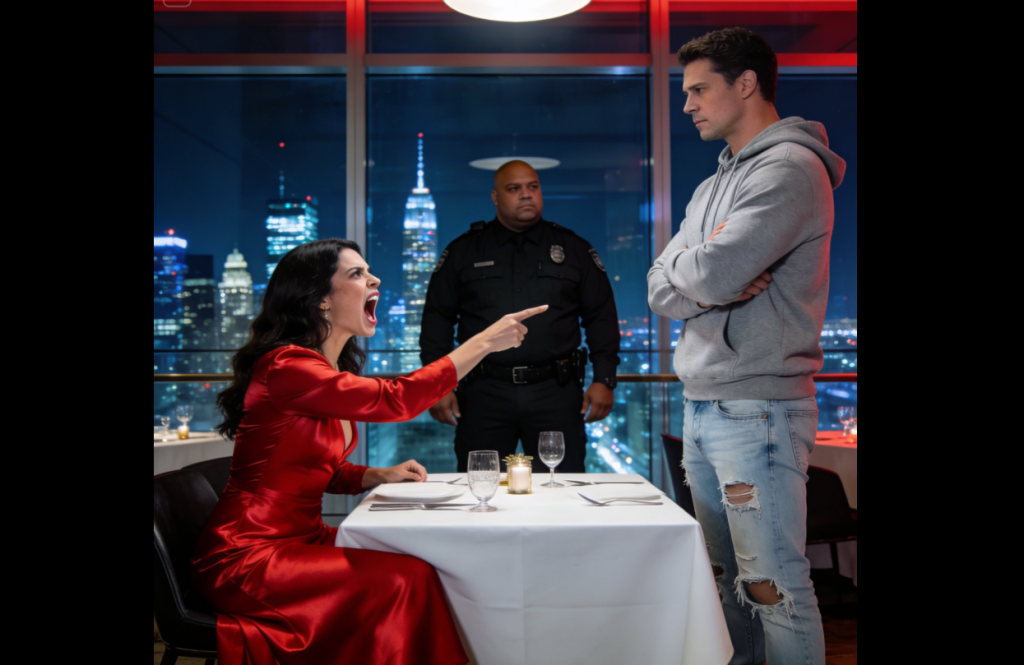
The sound of heavy work boots, stained with dust and dried earth, echoed against the immaculate polished marble floor. It was Friday night at the Sterling Room, the most exclusive, expensive, and coveted restaurant in the entire city. Soft, warm lighting bathed the tables covered with white linen tablecloths, while a gentle jazz melody floated in the air, mingling with the delicate aroma of truffle oil and roast duck.
Brandon Foster pushed open the heavy oak doors and stepped inside. He wore faded jeans, a washed-out gray sweatshirt with the zipper half-up, and had the rough hands of someone who’d just stepped off a construction site. Anyone who saw him would think he’d wandered into the wrong place, a tired laborer who’d stumbled into the elite’s sanctuary. But Brandon wasn’t lost. He’d built this restaurant. He’d designed every detail of the menu, selected the wood for the tables, and hired every member of the staff. Yet tonight he wasn’t there to check the food. He’d already visited eight of his restaurants disguised the same way, searching for the answer to a question that gnawed at his soul: how did his team treat people who didn’t look wealthy?
The receptionist, a young woman named Mia, looked at him. Her eyes traveled down to his dirty boots, up his worn sweatshirt, and settled on his face. It was a half-second assessment.
“Good evening, sir. Do you have a reservation?” Mia asked with a professional smile, not letting any prejudice show in her voice.
—Foster. Table for one. Seven thirty.
Mia checked her tablet. For a moment, her finger lingered on the restaurant map. Brandon watched her silently, wondering whether she would send him to the bar or hide him in a dark corner so as not to inconvenience the diners in suits. But Mia smiled genuinely.
—This way, Mr. Foster.
He led him through the main dining room, past families celebrating anniversaries and couples on romantic dates, until he crossed the subtle burgundy velvet rope that separated the regulars from the VIP section. There, the tables were raised three steps, the lighting was perfect, and the space between diners was a quiet luxury. Brandon was seated at table 13, a prime corner spot with a view of the entire restaurant. He settled into his leather chair, opened the menu, and took a deep breath. So far, so good.
Two tables away, at table 11, Trevor and Vanessa Hayes were finishing their appetizers. They were the epitome of ostentatious wealth. Trevor wore a bespoke suit and a watch that cost more than most of the restaurant’s employees’ houses. Vanessa, covered in dazzling jewelry, was taking pictures of her meal from three different angles for her thousands of social media followers. They paid thousands of dollars a month to belong to that world and considered themselves the undisputed owners of the place.
That’s when Trevor turned his head and his eyes landed on Brandon’s gray sweatshirt. His face twisted into a grimace of disgust. He leaned toward his wife and whispered something in her ear. Vanessa looked up from her phone, glanced at the dirt-stained boots of the man at table 13, and her expression shifted to pure disdain.
“We pay five hundred dollars a person so we don’t have to sit near people like that,” Vanessa muttered, venom dripping from every word. “It’s work clothes. He doesn’t belong in the VIP section.”
Trevor could no longer tolerate the affront to his status. Jaw clenched, he rose from his seat, smoothed his expensive jacket, and began striding with a determined and menacing gait toward table 13. As the wealthy man approached, his fists clenched, and other diners began to turn their heads, the entire atmosphere of the restaurant seemed to freeze. None of those present—not the arrogant couple, nor the silent onlookers, nor the manager who was about to be called—imagined that they were about to commit the most catastrophic mistake of their lives, unleashing a truth that would not only humiliate the wealthiest people in the room but change their lives forever.
“Excuse me,” Trevor said. His voice wasn’t friendly, not even polite. It was a whip laced with classism. “I think there’s been a mistake. This is the VIP section.”
Brandon slowly looked up from his menu, his face inscrutable.
—There’s no mistake. I have a reservation.
Trevor let out a dry, humorless laugh.
“The VIP area has standards. Dress codes. You’re wearing work clothes, dirty boots, and a sweatshirt. I don’t think you understand what it means to be a VIP. People dressed like you don’t eat in places like this.”
At nearby tables, conversations died down. A woman named Amy, at table 12, set down her wine glass, feeling her blood boil at the obvious harassment. At another table, a man discreetly pulled out his phone and began recording. Something in the air screamed that the situation was about to explode.
Brandon clasped his hands on the table, maintaining absolute calm.
—I understand perfectly. And I have a reservation for this table.
By that time, Vanessa was already by her husband’s side, feigning a concern filled with disgust.
“Honey, what’s wrong?” she asked loudly enough for everyone to hear. “Oh, I see. Maybe we should call the manager.”
Trevor raised his voice, shattering the intimate atmosphere of the room.
—Manager! We need the manager right now!
In less than a minute, Justin Clark, the restaurant’s young general manager, appeared hurriedly. Justin had only been in the position for six months, but he had been trained by an expensive and elite academy called “Elite Service Standards.” In his mind, he had a very strict protocol manual on how to categorize people based on their appearance.
—Good evening, I’m Justin, the manager. How can I help you?
“This man is sitting in the VIP area wearing work clothes,” Trevor spat, pointing at Brandon like he was garbage. “We pay premium prices for a premium experience. This is unacceptable. Either you remove him from this section, or we’re leaving.”
Justin looked at Brandon’s sweatshirt. His training dictated exactly what to do: a low-class guest, in work clothes, was to be redirected to protect the comfort of the wealthy customers.
“Sir,” Justin said to Brandon, using a professional but condescending tone, “would you please accompany me? I’d like to offer you an excellent table in our main dining room. It’s the same menu, but perhaps a more… suitable setting for you.”
“I’m very well suited here,” Brandon replied, his voice low but firm. “I have a reservation.”
“I don’t care about his reservation!” Trevor exploded. “Look at him. He clearly doesn’t belong in a space like this. We have no reason to share this section with someone who looks like he just crawled out of a ditch.”
Justin, caught between a wealthy customer who threatened to destroy the reputation of the place and a man in work clothes who refused to budge, decided to apply the pressure of his corporate training.
“Sir, I’m going to have to insist,” said the manager, his face hardening. “For the comfort of all our premium guests, the restaurant maintains certain presentation standards. Please gather your belongings and follow me to your new table.”
Brandon looked at Justin. He saw a young man doing exactly what he had been taught to do: discriminate with a smile, use polite words to mask the purest classism, assume that respect is measured by the thickness of one’s wallet and the brand of clothing one wears.
“Justin,” Brandon said in a sharp whisper. “Do you know who trained you?”
The manager blinked, confused.
—Elite Service Standards. I just explained it to you.
“And do you know what they really taught you?” Brandon stood up slowly, not aggressively, but radiating overwhelming authority. “They didn’t teach you hospitality. They taught you to discriminate.”
Before Justin could utter another condescending word, the urgent sound of heels echoed through the room. Claire, the area operations manager, rushed across the hall. Her face was pale and her breathing ragged. She stopped dead in her tracks at the sight.
“Mr. Foster?” Her voice trembled, filled with a mixture of relief and terror. “Is that you?”
Justin frowned, quickly pulled out his tablet, and checked the reservation system. He searched for the name of table 13. He cross-referenced the information with the property records. The screen returned the answer. The device almost slipped from his trembling hands. He felt the ground disappear beneath his feet.
“Oh my God…” whispered the manager, feeling the air leave his lungs.
Trevor, enraged by the interruption, glared at Claire.
“Who the hell is Mr. Foster? I demand that this bum be removed from here!”
Claire turned to the millionaire, her eyes burning with suppressed indignation.
—Mr. Hayes… this is Brandon Foster. He owns the Sterling Room. In fact, he owns all eight restaurants in our chain.
The silence that followed was absolute, heavy, and suffocating. It was as if they had sucked all the oxygen out of the room.
Trevor’s face went from angry red to deathly white in less than three seconds. His hand shot out to the edge of the table to keep from falling, because his knees literally buckled under his weight. Vanessa dropped her phone to the floor, bringing both hands to her mouth as she took a step back, stumbling clumsily over her own chair.
Justin was paralyzed. All the color had drained from his face.
“Mr. Foster… I… I didn’t know,” the manager stammered, on the verge of tears. “I was following training protocols. I was taught to judge client compatibility…”
“Are you telling me you were taught to assume who belongs somewhere and who doesn’t based on how they look?” Brandon asked. His voice was no longer quiet. It echoed in every corner of the room. “Were you taught that someone in work clothes doesn’t deserve respect?”
Trevor tried to speak, but his voice came out as a muffled squeal.
—We didn’t know… if he had told us he was the owner…
“If I’d told them I was the owner!” Brandon interrupted, his anger cold and contained. “Is that your logic? That I’d then deserve to sit here? That respect depends on what someone owns, instead of being a fundamental right of every human being who walks through that door?”
Trevor and Vanessa were speechless. They were devastated, humiliated in front of all the witnesses who now looked at them with utter contempt. Without another word, the couple gathered their coats with trembling hands and fled the restaurant, shuffling in utter shame.
Brandon turned to the manager. He didn’t fire him that night, but he demanded all the complaint reports from the past year. What he discovered in the following weeks was an abyss of moral decay. Justin wasn’t an isolated monster; he was both the victim and the enforcer of a system designed for exclusion.
The “Elite Service Standards” academy had been charging dozens of the city’s restaurants millions to train their staff with manuals that, under codes like “streetwear” or “workwear,” explicitly ordered the expulsion of working-class people, minorities, and immigrants to “maintain brand purity.” Brandon uncovered heartbreaking stories in his own records: a construction worker kicked out on his birthday, a nurse denied entry after a twelve-hour shift, a law student humiliated in front of his friends.
Brandon Foster wasn’t content with just cleaning up his own restaurant. He teamed up with an investigative journalist and the customers who had been discriminated against. Despite the multimillion-dollar legal threats the training academy leveled against him, despite being offered a $250,000 bribe to keep quiet, Brandon didn’t back down. He took the case to court and to the public eye.
The scandal was monumental. Video evidence and internal manuals were leaked. Dozens of restaurants canceled their contracts with the academy, bankrupting it in less than six months. The entire city had to rewrite its laws on discrimination in public establishments, and the Sterling Room became a beacon of true hospitality, implementing the first training program based on absolute human dignity.
Months later, on another busy Friday night, Brandon walked through the dining room of his restaurant. He was still wearing his worn jeans and gray sweatshirt. Around him, the tables were full. At table 11, where arrogance had once sat, a working-class family now dined, laughing heartily.
Brandon smiled. He had learned the most valuable lesson of his life, one that had cost tears, struggles, and courage: true wealth isn’t measured in the fabric of a suit or the metal of a watch. Respect isn’t something earned by wearing designer clothes or having a fat bank account. Respect is an unbreakable debt we owe to every human being. Sometimes, the man with the dirt-stained clothes owns the building. But, most importantly, every person in this world deserves to be treated as human. Because dignity is never negotiable.
Leave a Reply