It started with a phone call from the school nurse.
“Mrs. Miller, your son, Lucas, just vomited during class. He’s very pale and disoriented. We think you should come right away.”
There are certain sentences that split your life cleanly into Before and After. That was one of them.
I was in the middle of preparing a presentation at work. Thirty slides, six months of data, a roomful of executives waiting for answers. My laptop was open, my notes color-coded, my coffee still warm. I’d finally felt like maybe, just maybe, I was getting the hang of balancing motherhood and career.
The nurse’s voice knocked all of that off its axis.
“I’ll be right there,” I said, my own voice sounding distant, like it belonged to someone else.
I hung up and grabbed my keys. On instinct, I called my husband, Brian. He worked just ten minutes from the school. It made sense. Logically, practically, emotionally—he should have been the first one racing to Lucas.
He picked up on the second ring. “Yeah?”
“It’s Lucas,” I said. “He’s sick at school. The nurse says he’s pale and disoriented. Can you—”
“I’m at work,” he cut me off, his voice cold and flat. No pause, no worry. “You’re the mother. Handle it.”
Then he hung up.
I stood there for half a second, staring at my phone, hearing the dead line hum in my ear. Something flashed through me—rage, heartbreak, maybe both—but there was no time to unpack it. Lucas came first. Always.
I told my manager there was an emergency with my child. She put a hand on my arm and told me to go, don’t worry about the presentation. Her eyes were kind in a way I wasn’t used to lately.
Driving to the school, my mind went everywhere at once. Food poisoning? A virus? A concussion I hadn’t heard about? I replayed that morning: Lucas yawning at the breakfast table, pushing around his cereal, asking if nine was “too old” for cartoons. Nothing had seemed wrong.
By the time I pulled into the school lot, my nails had left half-moons in my palms.
I rushed into the front office, breathless. “I’m Lucas Miller’s mom. The nurse called—”
The nurse wasn’t there.
Instead, two police officers stood waiting just inside the door. They straightened when they saw me, like they’d been rehearsing for this exact moment.
“Mrs. Miller?” one of them asked. He was tall, mid-forties, kind eyes that didn’t quite soften the seriousness in his face. “I’m Officer Ramirez. This is Officer Clark. Please come with us. We need to show you something.”
My heart dropped so hard I almost reached for a chair.
“What happened? Where’s Lucas?” My voice cracked on his name.
“He’s safe,” Ramirez said quickly. “He’s at the hospital for observation. The paramedics took him as a precaution. He was conscious when they left.”
I clung to that word—conscious—like it was a life raft.
“If he’s at the hospital, why—what do you need to show me?”
Ramirez exchanged a brief look with Clark. Then he gestured toward a small office off the main hall. “Please, ma’am. It’ll make more sense if you see.”
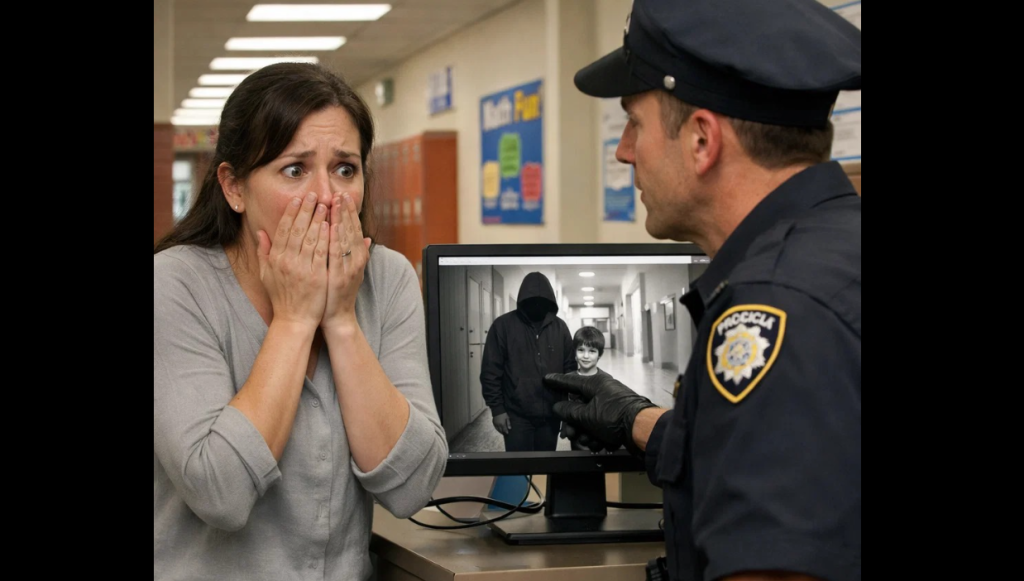
The office was cramped, paper-cluttered, the blinds half-closed. A monitor sat on the desk, already cued up with a video. The school principal hovered near the back wall, cheeks blotchy, eyes shiny. She didn’t meet my gaze.
Officer Clark pressed play.
The footage was timestamped from earlier that morning. A familiar view: the front gate of the school, kids filing in with oversized backpacks, teachers greeting them, a crossing guard waving her sign like a flag.
The camera switched angles to the hallway outside Lucas’s classroom. The usual bustle—kids shoving, laughing, teachers juggling coffee and folders. Ordinary chaos. Safe chaos.
Then the ordinary shifted.
A woman in a hoodie and sunglasses walked straight down the hallway.
No visitor badge. No stopping at the front desk. No hesitation like parents usually have when they’re not sure which door is which. She moved like she belonged there, like she knew exactly where she was going.
The principal winced slightly as the woman passed the front office without so much as a glance.
“Do you recognize her?” Ramirez asked.
“Not yet,” I murmured, leaning closer.
The woman turned the corner toward Lucas’s classroom. The camera angle caught the side of her face briefly—nothing more than a jawline, a glimpse of chin. Then she slipped inside his classroom during the early minutes of homeroom.
Seconds later, the teacher stepped out, phone pressed to her ear. I watched her mouth the words “I’ll be right back,” oblivious that she was leaving my son alone with a stranger.
The video jumped ahead thirty seconds.
The classroom door opened again. The woman emerged, this time without the hood. She reached up, pushed back the sunglasses.
The camera caught a clear, unobstructed shot of her face.
My jaw dropped.
I knew that face.
I knew that slightly too-wide smile, those eyes that always seemed a little too bright, like someone had cranked the saturation up on her emotions and then let them spill.
It was Stephanie.
My husband’s ex-wife.
The woman he always referred to as “unstable,” “out of the picture,” and “never allowed near Lucas.”
The officer paused the footage and looked at me. “Ma’am, do you know this woman?”
My mouth went dry. For a second, I thought I might pass out. My fingers clutched the back of the chair so tightly my knuckles ached.
“Yes,” I whispered. “That’s my husband’s ex.”
“And he didn’t tell you she had access to your child’s school?” Clark asked carefully.
“No,” I said, anger threading into my fear. “He said she wasn’t in Lucas’s life at all. He said the courts… he said she was dangerous.”
Ramirez nodded slowly, jaw tightening. “Well, she walked right into this school this morning. According to the classroom teacher, she claimed she was Lucas’s aunt. Said she needed to deliver his medication. The teacher stepped out to verify with the office, but… the office never got that call.” He glanced at the principal, whose eyes dropped to the floor.
“So Lucas…” My voice broke. “He took something from her?”
“Yes, ma’am,” Ramirez said gently. “Lucas confirms that she gave him a pill and told him to swallow it. About fifteen minutes later, he vomited and nearly fainted. The nurse called 911. EMS gave him something to counteract it and transported him.”
“He’s okay now,” the principal rushed to add. “Stable. Awake. But the nurses wanted him monitored. They said the sedative properties—”
“Sedative?” The word echoed in my skull.
“Mild,” Ramirez said quickly. “Non-lethal, based on what the hospital told us so far. But not something a child should be given without supervision.”
I stared at the frozen image on the screen—Stephanie’s face captured in grainy pixels, lips slightly parted, eyes scanning the hallway with a predator’s calculation.
She wasn’t supposed to know where Lucas went to school. She wasn’t supposed to know what classroom he was in. She wasn’t supposed to know anything.
But she did.
And Brian had had the nerve to say, “You’re the mother. Handle it.”
Oh, I would.
My hands were trembling as the officers finished explaining what little they knew. They asked if I wanted an escort to the hospital. I thanked them and said no.
I didn’t drive to the hospital.
Not yet.
First—Brian’s office.
Adrenaline drove me more than I drove the car. The streets between the school and Brian’s downtown office blurred into one long, furious line.
His firm occupied a glass building with chrome accents and a lobby that always smelled like expensive cologne and floor polish. I’d been there countless times for holiday parties and “bring your spouse” events. It had never felt hostile before.
Today, the marble floors might as well have been ice.
I walked straight past the front desk, ignoring the receptionist’s startled “Excuse me, ma’am, do you have an appointment?”
“No,” I said, not slowing. “But he’s about to.”
The hallway to Brian’s office felt too quiet. My heels clicked in sharp, angry beats. Through the glass walls, I saw men in suits hunched over screens, women in blazers gesturing at charts. No one looked up. No one ever looked up unless something exploded.
I reached Brian’s office and didn’t bother knocking. I slammed the door shut behind me, the glass rattling in its frame.
He looked up from his computer, startled, brow furrowing. “Hannah? What are you—?”
“You said Stephanie was out of the picture,” I said, my voice low and shaking.
His confusion lasted a full second before something else flickered behind his eyes. Guilt? Fear? I searched his face like I’d never done before, parsing every microexpression.
“She is,” he said. Too quickly.
“No.” I pulled up the still frame of the security footage on my phone and thrust it toward him. Stephanie’s face filled the screen, grainy but unmistakable. “She was at Lucas’s school this morning. She walked into his classroom, gave him something to swallow, and now he’s in the hospital.”
He stood slowly, his chair rolling back an inch. “Wait—what?”
“You said she had no contact. No custody. No rights.” My voice climbed, sharper with every word. “But she knew where our son was, what class he was in, and had enough confidence to walk straight in and give him medication. How?”
Brian’s face went gray. He sat down hard, all the air seeming to leave his body. For a moment, he looked less like my husband and more like a boy caught cheating on a test.
“I didn’t think she’d actually—” he started.
“You didn’t think?” I could barely hear myself over the roar in my ears. “You lied, Brian.”
He rubbed his temples like he could massage the situation into something less horrific. “She reached out a few months ago,” he said finally. “Said she’d gotten help. That she was in therapy, on medication, stable. She wanted to see Lucas. I didn’t want to upset you or confuse him. So I… I met her a few times. Just to see.”
The floor seemed to tilt.
“A few months?” I repeated. “You’ve been meeting her for months?”
“It was just coffee, Hannah. Talking. I wanted to see if—if maybe she had changed. I thought if she really was stable, maybe it would be good for Lucas someday. To know his biological mother isn’t—”
“Isn’t what?” I snapped. “Dangerous? Because she just drugged our child.”
He flinched.
My mind raced through every strange moment of the past year—the late-night texts he’d hidden, the vague mentions of “work drinks,” the times he’d come home distracted. I’d assumed it was the marriage. Or the stress. Or me.
It was her.
“You hid her from me,” I said, feeling something crack in my chest. “You let her get close without telling me. Did you give her our address? Our schedule? Lucas’s school?”
His silence answered before he did.
“She was asking,” he finally murmured. “About him. About his routine. I only told her the name of the school. I thought—she lives across town. I didn’t think she’d go there. I just… I didn’t think.”
“You didn’t think,” I repeated slowly. “Our son was poisoned in his classroom, and your defense is that you didn’t think?”
“I didn’t think she’d hurt him.” His voice was small now. “She said she just wanted to see him. To know if he was okay. She swore she wouldn’t do anything. I thought… I thought if I gave her that, she’d leave us alone.”
“You thought wrong,” I said, each word a knife. “Spectacularly.”
He swallowed, eyes shiny. “Is he—he’s really okay? The hospital said it wasn’t lethal, right? Maybe she didn’t mean—”
“Stop,” I said sharply. “Do not defend her to me right now.”
He opened his mouth, closed it again.
“You didn’t go to the school,” I said. “You didn’t call 911. You didn’t even stay on the phone long enough to ask what was wrong. You hung up on me.”
“I was in a meeting,” he said weakly.
“So was I,” I shot back. “Guess which one of us left.”
He didn’t speak after that.
I walked out of the glass office and through the pristine lobby, feeling eyes on my back. For once, I didn’t care how it looked. Let them talk. Let them whisper about the woman with wild eyes marching through their temple of finance.
This wasn’t just betrayal.
This was negligence.
This was endangerment.
And I had no idea how deep it ran.
By the time I got to the hospital, my anger had cooled into something colder and more focused.
Lucas was in a pediatric observation room with cartoons playing quietly on the TV and a stuffed giraffe at the foot of his bed. The nurses had clipped a little pulse monitor to his finger; it glowed red in the dim light.
His face was pale, but his eyes were open. When he saw me, they filled with tears.
“Mom,” he whispered.
I was at his side in three steps, brushing his hair back, pressing my lips to his forehead. He was warm, solid, alive.
“Hey, baby. I’m here.” My voice finally cracked. “You scared me so much.”
He swallowed. “I’m sorry.”
“Hey,” I said sharply, pulling back to look him in the eye. “No. You didn’t do anything wrong. Do you understand me? Not one thing.”
He hesitated. “She said she was a new friend.”
My heart squeezed. “Who did?”
“The lady,” he said. “From school. She said she was your friend and Dad’s friend. She said she knew me when I was a baby. She said she brought me the medicine you forgot.”
Cold swept through me. “She said I forgot your medicine?”
He nodded, eyes glassy. “She said you’d be in trouble if the teacher told you. So I shouldn’t tell anyone. But I felt funny, and then the room was spinny and…” His lower lip trembled. “I threw up on my math book.”
I forced a smile I didn’t feel. “Well, that’s one way to get out of homework.”
He let out a weak little laugh.
“But listen to me, Lucas.” I held his hand gently. “She’s not my friend. And she’s not your friend. She lied. She should never have come to your classroom. She should never have given you anything. And she will never come near you again. Okay?”
“Okay,” he whispered, though a tiny furrow stayed between his brows, like he was trying to reconcile what I was saying with what had already happened.
When the doctor came in later, he explained that the substance in Lucas’s system was a low-dose sedative, the kind occasionally prescribed for anxiety or insomnia. “Taken in higher quantities, or combined with other medications, it could have been dangerous,” he said. “But what he ingested was mild. He’ll be groggy today, maybe have a headache, but his labs look good. You were lucky.”
Lucky.
That night, after Lucas fell asleep and my parents arrived to sit with him, I went home, sat at the kitchen table, and let myself finally fall apart. I cried until there was nothing left, then stared at the cracked pattern in the wood and felt something else rise in me.
Resolve.
If Brian wasn’t going to protect our son, I would.
Even if I had to protect him from his own father.
The next morning, I called a lawyer.
A good one. Recommended by a colleague who’d whispered, “She’s a shark, in the best way,” over coffee once when I’d casually asked about family attorneys “for a friend.”
Then I called the school district.
Then the police.
Officer Ramirez met me at the station to take my formal statement, now that Lucas was stable. He slid a cup of coffee toward me I didn’t drink. “We’ve already pulled the footage, interviewed staff,” he said. “We’re working on a warrant for Stephanie’s residence.”
“Brian gave her our son’s school information,” I told him. “He admitted it. He said he didn’t think she’d do anything.”
Ramirez’s jaw flexed. “We’ll need him to come in, too. If he knowingly allowed an individual with a history of instability access to a minor… there may be additional charges or at least documentation of negligence.”
By noon, Stephanie had been arrested.
Trespassing. Impersonation. Administering a substance to a minor without consent. They found a prescription bottle in her purse with her name on it and several pills missing. She told them she “just wanted him to relax” and “be open to seeing her again.”
She cried during her mugshot, I heard later.
I didn’t feel sorry for her.
Brian, however, was not going to disappear into a set of charges and an orange jumpsuit.
Because he hadn’t physically handed Lucas the pill. He hadn’t signed her in at the school. He hadn’t walked through the hallway in a hoodie and sunglasses.
But he had facilitated this.
He had chosen secrecy over transparency. His silence had been a key that unlocked the door.
My lawyer, whose name was Claire and whose heels clicked like gunshots in courthouses, filed for emergency temporary custody the next day.
“He’s going to fight it,” I said in her office, twisting a tissue in my hands.
“Good,” she replied. “Let him. Judges tend to look unfavorably on fathers who knowingly enable unstable ex-spouses and then shrug on the witness stand.”
She was right.
Brian did try to fight it.
He showed up in court with his own attorney, looking rumpled in a suit that suddenly didn’t make him seem powerful, just small. The judge reviewed the security footage, the police report, the hospital records. She listened to Lucas’s teacher describe the woman who’d walked into her classroom, all easy confidence and lies.
Then she listened to Brian.
“Mr. Miller,” the judge said, peering at him over her glasses. “Is it true that you told your current wife that your ex-wife was ‘out of the picture’ and ‘never allowed near your son’?”
“Yes, Your Honor,” he said, eyes fixed on the table.
“And is it also true that, during that same period, you were meeting with Ms. Stephanie Miller regularly and providing her details about your son’s life without telling your current wife?”
He swallowed. “Yes, Your Honor.”
“And is it true you supplied Ms. Miller with the name of your son’s school?”
“Yes.”
The judge’s lips thinned. “Mr. Miller, I might remind you that our concern here is not your hurt pride or your intentions. It is the safety of a nine-year-old boy who was placed in harm’s way by the choices of the adults around him.”
Brian’s attorney tried to argue that he hadn’t known Stephanie was a threat, that he believed she’d improved, that he was trying to “build bridges” for Lucas’s sake.
The judge was unmoved.
“It is the duty of a parent,” she said, “to err on the side of caution when it comes to their children’s safety. Not secrecy. Not unilateral decision-making. Certainly not allowing access to someone with a documented history of instability without the consent or knowledge of the other custodial parent.”
She granted me full legal custody pending a more thorough investigation and psychological evaluations.
Brian’s face in the courtroom was pale, stunned, almost childlike. As if he couldn’t fathom that consequences applied to him.
Outside the courtroom, as people shuffled past us, he turned to me.
“How could you do this to me?” he asked.
He sounded genuinely bewildered.
“How could you risk our son’s life and act like it was my job to fix it?” I replied.
For the first time since I’d known him, he had no answer.
Meanwhile, Stephanie’s background check dug up things Brian had conveniently failed to mention. Not just “emotional instability,” as he’d vaguely described. Not just “a few bad years.”
She had a history of mental health crises, yes—but she also had prior custody suspensions, documented episodes of erratic behavior, and two restraining orders from another state related to her younger siblings.
Things Brian had known.
Things he had minimized under the umbrella of “She’s getting better” because it was easier than confronting the reality of what he was inviting back into our lives.
The school district issued a formal apology. They launched a full review of entry procedures, updating policies, installing a new visitor verification system. The principal was placed on administrative leave, pending investigation into why a woman with no badge and no check-in had slipped through unnoticed.
It wasn’t justice. Not yet.
But it was accountability.
Three weeks later, life on the surface looked almost normal again.
Lucas went back to laughing at cartoons. He ate dinner without pushing food around as much. He went to bed without asking me to leave the light on in the hallway.
Sometimes, when he thought I wasn’t looking, he would pause mid-play, his hand hovering over his toys, eyes losing focus as if replaying something only he could see.
He never mentioned Stephanie.
And I never brought her up.
We moved.
The old house felt tainted somehow—not just by her shadow, but by the memory of Brian’s decisions. I found a smaller place closer to my parents, a townhouse with creaky stairs and a little balcony where Lucas could grow spider plants. My parents helped us paint, my dad whistling off-key as he rolled a cheerful blue onto Lucas’s bedroom walls.
I changed the locks myself. It felt symbolic.
I transferred Lucas to a new school. This time, I asked more questions than I’d ever thought to ask: about security measures, visitor protocols, staff training. The administrators answered patiently. One of them even said, “I heard about what happened… where you came from. We’ve taken extra steps here since.”
Brian asked for visitation.
“I want to see my son,” he said over the phone one night, his voice strained. “He’s my son, Hannah. I made a mistake, but I love him.”
“I know you do,” I said quietly. “But loving someone and protecting them are not the same thing. You’re going to have to earn it.”
The court agreed. Supervised visitation only, at first. Conditions. Therapy. Progress reports. Clear boundaries.
He cried the first time he saw Lucas in the visitation center, I was told. Lucas hugged him stiffly, then pulled away to show him a drawing of a giraffe. Kids are strange and resilient like that. They love even when they don’t fully understand why they’re hurt.
I watched from the observation window for a moment and then stepped back. This was their time. Complicated, monitored, fractured—but still theirs.
As for me?
I finally understood that motherhood didn’t mean fixing things everyone else broke.
It meant protecting.
Even if the threat came from within your own home. Even if the person you had to protect your child from was someone you once promised to love.
One night, a few weeks after we’d settled into the new townhouse, I stood in Lucas’s doorway and watched him sleep. The frown line between his brows was still there, faint but visible, even at rest. I wondered how much of that was from me, from what he’d seen, from what he’d felt that day in the classroom when his world tilted and his body betrayed him.
I tucked the blanket up around his shoulders and sat on the edge of his bed, listening to the soft rasp of his breathing.
“Mom?” he mumbled, eyes still closed.
“Yeah, baby?” I whispered.
“Was she…” He swallowed. “Was she really a bad person?”
For a moment, my first impulse was to say yes. To label it in black and white, to make the world simpler than it is. But I thought of Stephanie’s mugshot, the smeared mascara, the wild grief. I thought of Brian’s flat voice, his fear, his denial. I thought of the way hurt travels through families like a virus unless someone, somewhere, puts up a barrier.
“She made a very bad choice,” I said finally. “A dangerous one. She hurt you, and that’s not okay.”
He exhaled, still half asleep. “Oh.”
He was quiet for a while, long enough that I thought he’d drifted off again.
Then, softly, “What about Dad?”
That one hurt more.
I paused, staring at the night-light casting soft stars on his wall. How do you explain to a nine-year-old that sometimes the people who are supposed to protect you end up being the ones who leave the door open for harm?
“Sometimes,” I said slowly, choosing each word like a step over broken glass, “people don’t protect you like they should. They make choices that put you in danger because they’re scared, or selfish, or confused. That doesn’t mean it’s your fault. It doesn’t mean you weren’t worth protecting. But it does mean you get to decide who deserves to stay in your life, and how close they’re allowed to be.”
Lucas’s fingers curled in the blanket. “Do you decide, too?”
“I do,” I said. “That’s my job. Until you’re big enough to decide for yourself.”
He nodded, his face relaxing. “Okay.”
He fell back into deeper sleep, the frown line smoothing slightly. I sat there a little longer, letting my own shoulders loosen, feeling the weight of what we’d survived and the even heavier weight of what we’d learned.
The next morning, we packed his backpack with his new school’s supplies list. He added an extra pencil “just in case.” I added a small laminated card in an inside pocket with emergency phone numbers and a picture of us at the beach.
At drop-off, he squeezed my hand a little tighter than usual before letting go.
“You’ll be here?” he asked.
“Always,” I said.
And this time, it wasn’t just a promise.
It was a vow.
We walked forward.
Together.
THE END.
Leave a Reply