Part One: The Storm and the Steps
Back then, Maria Santos was already in her early thirties—an age when the women in her town believed they should be worrying about husbands, babies, and the kind of life that looked respectable from across the street.
Maria’s life had never followed a straight road.
She had stopped apologizing for that years ago.
She lived alone in an aging teachers’ dormitory attached to San Isidro Public Elementary School, a faded concrete building at the edge of a provincial town in the Philippines. During typhoon season, the metal roofing rattled so violently that sleep became a negotiation with noise. The hallways smelled faintly of chalk dust, damp wood, and boiled rice from the communal kitchen.
Her room was narrow and sparse. A single bed with a thin mattress. A wooden desk scarred by generations of teachers who had carved their frustrations into it with ballpoint pens. A standing fan that squeaked every time it rotated left. A small bookshelf crammed with donated textbooks and dog-eared novels that had crossed oceans before landing in her hands.
Some days she ate nothing but rice and salt.
Some nights she fell asleep with lesson plans still open on her lap, red pen resting across her chest.
A teacher’s salary was small.
Her shoes wore thin quickly because she walked everywhere.
But her heart had never lacked love.
It wasn’t loud love.
It wasn’t the kind that announced itself in grand gestures or expensive gifts.
Maria’s love lived in small rituals.
Opening classroom windows at dawn to let fresh air push out stale heat.
Staying after school to tutor children who struggled to read.
Keeping a tin can hidden inside her drawer where she saved coins—five pesos here, ten pesos there—so she could buy pencils for students whose parents couldn’t.
She noticed what others ignored.
The boy who always chose the back row because his shirt was faded and patched.
The girl who fought everyone because her father came home drunk every night.
The quiet child who never brought lunch and insisted she “wasn’t hungry.”
In a town where survival often meant minding your own business, Maria did the opposite.
“You’ll wear yourself out,” the older teachers warned her.
Maybe she would.
But she had grown up poor herself. She knew what it meant to feel invisible.
And she had promised herself—quietly, fiercely—that if she ever had the power to make someone feel seen, even briefly, she would.
She didn’t know yet that promise would be tested under a sky the color of wet cement.
The rain began just after noon.
Not gentle rain.
Angry rain.
It slammed against roofs and flooded the narrow streets until tricycles crawled like uncertain insects through muddy rivers. Vendors covered their carts with plastic sheets. Children ran barefoot, shrieking with laughter or fear.
Maria had gone to the local rural health center to deliver attendance forms for a community literacy program. It wasn’t technically her responsibility, but the nurse assigned to paperwork was caring for three children and a sick mother.
So Maria went.
By the time she reached the health center, she was soaked through. Her blouse clung to her back. Strands of hair stuck to her forehead. She wiped her face with the edge of her scarf as she climbed the cement steps.
That was when she saw them.
Two small boys.
Twins.
They were sitting on the steps beneath the overhang, but the wind had driven rain sideways so that they were drenched anyway. A thin piece of cloth covered them uselessly, plastered against their heads and shoulders.
They were huddled together so tightly it looked as if they were trying to fuse into one body.
Their arms were wrapped around each other.
Their bare feet were pressed against cold cement.
They were crying.
Not loudly.
Not in desperate, screaming pleas.
But in the exhausted, hoarse way children cry when they have been crying too long. When the body continues the sound long after the mind has gone quiet.
Maria stopped walking.
The rain struck her shoulders.
She looked around.
No adults nearby.
No mother rushing back.
No staff member opening the door.
Just the boys.
Alone.
Beside them lay a crumpled piece of paper, heavy with rain.
Maria bent slowly, careful not to startle them, and picked it up.
The ink had bled, but the message remained legible:
Please let someone raise them. I no longer have the means…
No name.
No number.
No explanation.
Just a sentence that felt torn from someone’s chest.
Maria’s throat tightened.
She looked at the boys again.
Their lips trembled.
Their fingers clenched.
They did not beg.
They did not reach out.
They were simply there.
Waiting for whatever happened next.
She knelt.
“Hello,” she said softly.
The boys flinched, pressing closer together.
She didn’t reach for them.
She knew fear.
She knew children didn’t relax just because someone smiled.
“My name is Maria,” she said, lowering her voice the way she did in her classroom when a student was close to tears. “I’m a teacher.”
One of the boys lifted his head slightly.
His eyes were enormous—dark, rimmed with red, filled with hunger and something older than his years.
Will you hurt me?
Maria removed her scarf—the only semi-dry fabric she had—and wrapped it gently around both of them.
Their skin was shockingly cold.
“No one should be out here in the rain,” she whispered.
Then she did something that didn’t feel like a decision.
She lifted them.
One under each arm, balancing their light bodies against her chest.
They weighed less than her schoolbag.
One boy clutched her shoulder instantly.
The other held onto his brother, then tentatively to the edge of her blouse.
She carried them inside.
Her arms trembled—not from the weight, but from the certainty that her life had just shifted.
The police were notified.
Paperwork was filed.
A social worker arrived with tired eyes and a clipboard.
“This happens,” she said quietly. “Sometimes parents come back.”
Days passed.
No one came.
The twins were placed temporarily in Maria’s care because there was no immediate foster placement available in the town.
“You can stop anytime,” the social worker told her.
Maria nodded.
But her body didn’t understand the word stop.
At first, she referred to them simply as “the twins.”
They barely spoke.
They flinched at loud noises.
They slept curled around each other on a mat beside her bed.
At night, one would wake and cry without sound—mouth open, no voice escaping.
After listening to them whimper in their sleep for a week, Maria made a decision.
She gave them names.
Miguel.
Daniel.
She chose them carefully.
Miguel for strength.
Daniel for grace.
The first time she spoke their names aloud, they stared at her as if the words were fragile glass.
Slowly, they began to respond.
Miguel turned when she called.
Daniel reached for her hand.
Something settled inside Maria.
Heavy.
Terrifying.
Sacred.
Her days became a balancing act.
She taught in the mornings.
Rushed home at noon to cook porridge.
Took the boys with her to sell lottery tickets in the afternoons to earn extra pesos.
At night, they studied by oil lamp when electricity failed.
People whispered.
“Why would she take on that burden?”
“She’ll never marry now.”
“She’s foolish.”
Maria let them speak.
Miguel showed an unusual ease with numbers.
He counted faster than most children his age.
Daniel asked questions constantly.
“Why do clouds move?”
“How does a plane stay in the sky?”
At night, Daniel often lay awake and whispered, “Why can airplanes fly?”
Maria would smile in the dark.
“Because dreams give them lift.”
She didn’t know then how literal that would become.
Years passed.
She patched her dresses.
Glued the soles of her shoes.
Drank ginger tea instead of buying medicine when she caught colds.
But the boys’ education never faltered.
Miguel devoured math textbooks.
Daniel built model airplanes from scrap wood.
When they were accepted into a prestigious flight training program in Manila, Maria sat on her narrow bed and cried until sunrise.
Not from fear.
From pride.
She had once carried them from the rain.
Now they were leaving the ground entirely.
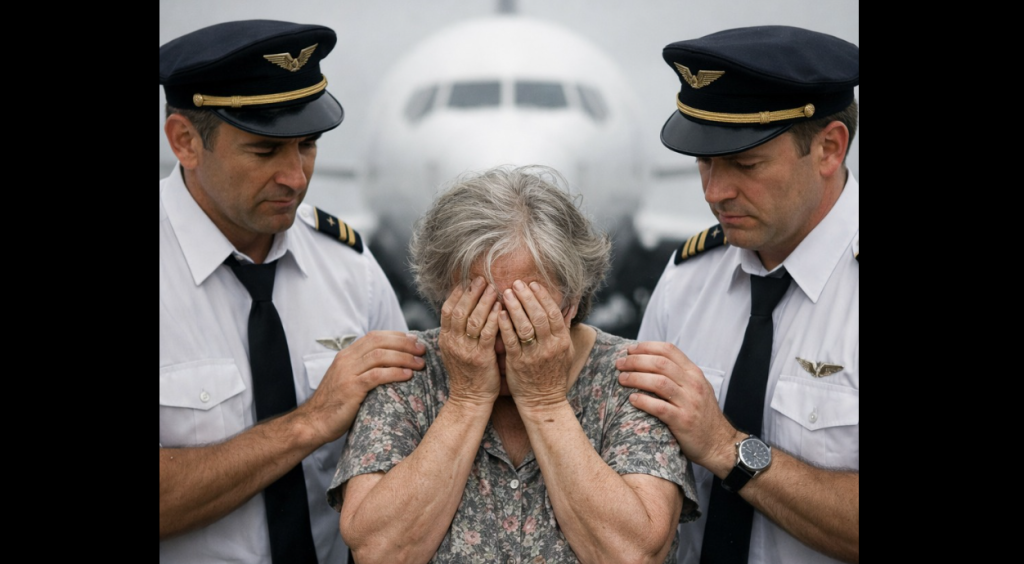
Fifteen years later, in a busy Manila airport, two pilots stood in crisp uniforms.
Miguel and Daniel Santos—by choice.
Maria walked slowly toward them, hair streaked white, hands trembling slightly.
A woman stepped forward before they could embrace.
“I am their biological mother,” she said quietly.
She looked older than her years.
Worn.
Desperate.
She placed a thick envelope on the airport café table.
“Ten million pesos,” she said. “For the cost of raising them.”
Miguel pushed the envelope back.
Daniel spoke gently.
“The one who raised us is here.”
They chose Maria.
Legally.
Publicly.
Finally.
Later, in a modest home filled with photographs of graduation days and flight school milestones, Maria sat quietly.
Miguel and Daniel brought her to the edge of a runway one evening.
A plane roared down the tarmac and lifted into the sky.
“We fly because of you,” Miguel said.
Daniel placed a small wing-shaped pendant in her hand.
Maria closed her fingers around it.
For the first time in her life, she allowed herself to feel something she had denied for decades.
Peace.
Because some mothers do not give birth to their children—
but they are the ones who give them wings.
Leave a Reply