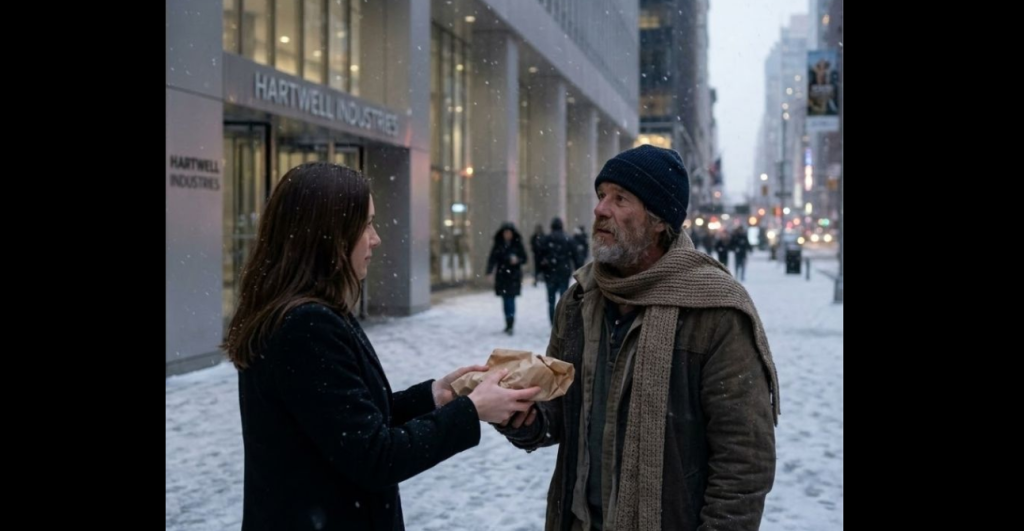
The bitter December wind cut through Megan Reed’s thin jacket as she hurried down a crowded Manhattan sidewalk. At 34, she had mastered the art of stretching every dollar to support herself and her 10-year-old daughter, Haley. The administrative position at Hartwell Industries had been her saving grace after her ex-husband disappeared 3 years earlier, leaving unpaid bills and broken promises behind.
“Morning, Miss Reed,” the security guard called as she badged into the gleaming skyscraper that housed Hartwell’s headquarters.
“Morning, Pete. Freezing out there today?” she replied, stomping snow from her well-worn boots before stepping into the warmth of the lobby.
Megan did not notice the disheveled man sitting against the building’s exterior wall, partially hidden behind a pile of cardboard. Few people did. Most hurried past, eyes fixed forward or down at their phones. But that was not Megan’s way.
On the 22nd floor, she took her place at the reception desk of the human resources department. Her supervisor, Victoria Dawson, swept in moments later, immaculate in designer clothing that cost more than Megan made in a month.
“The quarterly reports need to be on my desk by noon,” Victoria said without looking up from her phone. “And Mr. Hartwell is visiting the department today, so everything needs to be perfect.”
“Mr. Hartwell? The CEO?” Megan asked, surprised. In her 18 months at the company, she had never seen the reclusive founder and CEO, William Hartwell. His appearances were usually limited to board meetings and major events.
“Yes, that Mr. Hartwell,” Victoria replied with an eye roll. “He’s doing an executive walkthrough of all departments. Make sure the coffee station is stocked with those special beans he likes.”
The morning passed in a blur. At lunch, Megan grabbed her brown paper bag and headed downstairs. Snow now fell in heavy flakes.
As she exited the building, she saw the same homeless man from earlier, huddled against the wall and shivering violently. He appeared to be in his 50s, with a gray beard and weathered face partially hidden beneath a tattered hood. His red, chapped hands clutched a cardboard sign that read, “Anything helps.”
“Sir,” Megan said gently, approaching him. “Would you like half of my sandwich? It’s turkey and cheese.”
The man looked up, surprise in his blue eyes. “That’s very kind of you,” he said, his voice unexpectedly articulate.
“It’s nothing.” She handed him half her sandwich and her thermos. “It’s homemade chicken noodle soup. Keep the thermos for now. I’ll be back after work.”
“Why would you help a stranger?” he asked.
Megan shrugged. “My dad always said kindness costs nothing but means everything.” She checked her watch. “I need to get back. Will you be here later?”
He nodded.
That afternoon, a crisis erupted when one of their top executives resigned. At 4:30, Victoria called Megan into her office.
“I need you to stay late. The executive team needs updated reports by morning.”
“I’m sorry, but I can’t,” Megan said. “I have to pick up my daughter from after-school care by 6:00 or they charge extra fees.”
“This isn’t optional,” Victoria replied coldly. “This is a critical business need.”
“I understand, but I’m a single mother. I have no one else.”
“Then perhaps Hartwell Industries isn’t the right fit for someone with your constraints.”
Fear tightened Megan’s chest. “Let me see if I can find someone to help with Haley.”
After 20 frantic calls, her neighbor Mrs. Wilson agreed to pick Haley up. Megan threw herself into the work.
At 7:30, she remembered the homeless man. He was still outside, barely visible in the snow.
On impulse, Megan used her emergency credit card to order a hot meal from the deli across the street. Fifteen minutes later, she took it down to him, ignoring Victoria’s disapproving gaze.
“You came back,” he said.
“I promised I would.” She handed him the food and removed her scarf. “Please take this.”
“I can’t take your scarf. You’ll be cold.”
“I have others,” she lied.
“Thank you, Miss Megan.”
“Megan Reed.”
“I’m Jack,” he replied.
“Nice to meet you, Jack.”
“Why risk your boss’s disapproval for a stranger?”
“3 years ago, after my husband left, people helped me when I had nothing. I’m just paying it forward.”
Back upstairs, Victoria confronted her.
“Did you just give company-ordered food to a homeless person?”
“I paid for it myself.”
“That man has been loitering outside our building for days. Security has been instructed to move him along.”
“He’s a human being, Victoria.”
“It’s inappropriate behavior for a Hartwell employee.”
Megan finished her reports by 9:00 p.m. As she packed up, Victoria returned with the head of security.
“We’ve reviewed the security footage,” Victoria said. “You were observed fraternizing with that vagrant and giving him company property.”
“The thermos?” Megan stared in disbelief. “It’s a $5 thermos.”
“Company policy is clear about theft.”
“You’re firing me over a thermos?”
“Your final check will be mailed to you. Clean out your desk.”
Thirty minutes later, Megan stood outside Hartwell Industries holding a box of her belongings, tears freezing on her cheeks. The homeless man was gone. The spot where he had sat was empty.
From the darkened CEO’s office above, a figure watched her leave and picked up a phone.
“Frank, it’s William Hartwell. I need you to do something for me immediately.”
The next morning, Megan sat at her kitchen table, applying to jobs. Holiday hiring freezes meant most positions would not be filled until January.
“Mom, are you okay?” Haley asked.
“I’ve got some time off,” Megan replied.
After dropping Haley at school, Megan received a call.
“This is Frank Turner, Mr. William Hartwell’s personal assistant. Mr. Hartwell would like to meet with you at 11:00 a.m.”
A car picked her up at 10:30 and drove her not to headquarters, but to an elegant brownstone on the Upper East Side.
In the library, she waited among shelves of books and family photographs.
When the door opened, she gasped.
Standing there was Jack.
Except he was clean-shaven, wearing an expensive suit.
“Hello, Megan,” he said. “William Hartwell, actually.”
She sank into a chair. “You were the homeless man.”
“Once a year, I spend a week on the streets near my company buildings,” he explained. “My father built Hartwell Industries from nothing. He worried I’d lose touch with reality.”
“So it was a test?”
“An experience. In 7 years, you’re the only Hartwell employee who has ever stopped to help me.”
“And for that kindness, I lost my job,” Megan said.
“Victoria Dawson had no authority to terminate you. Your termination has been rescinded. You’ll be reinstated immediately with back pay.”
Relief washed over her.
“But I’d like to offer you more than your old position.”
He handed her a folder. “Assistant director of our new community outreach division. The salary is double what you were making, with flexible hours.”
“Why me?” she asked.
“Your compassion wasn’t just kindness. It was leadership.”
She hesitated. “Won’t it look like special treatment?”
“I hope people think I reward humanity.”
He explained the vision: a structured community engagement department, beginning with addressing homelessness in cities where Hartwell operated.
“Take the weekend,” he said.
That evening, Megan researched William Hartwell. Born in Ohio to working-class parents, he had transformed his father’s small tech company into a multinational corporation. He avoided the spotlight. One article mentioned his annual disappearances, attributed to personal retreats. Now she understood.
Her phone pinged with a message from an unknown number.
The offer is genuine. No strings attached. Trust your instincts. – W
By Sunday night, she accepted.
On Tuesday, a courier delivered her new ID badge, business cards, and a handwritten note.
Looking forward to working together. Your thermos has been officially added to your employment benefits package.
Inside a velvet box lay a silver pendant shaped like a thermos engraved with the words: Kindness costs nothing but means everything.
For the first time in years, Megan felt hope.
Megan’s first day as assistant director of community outreach began on the executive floor of Hartwell Industries, a world of glass, steel, and sweeping Manhattan views.
Frank Turner escorted her to a corner office with floor-to-ceiling windows.
“This is mine?” she asked.
“Mr. Hartwell personally selected it,” Frank said.
On her desk sat a laptop, a company phone, and a small plant with a note: Growth begins with a single seed.
She met her core team: Ryan Cooper from marketing, Patricia Winters from finance, and Tyler Nguyen from IT, who had developed an app tracking shelter availability in his spare time.
“Mr. Hartwell shared your story,” Patricia said. “He said you embody the values this department should represent.”
Together, they began shaping their first initiative.
Later, Hartwell called Megan into his office.
“I have a board meeting tomorrow. They’ll want to hear about our first major initiative.”
“Already?”
“Everything moves faster up here.”
Megan proposed expanding Tyler’s app and converting an older Hartwell property into transitional housing with job training, counseling, and partnerships with local businesses.
“Get me a proposal by tomorrow morning,” Hartwell said.
They worked until 1:00 a.m. drafting it.
At 7:30 a.m., she stood beside Hartwell in the boardroom presenting the initiative to 12 executives.
“This isn’t charity,” she said confidently. “It’s strategic community investment.”
After deliberation, Hartwell informed her the board had approved double the budget and wanted implementation in 3 cities simultaneously.
“They want quarterly progress updates presented by you,” he added.
That evening, he handed her an invitation to the annual Hartwell holiday gala.
“You’ll need formal attire. There’s a stipend.”
The gala at the Plaza Hotel was a winter spectacle. Megan, in an emerald gown, wore the silver thermos pendant at her throat.
Seated beside Hartwell at the head table, she drew curious glances.
Throughout the evening, Hartwell introduced her to influential figures who could support their initiative.
“You’re a natural,” he told her.
Later, Caroline Blake, wife of a board member, leaned in.
“William has quite the history of mentoring promising young women. His ex-wife was once his assistant.”
Megan felt unease settle in.
On the dance floor, she confronted him gently.
“Is it true?”
“My ex-wife was my assistant before we dated. There was one other serious relationship with a colleague. Two relationships over 15 years hardly constitutes a pattern.”
“I promoted you because of your compassion and capability. Nothing more.”
Later, Victoria approached Megan.
“Enjoying your meteoric rise? How did you really catch Hartwell’s attention?”
“I treated a homeless man with dignity.”
Victoria’s eyes widened. “So the rumor is true.”
In the powder room, doubt crept in. Was she his latest project?
On the terrace overlooking the city, Hartwell placed his jacket around her shoulders.
“You’re not a project, Megan,” he said quietly. “Meeting you reminded me of who I used to be.”
“And personally?” she asked.
“I’d like to know you better outside the office. No pressure.”
“I’d like that,” she said.
He handed her an envelope containing a deed to a condominium near Haley’s school.
“It’s part of our employee housing initiative. Reduced monthly payments toward ownership.”
“I can’t accept this.”
“It’s a benefit you’ve earned.”
Six months later, Megan stood inside the newly renovated Hartwell Transition Center as the first families moved into temporary apartments equipped with job training and child care.
“You did it,” Hartwell said, casually dressed.
“We did it,” she corrected.
Their relationship had deepened carefully. Professionally, they remained structured. Personally, they shared dinners and weekends with Haley.
Haley adored him, especially after he helped her win a science fair.
William handed Megan a small velvet box.
Inside was a tiny key charm to add to her thermos necklace.
“It represents doors opening,” he said. “And maybe someday, the door to our home, if that’s a path you choose.”
“Are you asking what I think you’re asking?”
“I’m saying the possibility exists whenever you’re ready.”
Later, on the balcony of the condominium, Megan rested her head against his shoulder.
“I’m ready to consider that path,” she said softly. “What I feel for you is real.”
“So is what I feel for you,” he replied.
From administrative assistant to executive, from struggling single mother to leader of a transformative program, Megan’s life had shifted in ways she could never have predicted.
It had begun with a simple act of kindness on a snowy Manhattan sidewalk and a borrowed thermos on a winter day.
Spring arrived in Manhattan with a slow thaw, and with it came measurable results from the first 3 cities participating in the Hartwell Transition Initiative. Quarterly reports showed a 42% increase in successful transitions from temporary shelter to stable employment among participants enrolled in the pilot program. Partnerships with local businesses had expanded faster than projected. The shelter availability app, once a side project coded in Tyler Nguyen’s spare time, was now integrated into municipal service networks.
True to the board’s request, Megan stood at the head of the conference table each quarter, presenting data with clarity and confidence. The nervous administrative assistant who once avoided eye contact in meetings had been replaced by a composed executive capable of defending budgets, forecasting expansion costs, and articulating long-term strategy.
William Hartwell attended those presentations as CEO, not as the man who had once sat in the snow outside his own building. In the boardroom, there was no familiarity beyond professional respect. He asked hard questions when necessary and allowed her to answer them without interruption. Their boundaries remained intact.
Outside of work, their relationship unfolded carefully, deliberately. Haley’s opinion mattered most. William never assumed authority in her life, instead earning her trust gradually. He attended parent-teacher conferences when invited. He helped with math homework at the kitchen table of the condominium Megan now co-owned through the company’s housing initiative. He listened when she talked about school dramas and science experiments.
One evening, nearly 1 year after Megan’s termination and reinstatement, the three of them visited the original Hartwell Transition Center. A small plaque near the entrance read: Founded on the principle that dignity is the foundation of opportunity.
“Is that because of the thermos?” Haley asked, pointing at the inscription.
“In a way,” Megan replied.
William smiled but said nothing.
Victoria Dawson was no longer with Hartwell Industries. Officially, her departure had been framed as a leadership restructuring within HR. Unofficially, her management style had not aligned with the company’s evolving culture. Megan never sought details. She focused instead on building something sustainable.
Caroline Blake’s skepticism lingered in certain social circles, but quarterly reports and measurable outcomes gradually quieted most speculation. The outreach division became one of Hartwell Industries’ most publicly praised initiatives. What had once been dismissed as charity was now cited as a model for corporate-community integration.
Late one evening, after Haley had fallen asleep, Megan and William sat at the dining table reviewing expansion proposals for 2 additional cities.
“You’re pushing yourself again,” Megan observed.
“So are you,” he replied.
She traced the small key charm hanging beside the silver thermos around her neck. “There was a time when I thought stability meant never taking risks.”
“And now?”
“Now I think stability means building something strong enough to withstand them.”
He studied her quietly. “You’ve changed this company.”
“You gave me the platform.”
“You gave it purpose.”
Silence settled between them, comfortable and unforced.
“Do you ever regret that day?” she asked. “Sitting outside your own building in the snow?”
“Not once,” he answered. “It reminded me that success without humanity is hollow.”
“And if I’d walked past?”
“Then I would have learned something else,” he said evenly. “But I’m grateful you didn’t.”
Months later, on a clear autumn afternoon, the Hartwell Transition Initiative opened its fifth facility. Media cameras captured the ribbon-cutting ceremony, though William kept the focus on Megan and her team.
When reporters asked how the program began, she answered simply.
“With a conversation. And a reminder that small actions matter.”
That evening, back at the condominium, Haley set down her fork mid-dinner.
“So when are you two going to get married?” she asked bluntly.
Megan nearly choked on her water.
William, composed as ever, replied, “That’s a discussion your mom and I are still having.”
Haley nodded thoughtfully. “Just let me know. I want to help pick the cake.”
After she went to bed, Megan and William stepped onto the balcony. The city stretched below them, lights flickering in steady patterns.
“I never imagined this life,” Megan said quietly. “Not the job, not the program, not us.”
“Neither did I,” he admitted.
She turned toward him. “But I’m not here because you rescued me.”
“No,” he agreed. “You’re here because you deserved to be.”
She considered that for a moment, then spoke with measured certainty.
“If we take the next step, it won’t be because of gratitude or opportunity. It will be because we choose it.”
“That’s the only way I’d want it,” he replied.
There was no grand proposal that night. No spectacle. Only an understanding built slowly over time.
The thermos pendant remained around her neck, now accompanied by the small key. They were not symbols of rescue or obligation. They were reminders of a decision made in the cold — to see someone others ignored, to act without calculating the return.
Years later, when the Hartwell Transition Initiative operated in 12 cities and had helped thousands of families secure housing and employment, Megan would still keep that original thermos in a drawer in her office. It was dented and ordinary, the logo slightly faded.
Occasionally, during orientation for new outreach staff, she would hold it up and say:
“This is where it started. Not with a strategy. Not with a board directive. With a choice.”
A choice made by a single mother on a snowy sidewalk. A choice that cost nothing. A choice that changed everything.
Leave a Reply