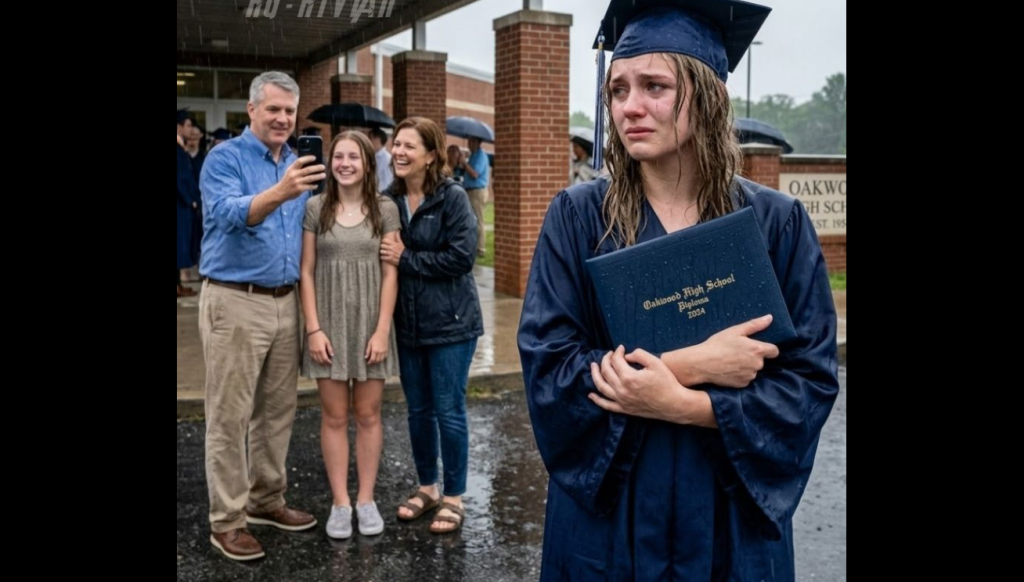
The night my parents threw me out, the sky opened up as if it had been waiting.
It was late June, and the kind of rain that soaks you straight through had started just as the graduation ceremony ended. My classmates were spilling out of the auditorium with their families, all flowers and photos and noisy plans for the future. My cap was crooked, my gown clinging to my legs, and my diploma felt strangely light in my hand—too small a thing to carry the weight of everything I’d done to get it.
“Over here, Grace! Smile!”
I heard my mother’s voice before I saw her. She was standing under one of the few awnings, arm looped around my younger sister’s shoulders like a claim. My father was adjusting the angle of his phone, frowning in concentration, making sure the light hit Grace’s face just right.
No one even glanced at me.
I stood there, a few yards away in the rain, watching my own family pose together like an advertisement for some glossy brochure about success and stability. Grace grinned, her hair curled perfectly, her white honor cord draped like a blessing over her shoulders. She hadn’t earned honors. I had. But I was the one still standing in the parking lot, rain dripping from my eyelashes, clutching a rolled-up diploma with my name on it.
I told myself I didn’t care.
I walked toward them anyway, because that’s what you do. You move toward the people who are supposed to be your safe place, even when every instinct in you whispers that you are about to get hurt.
My father finally noticed me when I was close enough to smell the faint cologne he always wore to the clinic. He didn’t lower the phone. His eyes skimmed over my soaked hair, my wrinkled gown, the way my shoes squelched when I stepped.
“You’re late,” he said.
“I was on stage,” I replied. “I got the academic award, remember? They called my name.”
My mother made a small, distracted sound, the kind she used when a patient told a long story she had no interest in. “We saw from a distance, dear,” she said. “We were saving our seats for Grace. You know how crowded it gets.”
I swallowed. Grace looked between us, her smile faltering for a second before she pasted it back on. She was good at that—reading a room, adjusting herself to match whatever expression would keep her in everyone’s good graces.
“Take one with all of us,” I suggested, forcing brightness into my voice. My fingers were trembling, but I tried to sound casual. “You’ll want one with both your daughters on graduation night.”
My father hesitated just long enough for the answer to be clear.
“Another time,” he said. “We have to get going. Early clinic hours tomorrow, and your sister has to be rested. College visits in the morning.”
There it was. The familiar sting. Grace’s future, always neatly laid out and lovingly paved. Mine, somehow always pushed aside, postponed, dismissed.
I glanced at my sister. “You got into a school already?”
“Dad will explain at home,” she said quickly, eyes darting toward him. There was a flicker of guilt there—small, quick, gone as soon as it appeared. “We should go. The roads are slick.”
They started toward the car without waiting for me. I stood there for a moment longer, rain tapping against my face, the diploma getting damp in my hands.
You tell yourself it doesn’t matter, I thought. You tell yourself this is just how it is. Responsible child, invisible child. Favorite child, fragile child. You, always the one who can handle being overlooked.
I followed them home anyway.
Our house was exactly as I remembered it from childhood: orderly, controlled, everything in its place. The framed degrees on the wall leading up the stairs. The family photos on the console table, almost all of them featuring Grace front and center while I hovered somewhere near an edge, half-cropped, half-shadowed.
I used to joke to myself that if a stranger looked through our albums, they would think my parents had one very cherished daughter and some random girl who kept photobombing.
By the time I’d changed out of my wet clothes and come downstairs, the air in the kitchen was different—thick, expectant. My parents sat at the table, their faces set in matching expressions of clinical detachment, like two doctors about to deliver bad news.
Grace sat too, but slightly apart, twisting a napkin between her fingers.
“Sit down, Adeline,” my father said.
He only used my full name when I was in trouble, or when he wanted to make a point.
My stomach knotted. I pulled out a chair, the scrape of wood on tile louder than it should have been.
“We need to talk about your plans,” he began.
“I already told you my plans,” I said, trying to keep my voice even. “I got into four universities. I picked the one with the best program and the biggest scholarship. You saw the letter.”
He nodded once. “We did. And we’ve thought about it. Long and hard.”
My mother folded her hands. Her wedding ring glittered under the kitchen light. I’d once watched that hand comfort patients, pat the shoulders of neighbors, wave graciously at church. I’d also watched it skim right past me to smooth Grace’s hair, to adjust Grace’s necklace, to tug Grace gently into the circle of their attention.
“Your father and I have decided,” she said carefully, “that it’s not in the best interests of the family for you to go away right now.”
I stared. “Not in the best interests of the family,” I repeated. “Or not in the best interests of the clinic?”
My father’s jaw tightened. “Don’t take that tone.”
“You need me to stay,” I said, the realization settling in cold and heavy. “To keep doing what I’ve already been doing. Working the front desk, handling records, making sure billing doesn’t fall apart. All the things I’ve been doing for free since I was sixteen.”
“You’re exaggerating,” he snapped.
“I’m not,” I said. “You know I’m not. And now that I’ve actually earned something for myself, you want me to give it up?”
Grace shifted in her seat. “It’s only for a little while,” she said, voice tentative. “Dad said maybe after a year—”
“A year,” I echoed. “You know how scholarships work, right? They’re not coupons I can clip and use whenever it’s convenient. They expire.”
My mother’s voice hardened. “Your sister will be starting her own program soon. She’ll be the face of this family’s next generation. We need stability. We need someone we can rely on, and you’ve always been…”
She hesitated, searching for a word.
“Capable,” my father supplied. “Reliable. Less… fragile. You handle responsibility well. Grace is still learning.”
Something in me cracked at that.
“So because I’m the one who can manage being ignored,” I said slowly, “that means I’m the one who has to sacrifice everything?”
“This isn’t sacrifice,” my father said. “This is duty. This is loyalty. You owe this family for everything we’ve done for you. A roof over your head, food, opportunities—”
“Opportunities?” The word came out strangled. “What opportunities? You mean the unpaid labor? The nights I spent balancing the clinic’s accounts instead of studying? The weekends I watched Liam—” I cut myself off. That last part was still only a fragile daydream back then. A whisper of something I wanted someday: a child, a home that felt different from this.
“This conversation is over,” my father said sharply. “You will call the university tomorrow and decline the offer. You’ll enroll at the local community college in something useful. Administration, perhaps. Something that allows you to stay close to home and contribute.”
“No,” I said.
The word surprised even me. It was small, but it was steady.
My father’s eyes flashed. My mother sucked in a breath. Grace’s fingers tightened around the napkin until it tore.
“Excuse me?” he said quietly.
“I said no,” I repeated. I felt strangely calm. “I’ve already accepted. I’m going. The deposit’s paid. The scholarship is mine. You don’t have to approve of it. You don’t even have to support it. But you don’t get to take it away from me.”
My father rose from his chair. For a moment, I saw not the respected doctor, the community figure everyone admired, but the man who believed his word was law in our house.
“Adeline Hart,” he said, voice like ice, “as long as you live under my roof, you will abide by my decisions.”
“Then I won’t live under your roof,” I said.
The kitchen went dead silent.
I hadn’t planned to say it. I had no idea where I would go, or how I would get there, or what I would do when I arrived. All I had was a scholarship letter, a little tin box of savings, and a bone-deep certainty that if I let them do this—if I let them crush this chance the way they’d crushed so many smaller ones—I would never belong to myself again.
My mother’s face pinched, as if I’d tossed a curse instead of a sentence. “Listen to yourself,” she said. “So dramatic. You’re barely eighteen. You have no idea how the world works.”
“Maybe not,” I said. “But I’m about to learn.”
Grace stood up suddenly. “Everyone calm down,” she pleaded. “We can figure this out. Addie, don’t say things you’ll regret. Dad, just—”
“Stay out of this,” my father snapped.
She quieted instantly.
There it was again. The hierarchy. His word, her echo, Grace’s compliance. And me, always the variable. The problem to be solved.
He pointed toward the stairs. “Pack your things,” he said. “If you think you’re too good for this family, you’re free to go see how far that scholarship gets you on your own. But don’t expect us to catch you when you fall. You won’t be coming back.”
My throat closed. For a moment, I thought I might beg anyway. That I might drop to my knees and apologize for wanting more, for daring to imagine a life that wasn’t tethered to the front desk of our clinic.
Then I saw Grace’s face.
She looked devastated, yes. But there was something else too—a flicker of something complicated and ugly. Fear, maybe. Or jealousy. Or the dawning realization that if I stayed, I would always cast a shadow she couldn’t outrun.
I turned away without another word.
Upstairs, I moved like someone underwater. I took only what I could carry: clothes, my laptop, the scholarship paperwork sealed in a folder I tucked deep into my backpack. The little tin box of savings I’d kept under the bed. A framed photo of me holding a science fair trophy in middle school, the last time anyone in the family had seemed even briefly impressed by me.
I left the rest. The childhood books. The participation trophies. The stuffed bear Grace had given me on my tenth birthday, which had “Best Sister” embroidered on its stomach like a joke.
When I came back downstairs, my suitcase in one hand and my backpack slung over one shoulder, my parents were waiting in the foyer. My mother’s lips were thin. My father’s arms were crossed. Grace hovered on the staircase, tears standing in her eyes.
“You’re making a mistake,” my mother said tiredly.
“I’d rather make my own mistakes than live with yours,” I replied.
My father opened the front door. Rain roared outside, and a gust of damp air blew in, chilling my bare arms. He didn’t offer an umbrella. He didn’t ask if I had somewhere to go.
“You leave tonight,” he said. “You don’t call us for help. You don’t drag this family’s name through the mud. And when you fail—and you will—you don’t come knocking on this door.”
I stepped past him.
There are moments in your life when you can feel a version of yourself splintering off, staying behind. In that doorway, I felt the girl I had been—the dutiful, quiet daughter who had kept accounts and secrets and schedules—peel away from me and remain in that house like a ghost.
“I won’t knock,” I said.
The door shut behind me with a finality that felt almost like physical impact.
Survive first, I told myself. Rise later.
The first few years were messy.
Survival is not glamorous. No one writes glossy pamphlets about sleeping on friends’ couches while you wait for your first scholarship check to clear. Or about choosing between textbooks and groceries. Or about studying in the break room of a grocery store because that’s the only place with both Wi-Fi and a functioning coffee machine.
I took every shift I could find—stocking shelves, cleaning exam rooms at a small clinic across town, answering phones at a call center. I learned how to stretch fifty dollars across two weeks. I learned which professors would let you sit in the back with a packed sandwich and which would glare until you closed your notebook and left.
And slowly, I built something.
I found tiny corners of the world where I was seen. A professor who noticed when I disappeared for a week and gently asked if I was okay. A classmate who shared her notes without making me feel indebted. The elderly woman in the corner apartment who learned my name and started leaving a second plate on her doorstep “in case you walked by and happened to be hungry.”
I never called home.
Sometimes, when the semester got especially rough, I would find myself scrolling to the “H” section of my contacts and staring at the word “Home.” My thumb would hover over it, the way it might hover over a bruise, drawn to the hurt. Then I would lock the phone and go back to whatever shift was paying for my next exam registration.
I heard about them indirectly. A mention in a local news blurb about my father’s clinic expanding. A mutual acquaintance who said, “Ah, the Harts. I know your family—they’re so proud of their daughter.”
They meant Grace, of course.
I pictured their house as I had left it: warm light glowing from the windows, my mother’s car in the driveway, my father’s briefcase on the hall table. I imagined Grace sitting at the kitchen counter, brochures spread out in front of her, my parents leaning in close.
I imagined them telling anyone who asked that they had one daughter; the other, the older one, had become “difficult,” “unstable,” “ungrateful.” It was easier, I realized, to erase me than to admit what they’d done.
The anger used to eat at me. Some nights, I lay awake in the narrow bed I rented in a shared apartment, replaying the graduation night conversation again and again, rewriting it in my head. In those alternate versions, I shouted more. I called them out more sharply. I exposed every hypocrisy, every double standard. I didn’t just leave; I slammed the door so hard it cracked the glass.
In reality, I had simply stepped into the rain and gone on.
It was while I was working the night desk at a hospital that I met Evan.
By then, I had moved cities, transferred schools, and narrowed my ambitions into something sharp and specific. I would work in healthcare administration, I’d decided. Not as a doctor like my father, but as the person who kept the place running. The one who understood the systems and the math and the regulations.
Maybe, I thought, I could build the kind of practice I’d always wished our family clinic had been: ethical, fair, open.
My shift started at eight in the evening. The hospital lobby looked different at night—quieter, softer, the overhead lights dimmed, the hum of daytime chaos replaced by something steadier. Nurses floated through in comfortable shoes. Residents moved in tight clusters, whispering through case details. Visitors came and went with tired faces and crumpled coffee cups.
I sat at the front, answering questions, directing people, and, during the rare slow stretches, studying. My textbooks lived in a neat stack beneath the desk. Highlighters, sticky notes, and scribbled flashcards surrounded the keyboard like bright little shields against exhaustion.
The first time I noticed Evan, he was arguing with the vending machine.
He stood there in wrinkled scrubs, hair slightly disheveled, stethoscope looped around his neck like he’d forgotten it was there. He had one hand on the machine, the other shoved through his hair, and he was muttering something under his breath that sounded a lot like bargaining.
I watched him shake the machine gently. Then not-so-gently.
“Careful,” I called. “She eats residents who kick her.”
He turned, startled, then laughed—a quick, warm sound that surprised me by how much it warmed something in my chest too.
“She?” he asked, coming over to the desk. “You gave the vending machine a gender?”
“She’s temperamental,” I said. “Has favorites. Spits out chips with no problem, but try to get the last chocolate bar and she’ll test your character.”
“Ah,” he said. “That explains it. I’m clearly failing.”
“Try button C7 twice, then give the left side a tap. She respects a gentle but firm approach.”
He followed my instructions. The machine whirred, clunked, and then, miraculously, dropped the chocolate bar into the tray.
He turned back to me, eyes wide. “That was either sorcery or years of intimate observation.”
“Little of both,” I said. “Night shifts are long.”
He smiled. There were faint shadows under his eyes, the kind that suggested too many consecutive days of not enough sleep, but his gaze was attentive, present.
“I’m Evan,” he said, extending a hand.
“Adeline,” I responded, shaking it. His grip was warm, his palm calloused slightly from constant handwashing and glove-snapping.
After that, he always stopped by my desk when he passed through the lobby.
Sometimes, it was just a quick wave. Sometimes, it was a five-minute conversation about whatever bizarre case he’d just seen in the ER. Sometimes, he’d drop off a coffee without comment, as if he’d simply had one too many and didn’t want it to go to waste.
He never pried. He never said things like, “So, tell me about your family,” or “Why are you always here?” Instead, he asked things like, “What are you studying tonight?” or “If you could change one thing about hospital bureaucracy, what would it be?”
(It turned out I had many opinions on that last one.)
He noticed when I looked especially tired and would tell me a ridiculous joke to make me roll my eyes and forget, for a moment, how many hours I had left in my shift.
One night, months after we’d first met, he perched on the corner of the desk while the lobby sat empty.
“Can I ask you something personal?” he said.
“That depends,” I replied. “Do I get to veto?”
“Absolutely.”
“Then go ahead.”
He studied me thoughtfully. “I’ve seen you here almost every night for months. You’re always working, always studying. I’ve watched you argue with insurance reps and calm down panicked families and help lost interns find the right wing.”
“So you’re saying I’m indispensable,” I said lightly.
“I’m saying,” he replied, “that most people in your position would’ve burned out by now. But you just… keep going. What are you aiming for, exactly?”
The question landed in that quiet place inside me where the promise I’d made at eighteen still lived.
“Freedom,” I said before I could stop myself.
He didn’t laugh. He didn’t call it dramatic. He just nodded, slowly.
“Seems like a worthy specialization,” he said.
Later, much later, when we were sharing a tiny apartment and arguing over who got the last slice of pizza, I would tell him why that word was the one that came out. I would tell him about the graduation night, the rain, the hissing sound of my father’s voice when he’d told me I’d never make it without him.
But for a long time, I didn’t tell him any of that. Not because I didn’t trust him, but because the past felt like a locked door. Every time I reached for the handle, I remembered the way it had slammed behind me.
Some secrets, though, refuse to stay buried forever.
Liam arrived two years after Evan did.
He came into the world squalling and furious, fists balled up, cheeks an impossible shade of pink. When the nurse laid him on my chest, he went abruptly quiet, his eyes blinking up at me like he couldn’t quite believe we were finally in the same place.
“Hey,” I whispered. “It’s just us now.”
I hadn’t planned on being a mother so soon. Evan and I had talked about “someday” in vague terms, always tacked onto the end of conversations about promotions and exams and overtime. But life rarely waits until you feel ready. Sometimes, it shoves you gently—or not so gently—into the next chapter.
All the fear I’d carried about turning into my parents melted the first time Liam’s tiny fingers curled around mine.
I understood, suddenly, how easy it might be to love a child fiercely and still hurt them in ways you didn’t intend. How exhaustion and pressure and fear could twist into control. How a parent might justify anything by telling themselves it was “for your own good.”
I also understood, with crystal clarity, that I would rather break my own bones than weaponize my love the way mine had.
So I built our little life with intention.
We didn’t have much money, but we had stability. We had schedules and routines. We had a tiny balcony where Evan and Liam would sit on Saturday mornings, building wobbly model rockets out of cardboard and tape while I drank coffee and pretended to read but really just watched them.
We had laughter. So much of it. The kind that bubbled up from nowhere when Liam mispronounced a word or when Evan tried to dance and failed spectacularly.
We had absence, too. A gap shaped like the family I’d once had.
Every milestone—a birthday, a promotion, the day I signed the lease on our first real house with an actual yard—came with a phantom ache. A quiet thought: My parents will never know. My sister will never see this.
Sometimes I wondered if they would even care.
Then the wedding invitation arrived.
It was a thick envelope, cream-colored, with my name written in looping script that didn’t match my mother’s precise hand. It showed up in our mailbox on an ordinary Tuesday, tucked between a utility bill and a coupon circular.
I almost threw it away.
If it had been from my parents, I might have. But when I flipped it over, I saw the sender listed in neat print in the corner.
Grace Elaine Hart & Daniel James
I stared at the names for a long time.
“Everything okay?” Evan called from the kitchen.
I slid a finger under the seal and opened the envelope.
The card inside was elegant: gold-embossed lettering, a watercolor border of soft florals, my sister’s name intertwined with a man’s I didn’t know. A date, a venue, a request for the honour of my presence, written as if the last eleven years had been nothing more than a brief gap in communication.
I read the words twice. Three times. My vision blurred.
“Adeline?” Evan appeared in the doorway, wiping his hands on a dish towel. “You look like you’ve seen a ghost.”
“In a way,” I said. I handed him the invitation.
He scanned it, eyebrows rising. “Your sister,” he murmured. “She… invited you?”
“That’s what it says.”
He hesitated. “Do you—want to go?”
The question wrapped itself around my ribs. My first instinct was to say no. To drop the invitation in the trash and pretend it had never arrived. To protect the life I’d built from any contamination by the people who had once told me I was nothing.
But the envelope had felt heavy in my hand when I opened it. Weighted with something I couldn’t quite name.
Sometimes, your past calls you not because it wants you back, but because there is something there that still belongs to you.
“Yes,” I heard myself say. “I think I do.”
Evan studied my face carefully. “Are you sure? You don’t owe them anything.”
“I know,” I said. “That’s not why I want to go.”
“Then why?”
I thought about the years I’d spent avoiding anything that carried the Hart name. The way I’d crossed to the opposite side of the street rather than walk past a clinic with similar signage. The way I’d changed the subject every time someone at the hospital mentioned my father’s practice or my sister’s supposed brilliance.
“I’m tired of running,” I said finally. “If I don’t walk into that room now, it will haunt me forever. I need to see them. Not because I miss them, but because I need to know that I can stand in the same space and not fall apart.”
Evan stepped closer and cupped my face in his hands. His thumbs brushed my cheeks, and for a moment, I let myself lean into him.
“Then we’ll go,” he said. “Together.”
“And Liam?” I asked. “It might be… a lot.”
He smiled faintly. “He’s tougher than he looks. Besides, if things get weird, we can always escape under the pretense of needing to get him home for bed.”
I laughed, a small, shaky sound. “Strategic parenting.”
“The best kind.”
Later that night, after Liam had fallen asleep with a toy spaceship clutched in one hand, I lay awake, the invitation on the bedside table like a pulse.
For the first time in years, I let myself think about my sister properly.
Grace had been born when I was three. My earliest memory of her was the way my mother’s face had softened when she held the baby, how gentle her voice had become. I remember tugging at my father’s sleeve, asking if I could hold her too, and the way he’d hesitated before saying, “Maybe when you’re older.”
I had watched from the doorway more times than I could count as my parents leaned over Grace’s homework, fingers tracing the answers, voices filled with encouragement. I remembered standing at the fringe of piano recitals, clutching my own report cards filled with A after A, while my mother fussed with the bow in Grace’s hair.
Grace, with her wide eyes and soft voice and impeccable timing. She had learned early that helplessness was a kind of currency. That a tilt of the head and a tremor in the voice could summon help in ways that hard work alone never had for me.
We weren’t close, not really. We orbited each other, siblings bound by circumstance rather than choice. There were moments, though. Secret, small moments that glowed in my memory like fireflies.
The night she had crawled into my bed during a thunderstorm, whispering that the thunder sounded like our parents fighting, and I had pretended not to notice the tears on her cheeks. The morning I’d helped her fix a science project her friend had “accidentally” broken. The time I’d snuck her a piece of cake after Dad had declared she needed to “watch her sugar.”
We had loved each other in the strange, uneven way siblings sometimes do—through quiet gestures and shared glances, through a thousand unsaid acknowledgments of the roles we’d been assigned.
And now, eleven years after the night our parents had chosen her and the clinic over me, she was sending me a card asking me to come watch her vow herself to someone else.
I wondered what she’d told him about me.
I wondered what she’d told herself.
The hotel ballroom on the day of the wedding looked like a scene from a magazine.
Crystal chandeliers sparkled overhead, throwing warm light over marble floors. Round tables were draped in linen and set with shining silverware and graceful centerpieces of white and blush roses. Waiters glided between guests in crisp uniforms, carrying trays of champagne.
I stood at the entrance for a moment, the noise folding over me in waves. Laughter, clinking glasses, the murmur of conversation. The faint notes of a string quartet.
“You okay?” Evan’s voice came from just behind me, low and steady. His hand rested lightly at the small of my back. On my other side, Liam clung to my fingers, eyes huge as he took in the towering cake across the room.
“Mom,” he whispered, “do we know anyone here?”
“Only ghosts,” I thought.
Out loud, I said, “A few.”
We stepped inside.
The change in the room was subtle at first. Conversations didn’t stop, but they shifted, like curtains stirring in a draft. Eyes turned toward us. People glanced down at the place cards near the entrance, then back up at me. I saw the flicker of recognition in some faces—colleagues who’d seen my name in professional contexts, never expecting it to appear here, attached to this family, this event.
Adeline Hart.
The name sat on the card like a small, sharp revelation.
I straightened my shoulders. I had chosen my dress carefully: simple, elegant, a deep shade that made me feel grounded. My hair was swept back. My hands shook only minimally.
“Dr. Hart?” a man near the entrance said slowly, reading the card and then looking up at me. His reaction was the one I recognized from conferences and meetings—surprise, respect, curiosity. I was used to it in boardrooms, in hospital corridors.
I had never expected to see it at my sister’s wedding.
And then I saw Grace.
She stood near the far end of the room, talking to a cluster of guests. Her white gown glimmered under the lights, a delicate lace overlay catching each shift and turn. Her hair was arranged in soft waves, a veil pinned in place with tiny jeweled combs. She looked every inch the golden girl I remembered: polished, radiant, perfectly composed.
Until her gaze landed on me.
The expression on her face changed in an instant—from polite interest to shock to something more complicated. Surprise, yes. But also calculation. Panic threaded through it, tightening her jaw, flattening her smile.
“Adeline,” she breathed when she reached me, as if my name were a spell that might summon something she couldn’t control.
Behind her, my parents appeared.
Rowan Hart, MD, looked older, but not by much. His hair was grayer at the temples, his posture still ramrod straight. The aura of authority he’d always carried into exam rooms and staff meetings hung around him like a second suit.
Elaine looked almost exactly the same—elegant, controlled, a string of pearls at her throat. She wore an expression I recognized from years of watching her handle difficult patients: pleasant, but taut with restraint.
Elaine’s hand flew to her necklace when she saw me, fingers pressing against the pearls as if they might offer protection.
“Why are you here?” she whispered.
I lifted the invitation. “I was invited.”
For a beat, no one spoke.
A man stepped forward then, standing slightly behind Grace. He was tall, broad-shouldered, his suit perfectly tailored. His posture had that unmistakable mix of confidence and weariness that I’d seen on so many physicians. His eyes were sharp, assessing, taking in details quickly.
Daniel, I realized. The groom.
He looked at me, then at Grace, then at my parents, all of whom suddenly seemed to have forgotten how to breathe.
“You two know each other?” he asked.
I smiled. Not the brittle, defensive smile I’d worn so often as a teenager. A different one. Cooler. Controlled.
“Too well,” I said.
The words slid out easily, a simple truth wrapped in layers no one here yet understood.
Around us, the atmosphere shifted again. Guests who had been politely uninterested now leaned closer, their attention sharpening. The string quartet played on, but the notes felt distant, a soundtrack from another scene.
Grace’s fingers curled in the fabric of her gown. “We just haven’t seen each other in ages,” she said with a laugh that wobbled dangerously. “You know how life is. We lost touch.”
“Lost touch,” I repeated in my head. That was one way to describe being shoved into the rain at eighteen and told never to come back.
My mother stepped in quickly, voice brittle. “Grace doesn’t like talking about the past,” she said to Daniel. “Today is a happy day. Let’s focus on that, shall we?”
But Daniel wasn’t looking at her anymore. His gaze was still on me, thoughtful.
“Your last name is Hart,” he said. “So is hers. But she never mentioned…” He trailed off.
“She doesn’t like talking about the past,” my mother repeated, more sharply.
Daniel turned back to his bride. “Why didn’t you tell me you had an older sister?” he asked.
Grace’s mouth opened, closed, opened again. “It just… never came up,” she said weakly.
The lie hovered in the air between them like a faint but unmistakable stench.
Evan shifted subtly closer to me. I felt his presence at my side like a steadying anchor. Liam tugged at my hand, oblivious to the tension, his eyes still darting toward the cake.
I picked up a glass of champagne from a passing tray. The stem was cold against my fingers. I didn’t raise it to my lips. I just held it, grounding myself in the simple physical sensation.
“Adeline,” my father said in a low voice meant only for me. “I don’t know what you’re trying to do, but this isn’t the place.”
That old instinct flared in my chest—the one that used to make me fold inward, apologize, retreat. The one that had whispered, He’s right, you are too much, too demanding, too ungrateful.
I looked him in the eye.
“I’m not trying to do anything,” I said calmly. “I’m attending a wedding. That I was invited to.”
His face flushed. For a second, I saw the fury I remembered from that kitchen years ago. Then he noticed Daniel watching him and forced his features into a tight, artificial smile.
“Let’s all take a breath,” Daniel said carefully. “I’m just surprised, that’s all. Grace told me she ran the family clinic alone for years. That her parents depended on her. That she was the only one who stayed.”
My eyebrows twitched upward.
“Is that what she said?” I asked lightly.
A hush rippled through the nearby guests. Grace’s complexion went several shades paler.
“I need a moment,” she murmured. “Excuse me.”
She moved away too quickly for a bride, her heels clicking sharply against the marble. A few seconds later, my mother followed her, her expression pulled tight. My father stayed rooted to the spot, staring at me as if I were an unsolved equation that had just started rewriting itself.
Evan leaned in. “She’s falling apart,” he murmured.
“No,” I said softly. “She’s being revealed.”
I found Grace in the restroom hallway, braced against a marble counter.
In the harsh light, the carefully applied makeup did little to hide her panic. Her eyes were wide, her breathing too fast, her shoulders trembling under the weight of the gown.
She saw my reflection in the mirror before she turned.
“You had no right to come here,” she said, her voice frayed.
“I had every right,” I replied. “Your husband invited me.”
“Daniel doesn’t know everything,” she said quickly. “You don’t understand.”
“I’m starting to,” I said. “More than you think.”
She spun to face me fully. “You can’t do this,” she whispered. “Not today. You can’t stand out there and… and ruin everything I’ve built.”
I laughed, a small, disbelieving sound. “I haven’t said a word, Grace. I walked in the door. The rest is your story catching up with you.”
“You don’t know what it’s been like,” she snapped. The anger looked unnatural on her, sitting atop her features like borrowed clothes. “Mom and Dad… they depend on me. The clinic, the reputation, everything. I had to step up when you left.”
“When I left,” I repeated slowly. “Is that what you told people? That I left?”
“What was I supposed to say?” she demanded. “That my parents kicked you out? That they chose me? That they decided you were… wrong somehow?”
The sound that escaped me was raw. “You could have told the truth.”
She flinched. “They made it sound like you were unstable,” she said quietly. “That you’d lost your mind. That you’d thrown away your future. I didn’t know what to believe. I was still a kid.”
“You’re not a kid anymore,” I said. “And you’ve had eleven years to correct the record. Did you?”
Her silence was the only answer I needed.
“I couldn’t,” she said finally. “By the time I realized, it was too late. Everyone already thought—”
“Thought what?” I pressed. “That I’d dropped out? That I’d run off? That I’d abandoned you all?”
Her throat worked. “I didn’t want to lose what they were finally giving me,” she admitted.
There it was. The truth, small and ugly and entirely human.
“I worked for that clinic as much as you did,” I said quietly. “More, maybe. I had a scholarship. A way out. They took it from me. And when I refused to let them, they pushed me out instead. You watched.”
“I was scared,” she said.
“So was I.”
We stood in the hallway, the muffled sounds of the reception bleeding in from beyond the door—laughter, music, the clink of glassware. Two sisters in a quiet pocket of space, separated by eleven years of silence and a lifetime of unequal love.
“I’m not here for revenge,” I said finally. “I’m not here to expose you. I came because you sent me an invitation. I came because I wanted to see if I could walk back into a room full of ghosts and still breathe.”
“Then leave,” she pleaded. “You’ve proved your point. You showed up. Fine. You can tell yourself you’re stronger now. Just… please go before everything falls apart.”
I shook my head. “It’s too late for that, Grace. Things were already cracked before I got here. I didn’t cause this. Your lies did.”
Her hand shot out and gripped my arm. “He can’t find out,” she whispered. “If Daniel knows I lied about… about school, about the clinic, he’ll—”
“What?” I asked softly. “He’ll see you. Really see you, maybe, for the first time. Is that what you’re afraid of?”
“You think you’re so much better than me,” she hissed. “Because you did it alone. Because you walked away.”
“No,” I said. “I think I made the only choice I could survive. And now you’re realizing that the choices you made to survive might cost you the life you want.”
We stared at each other, years of resentment and fear and grief hanging between us.
“I’m not going to stand up and make a speech,” I said. “I’m not going to grab a microphone and announce your secrets. I don’t need to. The truth has a way of seeping out on its own. It’s already started. You feel it.”
She released my arm slowly, as if her fingers had turned numb.
“I hate you,” she whispered.
I believed her. In that moment, she did.
I also believed that hate was just another mask she’d been taught to wear when the world threatened to slip out of her control.
“You don’t,” I said. “You hate what I remind you of.”
I left her in the hallway, trembling in a gown that suddenly looked more like armor than celebration, and walked back into the ballroom.
When I returned to our table, the mood in the room had shifted again. Conversations were quieter, glances more frequent. My parents stood near the head table, speaking in urgent hushed tones to Daniel. He looked troubled, his jaw tight, his eyes flicking occasionally in my direction.
Evan handed me a glass of water. “How bad?” he asked softly.
“Cracks,” I said. “Everywhere. She’s terrified Daniel will see them.”
“He may already,” Evan observed.
As if on cue, a doctor I recognized from a regional hospital approached Daniel with a hearty greeting. They exchanged a few words about mutual colleagues, about the healthcare landscape in the city. Then the doctor turned to Grace with a friendly smile.
“And you,” he said. “You’ve been working at your family’s clinic for how many years now?”
Grace straightened, her public persona snapping back into place. “Ever since college,” she said brightly. “I’ve been managing everything. Administration, operations, outreach. It’s been my responsibility since I completed my program.”
“Ah, yes,” the doctor said. “Daniel mentioned you studied at—?”
Grace opened her mouth. “I completed a specialized track at—”
“Stanford,” she finished.
The name slid off her tongue with practiced ease.
The doctor’s smile thinned almost imperceptibly. “Really?” he said. “I collaborated with faculty there for five years. I’m surprised we never crossed paths. What department was your program in?”
Grace blinked. Just once. It was quick, but I saw it.
“My… program was more of an intensive,” she said. “Not exactly traditional.”
“Who supervised your track?” he pressed. “Perhaps I know them.”
Around us, the nearby guests had gone very quiet.
My father cleared his throat. “This isn’t the time for grilling, Mark,” he said. “We’re celebrating a wedding, not conducting an interview.”
“I’m just making conversation,” the doctor said mildly.
Daniel turned to his bride slowly. “Grace,” he said, voice soft but distinct. “What professors oversaw your program?”
She opened her mouth, closed it. For the first time, I saw true panic crack the surface of her composure.
“It was a long time ago,” she said. “I don’t remember all the names.”
“Most people remember the names of the mentors who shaped their careers,” Daniel said.
Her eyes filled with tears. “Why are you doing this?” she whispered.
“I’m trying to understand,” he replied. “Because the records from your family’s clinic don’t match what you’ve told me either.”
My father stiffened. “What records?” he demanded.
Daniel didn’t take his eyes off Grace. “When we talked about merging resources, I did some due diligence,” he said. “I reviewed the clinic’s public filings. I saw staff lists, credentialing records, billing logs. Your name appears as a receptionist. Occasionally as support staff. Never as a manager. Never as someone handling operations at the level you described.”
My mother’s hand flew to her pearls again. “This is inappropriate,” she said. “We can talk about all this later.”
“We will,” Daniel said evenly. “But we will talk about it.”
He finally turned to me.
“And you,” he said, tone gentler but no less focused. “Your name appears on older documents. Early administrative systems. Training logs. Billing correspondence from more than a decade ago. Why would that be, if you left and cut the family off?”
I held his gaze.
“Because I helped run the clinic when I was a teenager,” I said. “Because I was the one who stayed late to balance the books. Because I was the one who learned the billing software when we upgraded. Because free labor is cheaper than a professional administrator.”
Grace made a small, strangled sound.
“You’re lying,” my father snapped. “You’re twisting things to make yourself look good.”
“You’re the one who told me Adeline abandoned the practice,” Daniel said quietly. “You said she couldn’t handle responsibility. That she ran away from her obligations.”
My parents’ carefully curated narrative dangled in the air, exposed.
“Is that what they told you?” I asked.
He nodded once.
I looked around the room. I saw doctors I’d met in passing at conferences, nurses who’d changed departments over the years, neighbors who’d once watched us playing in the yard. Faces from my past and present all gathered under one roof, all listening.
“I didn’t run,” I said softly. “I was pushed.”
Somewhere behind me, a glass clinked nervously against a plate. No one made a toast.
My father stepped toward me, his face mottled. “You ungrateful—”
“Is it true?” Daniel interrupted, his voice unexpectedly sharp. “Did you throw her out?”
Rowan faltered. “She refused to prioritize the family,” he said. “She chose herself. She made reckless decisions. We had to… draw a line.”
“That’s not an answer,” Daniel said.
He looked at me again. “How much of what they’ve told me about you is false?” he asked. “Be honest.”
“Most of it,” I said. I didn’t elaborate. I didn’t list the nights I’d worked until midnight or the mornings I’d gone to school on three hours of sleep. I didn’t describe the scholarship they’d tried to rip away or the words they’d hurled at me in that kitchen.
I didn’t need to. The truth had already begun to seep into the room through the cracks in their version of events.
My parents were so focused on me, on Daniel, on the increasingly tense circle of guests, that they didn’t notice the new figure who had entered the ballroom.
I did.
He was dressed in an unassuming suit, a man whose job required him to blend rather than stand out. He stood near the entrance for a moment, scanning the room. When his gaze landed on my father, he began to move toward us.
Recognition hit my father a split second later. His face went pale.
“You shouldn’t be here,” Rowan hissed when the man reached us. “This is a private event.”
“I’m not here to cause a scene,” the man said calmly. “I was asked to deliver these personally and promptly.” He held out a thick envelope.
My father didn’t reach for it.
“I can come back another day,” the man said. “But it’s in your best interests to review them as soon as possible. The audit is moving forward.”
The word audit slithered through the air like a sudden icy draft.
“What audit?” my mother whispered.
The man glanced at me, then back at my father. “Billing irregularities,” he said. “We’ve discussed this in our correspondence.”
Correspondence. Emails. Phone calls. Letters.
I had made exactly one phone call months earlier, when a pattern of numbers in a public database I’d been browsing for work had looked too familiar. I hadn’t accused anyone. I hadn’t marched into an office and announced wrongdoing. I had simply pointed out discrepancies and stepped back.
I hadn’t thought it would come to this. Not here. Not now.
But justice, I’d learned, rarely checks the calendar before showing up.
“I’m just here to deliver documents,” the investigator said. “The rest is up to you.”
He held out the envelope again.
Silence.
I reached for it.
I didn’t keep it. I didn’t tear it open. I simply held it for a moment, feeling the weight of it. All the numbers, all the codes, all the tiny ethical lines crossed for just a bit more income.
Then I turned and offered it to my father.
“You should open this,” I said.
My hand was steady. His was not.
“Adeline,” my mother hissed. “What have you done?”
“I told the truth,” I said. “Once. To the right person. The consequences aren’t mine.”
My father took the envelope with trembling fingers.
“Is this what you wanted?” Grace whispered, her voice ragged. “To destroy us? To humiliate us? You couldn’t just stay gone?”
“I wanted a life that wasn’t built on lies,” I said quietly. “I wanted to stop carrying secrets that were never mine to hold.”
Daniel looked at me with a mixture of remorse and something like admiration. “I’m sorry,” he said. “For believing them. For not questioning more.”
“You had no reason to,” I replied. “They’re very good at sounding convincing.”
He nodded once.
Then he stepped back from Grace—not far, just enough to make space between them. Enough that the guests could see. Enough that she could feel it.
“You lied to me,” he said to her, his voice low. “About your education. About the clinic. About her.”
Tears were streaming down her cheeks now, tracking through her foundation.
“I didn’t want to lose you,” she whispered.
“You lost me when you decided I wasn’t worth the truth,” he said.
Her shoulders sagged. The gown that had fit her so perfectly just hours earlier now seemed heavy, restrictive.
Around us, the reception continued in a strange, suspended way. Some guests pretended to carry on conversations, words low and distracted. Others watched openly. No one reached for the champagne.
Liam tugged at my dress again.
“Mom,” he whispered. “Are you mad at that lady?”
I knelt, bringing us nose to nose.
“I’m not mad,” I said. “I’m sad.”
“Because she lied?” he asked.
“Yes,” I said. “Because when you lie, you hurt people. Sometimes even yourself.”
He nodded solemnly, as if filing this away in some important internal ledger.
“People shouldn’t lie,” he said, echoing my own thoughts from years of confusion.
I smoothed his hair. “Exactly.”
The investigator slipped away quietly. My parents stood rooted in place, clutching the envelope like it was both lifeline and noose. Grace had sunk into a chair, her gown pooling around her like a fallen curtain, her hands limp in her lap.
I didn’t feel triumphant. There was no rush of vindication, no satisfaction in finally seeing them squirm.
What I felt was… released.
The story they’d constructed about me had unraveled in public. Not because I’d shouted them down, but because time and truth had worn away the weak seams.
I had become myself in their absence. Now, standing in front of them, I realized I didn’t need their validation. I didn’t even need their understanding.
I just needed what they’d never been willing to give me: the freedom to walk away.
The wedding ended not with a bang, but with a slow dissolution.
Guests began to slip out in ones and twos, then in small clusters, murmuring to each other in low voices. The string quartet put their instruments away. Waiters cleared half-finished glasses, untouched slices of cake.
There was no bouquet toss. No exuberant dancing. No joyful farewell.
Evan drove us home in the quiet.
Liam fell asleep five minutes into the ride, his head lolling against the car seat, one sticky hand still clutching the party favor he’d been given.
I stared out the window at the passing city lights, the wedding invitation folded on my lap like a relic from a different reality.
“How do you feel?” Evan asked.
“Tired,” I said honestly. “And… light. Lighter than I expected.”
He nodded, one hand on the wheel, the other reaching over to cover mine. His thumb traced slow circles over my knuckles.
“I’m proud of you,” he said softly.
“For what?” I asked. “I didn’t actually do anything.”
He glanced at me. “You showed up,” he said. “You stood there and let the truth speak. You didn’t shrink. You didn’t apologize for existing. That’s not nothing.”
I watched the reflection of my face in the window. I barely recognized the girl who had once stood in a rain-soaked driveway with a suitcase and a breaking heart.
“I thought it would hurt more,” I admitted. “Seeing them. Hearing them talk about me like I was some… problem they’d solved.”
“It did hurt,” he said. “You just carried it differently this time.”
By the following week, the audit at the clinic had formally opened.
I didn’t push it forward. I didn’t call for updates. When the investigating agency reached out asking for clarification on some older records, I emailed the documents I still had copies of—training logs, early billing reports, notes I’d kept more out of habit than vindictiveness.
That was it. No crusade. No vengeful campaign.
The rest belonged to them.
I heard bits and pieces through professional channels.
The clinic had to suspend certain operations temporarily. Questions were raised about their billing practices, about upcoding and creative documentation. My father’s name, once spoken with automatic respect in local medical circles, now carried a question mark.
Grace’s carefully constructed reputation as the devoted daughter who had heroically run the clinic while her ungrateful older sister disappeared began to falter.
When Daniel requested a meeting, I agreed to coffee in a neutral, public place.
He arrived looking older than the last time I’d seen him, though it had only been a week. There were lines of fatigue around his eyes, his shoulders heavier with the knowledge he’d gained.
“I won’t take much of your time,” he said when we sat.
“You already are,” I replied lightly. “But go ahead. Allotted.”
He cracked a small, humorless smile. “I deserved that.”
He wrapped his hands around his coffee cup, as if absorbing its warmth.
“I owe you an apology,” he said.
I waited.
“I believed them,” he continued. “About you. About what happened. I let their version of you slot neatly into the narrative I wanted to believe about Grace—that she’d overcome so much, that she’d been abandoned and had stepped up. I didn’t question the gaps. I didn’t look too closely at the things that didn’t add up.”
He met my eyes.
“That’s on me,” he said. “And I’m sorry.”
I nodded slowly. “Thank you,” I said. “I accept the apology. But you should know—I don’t need it.”
He blinked. “You don’t?”
“I needed it years ago,” I said. “When I was a teenager desperate for someone—anyone—to see the truth. Now? I’ve built a life without their approval. Without their stories. Your apology doesn’t fix what they did. It doesn’t rewrite the past. But it does tell me something important about the kind of person you are.”
“And what’s that?” he asked.
“That once you see the truth, you don’t look away,” I said. “Grace could use someone like that in her life. Whether she actually lets you in… that’s up to her.”
His expression twisted. “I don’t know what’s going to happen between us,” he admitted. “There are so many layers of lies.”
“Then start with honest ones,” I suggested. “The kind where you look each other in the eye and admit exactly what you’ve done. Without excuses. Without blame.”
He nodded, staring into his coffee. “Do you hate her?” he asked.
“Yes,” I said. Then, “No. Sometimes. It depends on the day.”
“You have every reason to.”
“I have every reason to be angry,” I corrected. “Hate is… heavy. I carried enough of that around for free. I’m not interested in continuing to pay rent on it.”
He looked at me with something like awe. “You’re stronger than anyone gave you credit for.”
“They should have known,” I said. “They were the ones who tried so hard to break me.”
We parted with a handshake and a mutual understanding that our story, whatever it was, was now complete. We had entered each other’s lives at the point where the past erupted; we would exit again as the dust settled.
My parents never called.
Grace never wrote.
In the months that followed, I occasionally saw their names in small news items—updates on the clinic investigation, sanitized statements about “cooperating fully with authorities,” vague acknowledgments of “accounting discrepancies” and “regrettable oversights.”
I didn’t gloat. I didn’t send links to anyone. I didn’t even save the articles.
I simply read them, noted them, and moved on.
My own life filled up quietly.
At work, my responsibilities expanded. I was tasked with restructuring a department that had been hemorrhaging money and morale, and I dove into the challenge with the same focus I’d once poured into balancing my parents’ ledgers. Only this time, I was paid for it. Recognized for it. Promoted because of it.
At home, Evan and I painted the kitchen a brighter color. Liam started kindergarten, marching into his classroom with a backpack almost bigger than he was, turning back at the last second to blow me a kiss.
On the patio, Saturday mornings were still for model rockets and sticky fingers and the kind of small, ordinary joy I’d once thought belonged only to other people.
On some Sundays, when the weather was mild, I would sit in the garden with my laptop, reviewing proposals for a project I’d been dreaming about quietly for years.
A scholarship fund.
Not a massive one—we weren’t millionaires. But enough to matter. Enough to bridge the gap for students who, like me, had been told their dreams were too expensive, who’d been pressured to give up their chances in the name of “family duty.”
The application didn’t ask for grades, though we required basic academic standing. It asked for a story.
Tell us, I wrote on the form, about a time you were told you couldn’t or shouldn’t pursue something important to you. What did you do? What do you wish you’d been able to do?
I read every one.
The girl whose parents wanted her to stay and watch younger siblings instead of accepting an out-of-state engineering scholarship. The boy whose family needed him to work in the family restaurant rather than go to nursing school. The nonbinary student whose relatives had cut them off financially when they refused to follow the “proper path.”
The details varied. The ache underneath did not.
Sometimes, while reading, my vision blurred. Sometimes I had to get up and walk around the house, breathing deeply, listening to Liam’s chatter from another room, anchoring myself to the life I’d built rather than the one I’d lost.
When I signed the first round of scholarship letters, my hand shook a little.
“You’re changing lives,” Evan said, leaning against the doorframe, watching me.
“Maybe,” I said. “Or maybe I’m just giving them a nudge over a threshold they were going to cross anyway.”
“Either way,” he replied, “it’s good work.”
I smiled.
Justice, I’d learned, isn’t always dramatic. It doesn’t always arrive with handcuffs or headlines. Sometimes it comes in the form of a simple letter in the mail, telling a stranger, You don’t have to choose between your dreams and your survival. Not completely. Not this time.
It comes in the quiet certainty that you have stepped out of a story that was never written for you and into one you’re scripting yourself.
My parents remain, in my mind, characters in a chapter I’ve long since finished. I don’t forgive them, exactly. Forgiveness implies a closing of the book, a reconciliation that feels dishonest, considering they’ve never apologized.
But I don’t hate them either. Hate would keep them close. Hate would mean I still organized my life around their absence.
Instead, I let them be what they are: people I once loved, who made choices that hurt me, who chose fear and control over trust.
I think about Grace more often.
Sometimes I picture her in a small apartment, makeup scrubbed off, hair pulled back, staring at a mirror and trying to figure out who she is without the lies. Sometimes I imagine her still clinging to our parents, doubling down on their narrative, painting herself as the victim in a story that refuses to play along.
Sometimes I imagine her walking into a therapist’s office, sitting down, and finally telling the truth from the beginning.
I don’t know which is real.
What I do know is this: if she ever stands in a doorway, soaked and shaking, with a suitcase in her hand and nowhere to go, I will think very carefully about what I do next.
Because I have a child now, a life, boundaries that matter. I won’t set myself on fire to keep someone warm who once watched me shiver. But I also know too well what it feels like to hear a door slam behind you.
Some cycles, we break not with grand gestures, but with small, intentional choices.
Would I let her in? Would I close the door and let the past remain sealed?
I don’t know. And I don’t have to decide yet.
For now, it’s enough that I can walk past a clinic with my last name on it and feel nothing but distant curiosity. It’s enough that I can look at my son and know that his memories of childhood will be filled with messy, imperfect love, not conditional approval.
It’s enough that when he stands on a threshold someday—graduation, a new job, a decision that scares him a little—I will stand behind him, not in front of him, letting him walk into his own life without trying to reroute it toward my fears.
The night my parents kicked me out, they told me I’d never make it without them.
What they didn’t realize was that sometimes the best thing you can do for a plant is to take it out of the soil that’s slowly poisoning it.
I survived.
Then I rose.
Not as they would have defined success. Not as the dutiful daughter running the family clinic. Not as a footnote in my sister’s story.
But as myself.
And that, in the end, is a kind of justice no investigation can measure.
Leave a Reply