My parents heard them too, though they pretended not to. My mother whispered, “She doesn’t mean it,” even as she shot me a look full of venom. My father looked like he wanted to say something, but the words got stuck in his throat—caught somewhere between pride and fear, between the truth he could see and the version of the family he still wanted to protect.
But that was later.
That was when the room was full of people and perfume and my sister’s sobs were echoing off stainless steel.
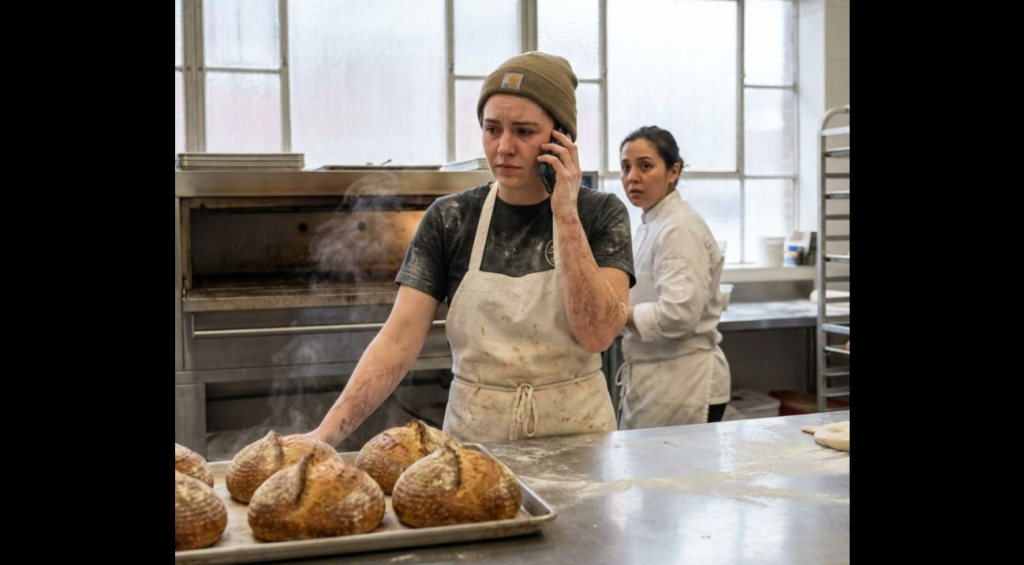
Before any of that happened, before anyone’s mask slipped far enough to reveal the raw skin underneath, I was elbow-deep in dough when my phone started buzzing in the pocket of my apron.
The ovens behind me roared like tame volcanoes, throwing out shimmering waves of heat that turned the bakery kitchen into my own private desert. The timer over my head was beeping in frantic bursts, the industrial mixer at my right thumped rhythmically as it kneaded a batch of brioche, and a fine mist of flour hung lazily in the air above the steel prep tables, glittering when it caught the light.
In other words, it was a normal Friday afternoon at the Gilded Crumb.
Friday afternoons were always a little insane. People liked to pretend weekends were for rest, but weekends were for cravings—brunch cravings, date-night cravings, “I worked hard this week and deserve something soft and sweet” cravings. Our Friday production schedule was a living thing, constantly shifting, constantly demanding, and if you didn’t respect it, it punished you. Dough collapsed. Butter melted. Laminations tore. Sugar burned.
The kitchen had its own language: beeps and hisses, the low hum of fans, the soft squeak of rubber soles on tile. My staff moved through it like dancers who had memorized the choreography, each one of us knowing when to step forward and when to get the hell out of the way.
Marcus was on ovens, his broad shoulders hunched slightly as he rotated trays with the careful precision of someone handling fragile art. Sophie, our front-of-house manager, was up front dealing with a minor crisis involving a gluten-free scone order and a customer who had decided “gluten-free” meant “fewer calories.” Lina was at the chocolate station, her hands a blur as she piped ganache into tiny shells. Jae was pulling espresso shots, the machine sighing and spitting steam like a dragon with a caffeine addiction.
And me? I was halfway through a batch of sourdough boules, my hands dusted white, my forearms warm, my mind in that strange split state where you’re thinking about three things at once: the dough’s hydration, the oven’s temp, and whether we had enough eggs for tomorrow’s custard.
I nudged the mixer speed down with my forearm, wiped the back of my hand across my forehead, and fished my phone out. The screen was slick under my fingertips. I half expected it to be a supplier calling about delayed butter shipments or Sophie texting to say we’d run out of pastry boxes again.
But it wasn’t any of those.
MOM, the screen read.
I almost didn’t answer.
My mother didn’t call to chat. She called when she needed something: money, reservations, a cake “like the one from that place we saw on TV.” Still, the muscle memory of being a dutiful daughter is powerful. Even after you’ve outgrown the house you were raised in, even after you’ve built something that belongs entirely to you, there’s a part of you that responds to that name on your screen like it’s a summons.
I hit accept and wedged the phone between my ear and shoulder.
I didn’t even get out a hello.
“Abigail, we need to talk about tonight.”
Her voice came sharp and urgent, no preamble, no warmth. She sounded like she was about to inform me that a distant relative had died, or the stock market had crashed, or the dog had run away. I stood very still, one hand on the oven door handle, my palm already hot from the metal.
“Hi, Mom,” I said anyway, because politeness had been drilled into me like it was a survival skill.
She plowed right over it. “Haley wants everything to be perfect tonight. You know, aesthetic.”
She savored that last word like it was something she’d invented herself, drawing it out in that way people do when they’re proud of learning internet jargon. My mother, Tara, had adopted the world of “aesthetic” like it was a religion. She followed Instagram accounts that taught her how to arrange charcuterie boards into edible landscapes and TikToks about capsule wardrobes, even though she still wore pearls to the grocery store.
I opened the oven door and was hit in the face with a wave of 400-degree heat. A pan of sourdough boules sat inside, their crusts just starting to blister and crack in all the right ways. I grabbed a towel, slid the tray out, and set it on the counter with a practiced, smooth motion.
Behind my ear, my mother kept talking.
“And, well,” she continued, “you always have that smell on you.”
I stared at the bread. The loaves were beautiful, each one scored with my signature pattern—three curved cuts like a rising sun. Their surface crackled quietly as the cooler kitchen air hit them.
“That… smell?” I repeated.
“That yeast smell,” she said, as if the words themselves were distasteful. “And your hands are always stained, dear. They look… rough. You look like a peasant, Abigail.”
There it was. Not even wrapped in politeness. Just dropped on the table, blunt and heavy.
A peasant.
I flexed my fingers without meaning to. The skin across my knuckles was dry and cracked from years of hot water, flour, and sugar. Small silver lines of old burns traced their way up my forearms, each one a souvenir from a hasty reach into an oven or a careless brush against hot metal. My nails were short, kept that way on purpose. Dough lodged stubbornly at the base of my cuticles no matter how often I scrubbed.
I knew what I looked like.
I also knew what my work tasted like. I knew what it meant when a stranger took a bite of my croissant and closed their eyes like they’d just been reminded that pleasure exists. I knew what it meant when a stressed nurse came in at 6:30 a.m. after a night shift and whispered, “Please tell me you still have cinnamon rolls,” like a cinnamon roll could keep her from falling apart.
But my mother’s world had no space for that kind of value. Her world had always been about what looked good from across the room.
“It just doesn’t fit the old Boston vibe she’s curating,” my mother added, as if that explained everything: the brownstone, the heritage, the carefully staged engagement dinner for my younger sister, Haley, and her billionaire fiancé.
The old Boston vibe.
She said it like our family was some kind of historic artifact, like the blood in our veins came with a brand identity.
“You’re uninviting me,” I said softly.
I hadn’t meant for it to come out like that. I had meant to sound cool, maybe amused, like her opinion didn’t matter. Instead my voice slipped out small, raw, like a fresh cut.
My mother sighed, as if I were the one being unreasonable. “Don’t be dramatic. It’s just—Haley has a vision, dear. Influencers will be there, and Jonathan’s business partners, and the press. It’s going to be very elegant. You can come to the family brunch on Sunday instead. That’s more… casual.”
Casual.
That meant paper napkins, not linen. That meant no cameras. That meant no one important outside the family, which meant my presence wouldn’t risk “ruining” the vibe.
I leaned back against the stainless steel counter. The metal was cold through the thin fabric of my shirt, even in the sweltering kitchen. For a second, I imagined myself tonight, standing in the candlelit dining room of our family brownstone, the air smelling faintly of expensive perfume and truffle oil, my hair pulled back in a bun that would never be sleek enough, my hands hiding in the pockets of a dress I could barely afford.
I pictured Haley in the center of it all, glowing and golden, lifting her left hand to show off the three-carat oval diamond that had already starred in three of her TikToks and a brand deal with a jewelry company. I pictured her laughing softly, head tilted just so, as her followers flooded her comments with “I’m obsessed” and “manifesting this for myself.”
I pictured myself in the background of her content, an out-of-focus smudge in the wrong shoes, the wrong dress, the wrong life.
“Okay,” I said.
I didn’t argue. I didn’t plead. I didn’t remind my mother that I was the one who had wired money to cover the deposit for the very venue they’d be sitting in tonight. I didn’t tell her that the champagne they’d be drinking had technically been paid for by the “peasant” she was uninviting.
I just whispered, “Okay,” and hung up.
The line cut off with a soft click. For a moment the only sounds were the whir of fans, the hum of compressors, and the distant laughter from the front of the bakery where the morning crowd was starting to thin.
I set the phone face down on the counter and wrapped both hands around the edge of the metal. My palms were slick with sweat, but the steel was unyielding, solid. I let my weight sink into my arms.
I waited for the hurt to crash over me, the way it always did. I waited for the familiar burning behind my eyes, the lump in my throat, the reflexive guilt that came whenever I disappointed my parents, even in ways that didn’t make sense.
Nothing came.
Instead, something else slid quietly into place inside my chest. It was cold, clear, implacable—like a night sky right before a storm: sharper, more honest.
People think baking is soft.
They see the videos—hands stirring glossy ganache, sugar falling in slow motion, dough rising under linen. They imagine gentle music, warm lighting, the “coziness” of it all. They picture aprons with ruffles and perfectly iced cupcakes, the kind you put sparklers on.
They don’t picture the burns.
They don’t picture the 3 a.m. alarms going off when the world is still black outside, your body protesting as you swing your feet onto a cold floor. They don’t picture hauling fifty-pound bags of flour on your shoulder or kneading dough until your shoulders ache and your fingers go numb. They don’t picture the way exhaustion settles into your bones and takes up permanent residence, an invisible roommate you stop fighting with and just learn to live around.
Baking is heat and repetition and discipline. It’s patience enforced by physics. You can’t bully dough into rising faster. You can’t sweet-talk butter into staying cold when the kitchen is too warm. You can’t “manifest” a croissant into flaky perfection if you don’t do the work.
Haley didn’t know that kind of tired.
My sister had delicate hands that had never lifted anything heavier than a designer tote bag. She was twenty-six, with a face made for ring lights and a life that existed on a screen: carefully framed, curated, and bathed in filter-soft sunshine. She made a living unboxing luxury handbags and filming her skincare routine in perfect natural light, explaining to hundreds of thousands of followers exactly how many steps it took to look like she’d just woken up like that.
My parents called her the golden child.
When she introduced them to Jonathan—yes, that Jonathan, as in the man whose properties had magazine spreads dedicated to their lobby arrangements—my father’s chest had practically exploded with pride. He had clapped Jonathan on the back at the country club, poured him his favorite Scotch, and said things like, “We’re just thrilled. Haley’s always been special, you know. She’s meant for big things.”
When Haley showed them the ring, my mother cried real tears, both hands up near her face, the diamond catching the light. They talked about the proposal like it was the culmination of some great destiny, a romantic saga that validated every choice they’d ever made as parents.
They never mentioned who had quietly wired five thousand dollars a month to cover the heating bill on the brownstone when my father’s investments tanked.
They didn’t talk about who had paid off the credit card debt from the luxury vacations my mother “needed” for her mental health.
They certainly didn’t bring up who had signed the check for Haley’s new camera when 1080p wasn’t “crisp” enough for her brand anymore.
For five years, I had been their invisible wallet.
It started small. A bill here, a loan there. The bakery took off faster than anyone expected—faster than even I had hoped, and I dreamed big. There were lines down the block by the third month, write-ups in magazines, influencers posting dreamy photos of my croissants and tagging the bakery. Money began to feel less like something to panic about and more like something to manage.
My parents’ emergencies always sounded urgent. “Just a little help, sweetheart.” “We’ll pay you back once things stabilize.” “It’s just until the market bounces back.”
They said it with such confidence I almost believed them.
And when Haley’s following exploded, when brands came knocking, when her face showed up in glossy campaigns, it felt right—at first—to support her. She was doing something creative. She was “building a brand.” I told myself we were both hustling, just in different arenas.
So I paid.
I paid and paid and paid, like a vending machine someone had jammed an infinite number of coins into, spitting out whatever selection they pressed.
Leaning against that counter, my mother’s words echoing in my head—peasant, old Boston vibe, not invited—I felt something fundamental shift, like a gear that had been grinding for years finally slipping free of its track.
There’s a concept I’d once read about in a magazine a customer had left behind, some sociological term that stuck to my brain like caramelized sugar.
The service paradox.
People love the product. They despise the producer.
They want their coffee, their croissants, their perfectly staged candlelit engagement dinner, their aesthetic. But the hands that make those things? The bodies that lift and sweat and stand on concrete floors for twelve hours a day? Those are meant to stay hidden in some metaphorical basement. Appreciated abstractly, perhaps, but not invited upstairs to sit at the table.
That was my place in my family.
They loved what my work bought them: the heating, the club dues, the designer bags, the secret down payment on the Vineyard summer rental.
They didn’t love me.
Not really. Not in a way that had room for me to be anything but the generator humming away out of sight.
I rolled my shoulders and watched steam curl up from the cooling loaves. On the far wall, the clock ticked toward 4:15 p.m.
The ovens weren’t going to wait for me to finish having an epiphany. Baking doesn’t care if your heart is breaking; dough still needs folding, the proofing schedule marches on like an army.
As I scored the next batch of loaves, my knife making neat, practiced slashes, I realized something else.
This wasn’t a family dynamic anymore.
It was a transaction.
And the terms of the contract had just changed.
That night, when the bakery finally closed and the last tray was washed and the last floor was mopped, I went upstairs to my apartment above the shop with my body humming with exhaustion.
The apartment wasn’t big. One bedroom, a narrow living room with a couch I’d found secondhand and reupholstered myself, a tiny kitchen that always smelled faintly like vanilla no matter how many times I cleaned it. But it was mine.
I used to think I’d move out “once things settled down,” once the bakery ran smoothly without me, once I could sleep past four in the morning without guilt.
But bakeries don’t settle. They evolve. And I had gotten used to living above my work, like a lighthouse keeper in the beam of my own making.
I ate dinner standing at the counter—half a lemon tart that hadn’t sold, because I didn’t have the energy to chew anything that required effort. I didn’t turn on the TV. I didn’t scroll through social media. I didn’t watch Haley’s live stream from the brownstone where she would be shimmering under candlelight while my mother cooed about her “vision.”
For once, I let myself not look.
My phone buzzed a few times—texts from cousins asking if I was coming tonight, a vague “Hope you can make it!” from an aunt who had no idea I’d been uninvited. I didn’t respond.
I washed my hands slowly, scrubbing flour out of the lines of my skin, and stared at my knuckles under the warm water.
My mother had called them rough. Peasant hands.
What did my mother’s hands look like now? Soft, probably. Lotion-smoothed. Nails manicured. Hands that had been free, because mine had been doing the holding.
I dried off, sat on my couch, and opened my banking app.
I didn’t do it dramatically. I didn’t slam my fist into the cushion and cry. I just looked at the recurring transfers—the ones I’d set up months ago because it was easier than sending money manually every time a new “emergency” appeared.
$5,000 to my parents on the first of every month.
$1,200 to Haley on the fifteenth, labeled “camera payment” though the camera had been paid off long ago.
$750 to cover my mother’s credit card minimum.
$600 to keep my father’s “investment account” from dipping below some threshold he was convinced mattered.
For a long time, those numbers had felt like responsibility.
Tonight, they looked like a rope.
I didn’t cancel them immediately. Not yet. I wasn’t ready to deal with the fallout. There’s a difference between a cold decision in your chest and the moment your finger actually hits the button that changes everything.
Instead, I took a screenshot.
Then another.
Then I opened a notes app and typed something simple:
Stop paying people who hate you.
I stared at that line until my eyes went blurry.
Then, because my body was still a baker’s body and didn’t know how to stop running on schedule, I set my alarm for 3:00 a.m. and crawled into bed.
Sleep didn’t come easily, but it came eventually, heavy and dreamless.
I found out the details the next morning.
The bell above the Gilded Crumb’s front door usually makes this sweet little sound, bright and cheerful, like it’s happy to announce whoever just walked in. That morning, around nine, it jittered loudly, a harsh metallic jangle I’d never heard before, like someone had flung the door open with more force than necessary.
I was in the back, at the laminating machine, rolling cool butter into dough, counting turns in my head. My hands were steady. My mind was oddly calm, like something had clicked into place overnight.
“Morning!” Sophie called from the front, her voice automatically warm and customer-ready. Then it dropped. “Oh. Uh—hi?”
I pressed the dough through the rollers and folded it. The machine hummed and thumped, steady. Still, something in Sophie’s voice made me glance toward the doorway.
My father’s silhouette filled it.
He wasn’t alone.
Brian Townsend strode into my bakery like he owned it, which in some ways he had always assumed he did, by virtue of owning me. Behind him came my mother, pearls already on, clutching her handbag like a talisman. Haley followed, immaculate in a cream cashmere matching set and soft expensive sneakers that had clearly never seen a stain.
They looked like they were arriving at a boardroom to fire someone.
“Abigail,” my mother said breathlessly, not even bothering with hello. “Thank God you’re here.”
I wiped my hands on my apron and stood up straight. Flour clung to the fabric. Around us, the kitchen kept moving: timers beeping, Marcus sliding trays into the oven, Lina tapping a pan to release air bubbles. But in the little circle where my family stood, the air felt suddenly brittle.
“We have a crisis,” my mother continued.
She said crisis the way she’d said aesthetic—like it was an event that had chosen her personally.
“Hi,” I replied. “Good to see you too.”
Her eyes flicked over me. Flour. Loose bun. Plain black shirt. Satisfied that I still looked like a disappointment, she brushed past me deeper into the kitchen, heels clacking on the tile. I watched Marcus’s face tighten. Health code didn’t mean much to Tara Townsend; rules were for other people.
Haley glanced at the pastry case—not at the pastries, but at her reflection in the curved glass. She adjusted a strand of hair, checked her lip gloss, and then joined our mother.
My father hung back by the mixer, pretending to inspect it like a curious tourist. His jaw was tight.
“What’s the crisis?” I asked, because someone had to move this scene along.
“The caterer canceled,” Haley said, still half watching herself in the reflection. Her tone suggested the caterer had personally betrayed her in a Shakespearean tragedy. “He said he had a—” she made air quotes with one perfectly manicured hand, “—family emergency. So unprofessional.”
I thought of all the shifts I’d covered for employees whose kid had a fever or whose father had been rushed to the ER. Family emergency wasn’t unprofessional. It was life.
But I didn’t say that. I just folded my arms and waited.
“Anyway,” Haley went on, finally turning to look at me like I was a tool she’d just remembered she owned, “we need you to fix it.”
My eyebrows lifted. “Fix what, exactly?”
“The desserts,” she snapped. “We need five dozen of your midnight cronuts—you know, the ones with the gold leaf? And a three-tier vanilla bean cake with raspberry filling. Fondant. Very smooth. Sharp edges. No… rustic nonsense. We need it all delivered to the venue by four.”
I glanced instinctively at the clock. 9:07 a.m.
Six hours.
The midnight cronuts were a labor of love and spite. I’d created them originally as a joke—my version of those “luxury” pastries people posted on Instagram, but with actual technique behind them. Laminated dough, fried precisely, dipped in a glossy black cacao glaze, brushed with edible gold leaf. They were named midnight because the dough had to rest overnight, twice, and because I usually ended up making them at midnight when demand spiked.
They sold out three months in advance. There was a waiting list longer than some people’s attention spans.
“You can’t be serious,” I said.
“I am serious,” Haley snapped. “This is Jonathan’s world. If it’s not perfect, it’s embarrassing. Influencers will be there. His investors will be there. I already told my followers I’m serving the Gilded Crumb desserts. So yes, I am serious.”
My mother chimed in, voice sharp with urgency. “Haley promised them. And you’re the only one who can do it.”
That last part, the compliment disguised as obligation, might have worked on me once. It did not land now.
“I can’t,” I said simply.
Haley’s eyes widened, offended. “Excuse me?”
“I can’t do that,” I repeated. “The cronuts require two days. The cake requires cooling time. I could make you something else—cookies, maybe, or a single sheet cake—”
“A sheet cake?” Haley shrieked like I’d offered her roadkill. “Are you insane? Do you want me to look cheap?”
My mother’s voice went tight. “Abigail, don’t be difficult.”
“Difficult,” I echoed, and felt something cold settle more firmly in my chest. “I’m telling you reality.”
Haley’s face twisted. “You’re punishing me because Mom uninvited you. God, you’re petty.”
“I’m not punishing you,” I said quietly. “I’m saying no.”
“You’re ruining my engagement,” she hissed, and tears sprang to her eyes so fast it was almost impressive. Haley could cry on cue; it was part of the brand. “You’re jealous. You’ve always been jealous of me. You’re just a baker, Abigail. You play with flour while I build a life.”
My father’s hand slammed down on the prep table.
Metal rattled. A bowl of ganache rippled.
“Enough,” he snapped. The tone in his voice was the one that used to make me flinch when I was twelve and had forgotten to load the dishwasher. “You will figure this out. I don’t care if you have to buy them from somewhere else and repackage them. You are going to fix this.”
My jaw tightened. “That would be fraud.”
“I don’t care,” he barked. “You’ve embarrassed your mother, you’ve embarrassed Haley, and now you’re going to make it right.”
I stared at him.
There was a moment, a tiny flicker, when I saw him not as my father but as a man who had gotten used to taking. A man who had convinced himself that taking was his right.
And in that moment, something inside me hardened.
Then the bell above the front door chimed again.
This time, the sound was deeper somehow, heavier, as if the air in the bakery had thickened.
Everyone in the kitchen went still.
Sophie’s voice out front wavered. “Uh—hi, welcome—”
I watched the doorway.
A man walked in wearing a charcoal suit that fit him like it had been sewn directly onto his body. Salt-and-pepper hair. A face that had been on magazine covers. The kind of posture that said he was used to rooms rearranging themselves around him.
Jonathan.
Haley squealed, high and bright. “Jonathan! You’re not supposed to see me before the party!”
She moved toward him, arms open for a cinematic embrace.
He sidestepped her like it was reflex. Like he’d dodged clinging hands and staged affection before.
He walked past my father, who straightened his blazer. Past my mother, who pasted on a smile so fast it looked painful. He came toward the counter where I stood in my flour-dusted apron.
He stopped in front of me.
Up close, his eyes were deep and steady. They scanned my face, not in a measuring way, but with a kind of focused recognition, like he’d walked into a crowded airport terminal and finally spotted the person he’d been waiting for.
“Are you Abigail?” he asked.
My mouth went dry.
I nodded.
“I’m Jonathan,” he said, as if I didn’t know. “Atlas Hotel Group.”
“I know,” I managed.
He let out an audible sigh of relief, and that alone felt like a shift in the universe. Powerful men didn’t sigh with relief in front of people like me. They didn’t show relief. They showed control.
“Thank God,” he said. “I’ve been trying to meet you for six months.”
Haley froze, one arm still half raised. My mother’s smile faltered at the corners.
Jonathan continued, voice warm with genuine admiration. “We exclusively contract with your bakery for our VIP suites. Your brioche is the only reason our Paris location has a five-star breakfast rating.”
Paris.
VIP suites.
My brain stuttered.
I had developed that brioche on a rainy night last fall after a hotel client requested something “luxurious but comforting.” I’d stayed in the kitchen until 2 a.m., tweaking the recipe. A little orange zest. A specific butter percentage. A longer proof. When I finally got it right, I’d eaten a piece standing over the sink, exhausted and triumphant.
“You’re the Atlas hotels,” I whispered.
He smiled, quick and self-deprecating. “Guilty. And you’re the genius behind the Gilded Crumb.”
Genius.
My father had never called me that.
Jonathan’s gaze shifted, and only then did he seem to register the tension in the room. The way my mother’s hands were clenched around her purse strap. The way Haley’s face was tightening with fury. The way my father’s shoulders were squared like a man preparing for a fight.
“You okay?” Jonathan asked me softly, and the question wasn’t performative. It was real.
“I’m…” I searched for the word. “Working.”
Jonathan nodded like he understood. Then he turned toward Haley, eyebrows lifting slightly. “Haley told me you were busy. That you weren’t interested in expanding.”
“I—” Haley began.
Jonathan didn’t let her finish. He pulled out his phone, thumb moving fast. “I sent five emails,” he said. “My team sent contracts. We wanted to partner with you to open a flagship location in our new Tokyo hotel. When you didn’t respond, I assumed you weren’t interested.”
Tokyo.
The word made the kitchen tilt.
“I never got any emails,” I said numbly. “I check my inbox every night.”
Jonathan frowned, scrolling. Then he held the phone out so I could see.
An email thread. Subject line: PROPOSAL: ATLAS TOKYO x GILDED CRUMB.
Sent to my official bakery email.
Replies had come from a different address.
I stared at it until the letters sharpened into meaning.
It was my father’s email.
For a heartbeat, the ovens might as well have stopped. Even the hum of refrigerators felt distant.
I lifted my gaze slowly to my father.
Brian’s face had gone pale. Sweat shone at his hairline. He looked suddenly small in his blazer.
“Dad?” I asked.
He swallowed hard. “I—I was protecting you,” he stammered.
I waited.
“You’re not ready for that kind of pressure,” he rushed on. “Tokyo? International expansion? It’s too much. You’re already exhausted. We need you here. Who would help your mother? Who would be there for Haley? For the family? I was trying to keep us together.”
There it was, packaged the way he always packaged control: as care.
Jonathan let out a short, humorless laugh. It cracked the air.
“You blocked a multi-million dollar partnership,” he said slowly, “because you wanted her available to run errands.”
My mother flinched, but didn’t deny it. Haley stepped forward, fingers reaching for Jonathan’s sleeve, voice bright with desperation.
“Babe, it doesn’t matter,” she said quickly. “It’s a misunderstanding. We’re all here now. Abigail can make the pastries for tonight and we can talk business later. Family first.”
Jonathan looked at her hand like he wasn’t sure how it had gotten there.
His gaze swept my parents, then returned to me.
He saw my apron. My flour. My hands.
He saw the way my father stood like a man trying to hold onto power he no longer had.
He saw the way my mother’s eyes flicked between us, calculating.
And he saw Haley, glossy and perfect, shaking with rage that didn’t match her on-screen sweetness.
“I don’t think there are going to be any pastries,” Jonathan said quietly.
“Actually,” I said, and my voice surprised even me with its steadiness, “there’s something you should know about the pastries.”
My mother’s face flashed with hope. “You have some in the back?” she demanded.
I shook my head. “No. The midnight cronuts sell out three months in advance.”
Haley’s eyes narrowed. “Then where are they?”
“I already donated them,” I said. “Every Friday at nine, whatever hasn’t been picked up gets delivered to the women’s shelter on Fourth Street.”
The words landed like a stone in my mother’s chest. I watched her blink rapidly, as if trying to process the idea that my best work belonged somewhere outside her world.
“There’s nothing here for you,” I finished softly. “Not a crumb.”
Haley’s composure shattered completely.
“You are jealous,” she spat. “You’ve always been jealous of me. You’re just a baker, Abigail. You play with flour while I build a brand. You can’t stand that I’m the one winning, so you’re sabotaging my engagement.”
Her voice rose, cracking. Tears streaked down her cheeks, ruining her makeup in messy rivers. My mother rushed to her side, murmuring soothing nonsense. My father stood rigid, fury and panic wrestling on his face.
My parents heard Haley’s insults too, though they pretended not to. My mother whispered, “She doesn’t mean it,” even as she shot me a look full of venom. My father looked like he wanted to say something, but the words got stuck in his throat.
Jonathan heard them.
He heard every word, every cruel little reduction of my life to “just a baker.” He heard the contempt that sat under their entitlement like a foundation.
His jaw tightened.
He didn’t raise his voice. He didn’t perform outrage.
He simply… shifted.
And in that shift, I saw a man making a decision.
Haley was still talking—still crying, still accusing—when Jonathan cut in.
“That’s enough,” he said, quiet but sharp.
Haley stopped mid-sob, startled. “Jonathan—”
He looked at her as if seeing her clearly for the first time. “You called her a peasant,” he said. “In her own business. After using her name to promise desserts you didn’t even order.”
Haley’s mouth opened. “I—”
“And you,” he said, turning to my parents, “blocked my team’s emails without telling her.”
My father’s face reddened. “I was protecting—”
“No,” Jonathan said calmly. “You were controlling.”
My mother pressed a hand to her throat. “Jonathan, please—this is family—”
Jonathan’s eyes flicked to me, and his voice softened slightly. “Is this always how they treat you?”
The question hit me in the ribs.
I didn’t answer right away, because part of me wanted to lie. Part of me wanted to smooth it over, to say, It’s complicated, to make it easier for everyone to return to the roles they understood.
But the cold clarity in my chest held.
“Yes,” I said.
The word was simple.
It was also, finally, true.
Jonathan exhaled slowly. Then he turned back to Haley.
“I’m ending this,” he said.
Haley went completely still. “What?”
“I’m ending the engagement,” Jonathan repeated, voice steady. “This isn’t about stress. Or a bad day. This is who you are when you don’t get what you want.”
Haley’s face contorted. “You can’t—Jonathan, this is insane—”
Jonathan held up a hand. “No. What’s insane is that I nearly married into a family that treats the person who feeds them like dirt.”
Haley made a strangled sound that might have been a sob. “You’re choosing her over me?”
Jonathan’s gaze didn’t even flicker. “I’m choosing values over vanity,” he said.
Then he turned back to me.
In the sudden silence, I could hear the crackle of bread crust cooling on racks. The distant hiss of espresso. Sophie’s breath held in the doorway.
I realized something then: Jonathan could walk away and go back to his world. He could cut ties, send lawyers, move on.
I couldn’t.
This was still my family.
Unless I decided, in that moment, that it wasn’t.
I did not shout. I did not cry. I did not make a speech about betrayal.
I untied my apron.
The knot slipped free with a small, soft sound. I folded the fabric carefully, edge to edge, like I respected it.
Then I reached into my pocket and pulled out the spare key to my bakery.
I set it on top of the folded apron.
The click rang louder than any of Haley’s screams.
“What are you doing?” my mother whispered, her voice suddenly small.
I pulled out my phone, thumb hovering over my contacts.
“Abigail, don’t be childish,” my father snapped, sensing the ground shifting.
I tapped MOM.
Block.
The notification popped up: “This contact will no longer be able to reach you.”
My mother gasped.
I tapped DAD.
Block.
My father’s face went gray.
Then I tapped HALEY.
Block.
Haley made a sound like she’d been punched.
I did it slowly, deliberately, holding the phone at an angle where they could see.
My mother’s hand flew to her chest. “You can’t just cut us off like strangers—”
“I’m clocking out,” I said simply.
Marcus straightened. “Chef?” he asked softly.
I turned to him. “You’re in charge. Close up early. Lock everything. Everyone gets paid for the full shift.”
Marcus’s spine lengthened with responsibility. “Yes, Chef.”
I walked past my father. Past my mother. Past Haley shaking on her stool, mascara streaked, ringless hand clenched like a fist.
I stopped in front of Jonathan.
“I’m going to get a coffee,” I said. “You’re welcome to join me.”
Jonathan didn’t look back. “After you,” he said.
We walked out together.
The bell chimed above us, cheerful again, as the door swished shut behind my family.
Cold Boston air hit my face, clean and sharp. Snow from last week’s storm sat in dirty piles along the curb. The sky was bright blue, unapologetic.
I inhaled deeply.
For the first time in a long time, the breath reached the bottom of my lungs.
Jonathan fell into step beside me as we headed toward the corner coffee shop. His voice, when he spoke, held something like quiet anger.
“Just so we’re clear,” he said, “I meant every word. You’re a genius.”
I let out a shaky exhale that was half laugh, half disbelief. “You’re very generous,” I said. “And very late, apparently. Tokyo?”
“Tokyo,” he confirmed. “We still want you. None of this changes that.”
I glanced at him. “It changes everything.”
And it did.
The fallout wasn’t cinematic.
No one stood outside my apartment wailing. No police came. No dramatic public showdown unfolded on the brownstone steps.
It arrived in quieter ways.
Haley posted a video that night, of course. She filmed herself sitting on her bedroom floor, surrounded by white roses that now looked like a joke. Soft piano music played. Her mascara was artfully smeared. She looked like grief with good lighting.
“My fiancé left me out of nowhere,” she whispered. “I’m not ready to tell the whole story, but sometimes… not everyone can handle a powerful woman.”
The comments poured in.
Queen.
He didn’t deserve you.
Family is toxic.
You’ll glow up from this.
For two days, the internet rallied around her.
Then the venue posted a discreet notice about a canceled event and non-refundable deposits. Then whispers trickled through the circles Haley wanted to impress—whispers about unpaid invoices, about tantrums, about a billionaire who had quietly walked away and refused to answer calls.
Jonathan stayed silent in public.
In private, he sent me an email the next day.
I’m sorry you had to endure that. We still want the partnership. If you’re open to it, my assistant will schedule a call. No pressure.
No pressure.
I had spent my whole life under pressure. Pressure to be grateful. Pressure to be quiet. Pressure to smooth things over.
The absence of it felt like a shock.
My parents tried to reach me.
Not directly—the blocks held—but through cousins, through old family friends, through employees at the bakery who suddenly started receiving “concerned” visits.
Sophie told me my mother had come by crying, asking if I was “okay,” asking if Sophie could “tell her daughter to call.”
Marcus told me my father had shown up once, hovering outside the kitchen door like a man afraid of being denied entry to a place he’d always assumed he owned.
I didn’t respond.
I didn’t need to explain that blocking them hadn’t been impulsive. It had been inevitable. It had been a switch flipped after years of dimming myself.
The brownstone went first.
I heard about it from an old neighbor who came into the bakery one morning and said casually, “Your folks left. Heat got shut off in February, pipes almost froze. I thought they had that big-shot fiancé to keep them warm.”
I shrugged. “Things change.”
They moved into a smaller place in the suburbs. The country club membership disappeared. The designer purchases stopped. Haley’s brand deals slowed, then dried up. The algorithm moved on, as it always does, hunting for the next pretty tragedy.
Without my money—and without Jonathan’s—the family ecosystem recalibrated brutally.
And here was the part that surprised me most:
They didn’t collapse.
They got smaller. They got quieter. They complained. They gossiped. They adjusted.
They learned, slowly, what it felt like to live inside their own effort.
Meanwhile, my bakery grew.
Without my parents siphoning my accounts, there was suddenly room—financial room, emotional room. Room to expand, to hire, to breathe.
When Jonathan and I met for coffee a week later, we didn’t talk about Haley. We didn’t talk about scandal.
We talked about croissants and supply chains and Tokyo’s customer flow patterns.
He treated me like a partner.
“Flagship,” he said. “Not a franchise. Your recipes. Your standards. Your call.”
“What’s the catch?” I asked, out of reflex.
He smiled. “You let us pay you what you’re worth.”
It turned out to be the hardest part.
I had spent so long accepting less—less respect, less credit, less support—that standing in a conference room with lawyers negotiating equity felt like walking onto a stage without knowing your lines.
But I had been running a bakery for years. I had been negotiating with flour vendors and landlords and health inspectors. I had been managing payroll and profit margins and people’s lives.
I knew more than I gave myself credit for.
So I negotiated.
We built a contract that protected my brand. Protected my staff. Protected my control. I refused the parts that smelled like exploitation. I insisted on local hiring and training programs. I insisted on quality control that couldn’t be bypassed for speed.
Jonathan didn’t fight me.
He respected me.
A year later, I stood in Tokyo in front of a glass storefront with my bakery’s name shining above it.
The crowd gathered outside clapped when we cut the ribbon. Cameras flashed. The doors opened, and warm buttery air washed over me like a blessing.
Inside, trays of pastries lined up on gleaming shelves—croissants layered with the same care as their Boston cousins, morning buns dusted with matcha sugar, a yuzu brioche that made my Tokyo team grin with pride.
I picked up a croissant and bit into it.
The crust shattered delicately. The interior was tender, layered, full of air.
It tasted like butter and salt and flour and time.
It tasted like freedom.
A week after the Tokyo opening, I flew back to Boston for forty-eight hours.
Not for my parents. Not for any obligation disguised as tradition.
For myself.
I stood on the sidewalk outside the original Gilded Crumb and watched the line wrap around the corner. People stamped their feet against the cold. They checked their phones. They laughed. They waited.
Marcus ran the counter with confidence now. Sophie moved like she owned the room. Lina’s pastries in the case looked like jewels. Jae pulled espresso shots with the ease of someone who no longer had to prove they belonged.
My bakery.
Our bakery.
I walked six blocks to Fourth Street.
Marisol hugged me at the shelter door and shouted, “We saw Tokyo! You’re famous!”
“Only in rooms that smell better than this,” I teased.
We opened a box of matcha-yuzu morning buns and passed them out. A little boy helped, solemn and proud, as women in worn coats took bites and closed their eyes like softness still existed.
“What’s the occasion?” someone asked.
“New beginning,” I said. “Thought it deserved a celebration.”
On my way out, Marisol squeezed my arm. “Your folks came by once,” she said casually. “Asked about you.”
My stomach tightened. “What did you tell them?”
She rolled her eyes. “I told them our fridge has your name on it every Friday and that’s all I need to know.”
I didn’t know what to say to that, so I just nodded.
That night, back in my apartment above the bakery, jet lag tugging at my bones, my phone buzzed with an email from my cousin Maeve.
Ran into your mom and dad at the diner off Route 3, she wrote. They were at a corner table, splitting a turkey club. They looked… smaller. Not dead. Not homeless. Just… regular. Thought you should know. Love you.
I stared at the message for a long time.
In my mind, I pictured my parents in a vinyl booth under fluorescent lighting, coffee a little burnt, pie a little too sweet. My father complaining about the service. My mother fussing with her pearls out of habit. Haley not there, probably.
For so long, I had been terrified that stepping away would destroy them. That withdrawing my money and my labor would tip them into catastrophe. That fear had kept me tethered.
But they were… fine.
Not thriving. Not center-stage. But alive. Eating turkey clubs.
They had landed.
The catastrophe had been mine, once: the slow erosion of self, the decades-long dimming of my own needs. Stepping away hadn’t caused disaster.
It had prevented one.
I wrote back to Maeve: Thank you. I’m glad they’re okay. Love you too.
Then I put my phone facedown, closed my eyes, and, for the first time in as long as I could remember, fell asleep without setting an alarm for before dawn.
In the morning, the bakery downstairs would run without me.
Marcus would unlock the door. Sophie would calibrate the espresso machine. Lina would tap a pan and check the shine of her ganache. Dough would rise. Ovens would roar. People would line up.
The world would keep turning, with or without my constant sacrifice.
That knowledge, once terrifying, now felt like something else.
Liberation.
Freedom isn’t always fireworks and ribbon-cuttings in faraway cities. Sometimes it’s quieter. Sometimes it’s the simple, radical act of trusting that the life you’ve built can support itself without you breaking your back to hold every piece in place.
Sometimes it’s choosing to sleep in, just once, and letting the dough rise in someone else’s capable hands.
Sometimes it’s a turkey club in a diner off Route 3, eaten by two people learning, very slowly, how to live within the limits of their own effort.
And sometimes, if you’re very lucky, it’s a warm croissant in your own kitchen, eaten standing up at the counter as the sun comes in the window—no one to impress, no one to please, no one to bankroll.
Just you.
And the quiet, steady knowledge that you finally stopped being their invisible wallet.
You became your own.
Leave a Reply