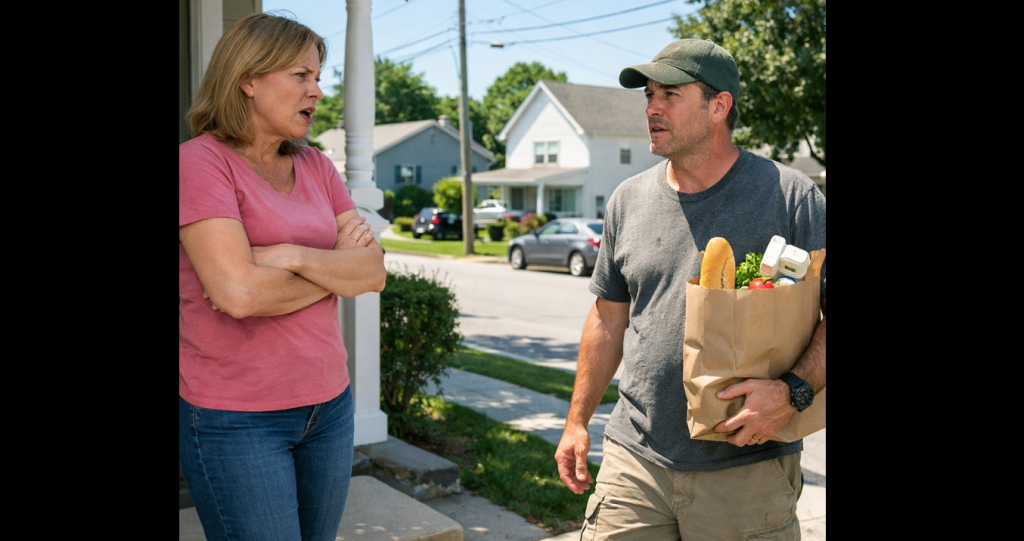
When I came home that Wednesday afternoon, my neighbor Mrs. Halvorsen was waiting on her porch like she’d been stationed there by the homeowners’ association.
Her arms were crossed so tightly against her cardigan that her knuckles looked pale, and her mouth had that pinched line that meant she’d already decided she was right before she ever opened it.
“Your house is so loud during the day, Marcus,” she complained the moment she saw me. “Someone is shouting in there.”
I stopped on the walkway with two grocery bags cutting grooves into my fingers. The late sunlight was leaning toward evening, turning everything in our quiet suburban street gold, and her words landed in the middle of that warmth like ice.
“That’s not possible,” I said, forcing a quick, polite laugh. “Nobody should be inside. I live alone.”
Mrs. Halvorsen’s eyes didn’t soften. “Well, someone is. I heard yelling again around noon. A man’s voice. I knocked, but no one answered.”
The certainty in her tone made my stomach twitch.
I didn’t want to invite myself into paranoia. I’d had enough of that in my life already. After my dad died, after my mom sold the house I grew up in, after I moved into this place alone and told myself solitude was peace, not loneliness… I’d learned to keep my mind from running too far ahead of facts.
So I made my face do the thing it always did when someone suggested something I didn’t want to consider.
I smiled. Light. Casual. Harmless.
“Probably the TV,” I said. “I leave it on sometimes to scare off burglars.”
She shook her head, irritated. “A TV doesn’t sound like a man yelling, Marcus.”
“I’ll check it out,” I said quickly, shifting my weight, trying to end the conversation before she pulled me deeper into her certainty. “Thanks for letting me know.”
Mrs. Halvorsen didn’t look satisfied, but she stepped back onto her porch like she’d delivered a warning and done her civic duty.
I walked up my steps and unlocked my door with a steadier hand than I felt.
Inside, the air was still.
Not the good kind of still, like a house resting. The other kind. The kind that feels like a held breath.
I stood in the entryway for a moment, groceries hanging at my sides, listening.
No footsteps. No voices. No television. No hum of appliances beyond the usual refrigerator drone.
Just quiet.
I set the grocery bags down on the kitchen counter and walked through the house.
Living room first. Everything was exactly where I left it—remote on the side table, couch cushion slightly out of place from where I’d sat the night before, the throw blanket folded in the same imperfect way.
Dining room. Nothing disturbed.
Kitchen. Clean. Too clean, actually, the way it always was because I lived alone and never cooked anything that required more than a pan and a little guilt.
Bathroom. Same.
Bedroom. Same.
No open windows. No sign of forced entry. No footprints on the hardwood floors. No drawers left open. No missing jewelry—although I didn’t have much to miss.
Nothing.
And yet the uneasy feeling stayed.
I told myself my neighbor misheard something. Or that she heard some kid shouting outside and assumed it was inside my house. Or that she wanted drama because retired people sometimes treat other people’s lives like television.
I pushed the thought away, but it didn’t go easily.
That night, I barely slept.
Every small sound in the house made my eyes open. A pipe shifting. The refrigerator kicking on. A car passing outside.
At one point I sat up in bed and stared at my bedroom door, half expecting it to open.
It didn’t.
But my mind did something worse.
It started replaying the last few months and pulling details I’d ignored into a new shape.
I thought about how the lock on my back gate had been scratched recently, like a key had scraped it. I thought about the time I found my junk drawer reorganized—neater than I left it—after I’d sworn I hadn’t touched it in weeks. I thought about the faint smell of cologne in the hallway one afternoon when I came home early, a scent I couldn’t place.
I had shrugged it all off as imagination.
Now, lying there in the dark, I felt foolish.
And angry.
Not just at the idea of someone in my home, but at the idea of being wrong-footed in my own life. I had worked hard for this house. I had built a quiet routine that felt safe.
No one gets to step into that without my permission.
The next morning, after pacing around my kitchen for half an hour with my coffee going cold, I made a decision.
I called my manager and said I was feeling sick. It wasn’t a lie exactly—my stomach was tight and my head felt heavy and my body was buzzing with something that wasn’t quite fear but wasn’t calm either.
At 7:45 a.m. I opened my garage door and backed my car out just enough that anyone glancing down the street would see me leave.
Then I shut off the engine.
I got out, looked around, and quietly pushed the car back inside.
It was ridiculous. It felt like something a person in a thriller movie would do. But something about doing it made me feel better.
Like I was taking control.
I slipped back into the house through the side door, moved quickly to my bedroom, and slid under the bed.
Dust tickled my throat immediately. The space beneath the mattress was dark, narrow, and smelled faintly of old fabric and whatever I’d lost down there years ago—an earring, maybe, a stray sock. I pulled the comforter down just enough to hide myself.
My heart was pounding so loudly I was afraid it would give me away.
Minutes crawled into hours.
At first I stared at the underside of the bed slats and listened to the house settle. My mind kept trying to talk me out of this. You’re overreacting. You’re humiliating yourself. There’s no one here. Mrs. Halvorsen is bored.
But I stayed.
Because if I was wrong, I needed proof of wrong.
And if I was right… I needed to know what kind of right it was.
Silence stretched across the house, heavy and suffocating.
Around 10:30 I started to feel cramping in my legs from holding still. I shifted slightly, careful. My elbow bumped something under there—an old shoebox I hadn’t touched in years.
A memory flashed: my father’s handwriting on the label, the way he used to write names with sharp, angled letters.
I swallowed hard and shoved the thought away. This wasn’t about my father. Not today.
At 11:20 a.m., just as doubt started to win, I heard the unmistakable sound of the front door opening.
Slow.
Careful.
Familiar.
It wasn’t forced entry. It wasn’t a shoulder slammed into wood. It was a key sliding into a lock.
My throat went dry.
Footsteps moved through the hallway with the casual confidence of someone who believed they belonged here. Shoes scraped lightly on the floor—a rhythm I recognized but couldn’t immediately place, like hearing a song you haven’t heard in years and suddenly realizing you know every beat.
My breath hitched.
Then the footsteps entered my bedroom.
A man’s voice—low, irritated—muttered, “You always leave such a mess, Marcus…”
My blood turned cold.
He knew my name.
And his voice sounded impossibly familiar.
I froze, every muscle locked, as the shadow of his legs moved around the room—back and forth, unhurried—and stopped right next to the bed.
I forced myself to breathe quietly, shallow, as dust coated my throat with each inhale.
The man moved with unsettling confidence. A drawer opened. Something shifted on my nightstand. I heard the faint scrape of a box being dragged out of a closet.
He wasn’t stealing my TV. He wasn’t rifling through jewelry. He was searching.
For something specific.
A dresser drawer slammed shut and he muttered again, annoyed like he was lecturing a roommate.
“You always hide things in different places, Marcus…”
My skin prickled.
How does he know what I do?
He walked to the closet, sliding the door open. Hangers rattled softly. From under the bed I saw only his boots—brown leather, creased from years of wear but recently polished.
This wasn’t a panicked burglar.
He wasn’t rushed.
He wasn’t cautious.
He behaved like someone returning home after a long absence.
I needed to understand who he was.
Inch by inch, I shifted toward the edge of the bed to widen my view. My cheek pressed against the carpet. My eyes strained toward the light filtering through the room.
He reached up to the top shelf of the closet and pulled down a blue box I didn’t recognize. He opened it, whispered something in an accent I couldn’t pinpoint, then began rummaging through it with quick, practiced motions.
Then my phone vibrated in my pocket.
The sound was barely audible, but in the silence it might as well have been a fire alarm.
The man froze immediately.
My breath stopped.
The room held still, the air thick like it had turned to gel.
Slowly, he crouched.
His boots turned toward the bed.
Then his fingers appeared, curling around the comforter as he lifted it to look underneath.
My body moved before my brain could debate it.
I rolled out the opposite side and scrambled to my feet, slamming my shoulder into the dresser. The lamp on the nightstand toppled, crashing to the floor, bulb shattering.
The man lunged toward me.
I stumbled backward, grabbing the lamp base like a weapon, my hands shaking.
He straightened.
And for the first time, I saw his face clearly.
He resembled me.
Not perfectly—his jaw was broader, his nose slightly crooked, his hair thicker. But the resemblance was enough to make my stomach twist violently.
It was like looking at a version of myself that had lived a different life and carried different scars.
He stared at me with an odd mixture of irritation and resignation, like this moment had been postponed but inevitable.
“You weren’t supposed to be here,” he said evenly.
“Who are you?” I demanded, gripping the lamp base harder, knuckles white.
His gaze flicked to the broken lamp, then back to me. He raised his hands slowly.
“My name is Adrian,” he said.
The name landed in the air like a key turning.
“I didn’t plan for you to find out like this.”
“What are you doing in my house?” I snapped.
He hesitated, then said something that made my skin crawl.
“I’ve been staying here,” he admitted. “Only during the day. You’re gone for hours. You never notice.”
My pulse hammered. “You’ve been living here for months?”
“Yes,” he said quietly. “I wasn’t trying to hurt you.”
“You broke into my home!” My voice cracked.
He shook his head once. “I didn’t break in.”
“What does that mean?” I demanded.
He swallowed hard, eyes drifting toward the hallway like he was listening for someone else.
“I have a key,” he said.
A cold shiver ran through me.
“A key?” I repeated. “Where did you get a key to my house?”
He held my gaze for a long moment, then answered with devastating simplicity.
“From your father.”
My heart kicked hard in my chest.
“My father died when I was nineteen,” I said, the lamp still clenched in my hand like it could protect me from the universe.
Adrian nodded slowly, as if he already knew the shape of my pain.
“I know,” he said.
“Then how did he give you a key?”
Adrian exhaled, then sat down on the edge of my bed like he belonged there, like he had done it before. His calmness was unnerving, but it wasn’t arrogance. It felt… heavy.
“Because he was my father too,” he said.
For a moment, the words didn’t sink in.
They felt impossible, like someone had spoken in the wrong language and my brain hadn’t translated yet.
I stared at him, waiting for sarcasm. For a grin. For some sign he was delusional.
But his expression remained steady.
“You’re lying,” I said, voice hard.
“I’m not,” he replied.
He opened the blue box again and slid it across the bed toward me with careful hands.
“Your father left these behind,” he said. “He meant for you to find them someday.”
I didn’t move at first. My arms felt heavy. My mind felt like it had slammed into a wall.
Then I forced myself forward.
Inside were old letters—worn, yellowed—my father’s handwriting unmistakable. The sharp angles. The way he crossed his T’s like he was underlining the world.
I pulled out the first letter. It wasn’t addressed to my mother.
It was addressed to a woman named Elena.
My chest tightened as I read the opening line.
And the floor beneath the life I thought I knew began to crack.
The paper felt too thin to carry the weight it held.
I sat on the edge of my bed with the lamp base still in my hand like I was waiting for this to turn violent again, but my grip loosened as soon as I saw my father’s handwriting. The sharp slant of the letters. The way he looped his g’s and wrote my name like he was underlining it. The way he always dated things in the upper right corner even when it was a grocery list.
The first letter was addressed to Elena Keller.
Not my mother.
Not anyone I recognized.
My eyes skimmed the opening line, and my stomach sank so hard it felt like it dropped into my shoes.
Elena—
If you’re reading this, it means I didn’t have the courage to say it out loud again. I’m sorry. I’m sorry for the way I built my life like a house with hidden rooms. I’m sorry for the way I loved you and still chose secrecy. Most of all, I’m sorry for the boys.
I blinked and read it again.
The boys.
I looked up at Adrian so fast my neck hurt.
He watched me without flinching, but his face wasn’t smug. It was tired. The kind of tired that comes from carrying a truth no one wants.
I swallowed, and my voice came out rough. “What is this?”
Adrian didn’t answer. He didn’t have to. He’d already given me the sentence that cracked my whole life open.
Because he was my father too.
I kept reading.
The letter wasn’t romantic. It wasn’t poetry. It was my father—practical, heavy, ashamed—trying to put a lifetime of consequences into a few pages.
He wrote about meeting Elena when he was young, before he married my mother. He wrote about being afraid to choose. About leaving one relationship unfinished, not because he didn’t love Elena, but because he wanted stability and approval and the safe story everyone expects.
He wrote about my mother’s pregnancy with me. About how he convinced himself the past was behind him. About how the past doesn’t care what you convince yourself of.
Adrian was born the year Marcus started kindergarten, my father wrote. Two boys in two houses, and I thought I could keep both walls standing if I never leaned too hard on either one. I was wrong. You can’t split yourself in half and expect your children not to feel the missing pieces.
My throat tightened.
I remembered my dad being “busy” a lot when I was little. I remembered the Saturdays he’d say he was “going to the hardware store” and come back hours later with nothing but a coffee cup that wasn’t from any place near our house. I remembered him staring at his phone sometimes like it was a threat.
I remembered my mom’s face when he’d walk through the door late—tight, suspicious, but resigned.
I’d always assumed it was normal marriage tension.
Now it looked like something else.
I flipped to the next letter. Another date. Another apology. Another attempt at explaining what couldn’t be justified.
And then I found the one that made my hands go numb.
It was addressed to me.
Not “Dear Son.” Not “Marcus.”
Just M at the top, like he couldn’t bring himself to write my full name.
If you find this, it means I failed at the one thing I wanted most—keeping you safe from my mistakes. I am not asking for forgiveness. I am asking for understanding.
Understanding.
Like this was a math problem and not my life.
I read on anyway, because once you start opening a sealed room, you can’t stop halfway through.
There is someone you should have known. There is someone who shares my blood the way you do. His name is Adrian Keller. He is your brother. I kept him from you because I kept everything from you. I told myself secrecy was protection. It wasn’t. It was cowardice. If Adrian ever comes to you, please do not treat him like a stranger. He’s not. He’s my consequence and my responsibility, and I failed him too.
My vision blurred.
The lamp base slid from my hand and thudded onto the carpet.
I stared at the page until the words swam.
When I finally looked up, Adrian was still sitting on my bed like a man waiting to be sentenced.
“I didn’t write those,” he said quietly, like he needed to make sure I understood he wasn’t manipulating me. “He did.”
I couldn’t find my voice right away. My mouth opened and closed like I’d forgotten how to speak.
“You…” I finally managed. “You’re telling me you’re—”
“Your brother,” Adrian said.
The word hit me in the chest like a punch.
I shook my head hard. “No. No, my dad—my dad wouldn’t—”
Adrian’s eyes flickered with something that looked like pain, but he kept his voice even. “He did,” he said. “And he tried to fix it, sort of. Not enough. But he tried.”
I grabbed another letter with shaking hands. “Why didn’t he tell me?” I whispered.
Adrian let out a breath. “He told himself he was protecting you,” he said. “He told himself if you knew, it would ruin your family. He didn’t want to lose you.”
I laughed once, sharp and hollow. “So he hid you,” I said, voice rising. “He hid you like a mistake.”
Adrian’s jaw tightened, but he didn’t deny it. “Yeah,” he said quietly. “Pretty much.”
The room felt too small suddenly. My bedroom, my house, my reality—it all shrank around me like a fist.
I stood up abruptly and paced to the window. My hands trembled against the glass.
My neighbor was right.
There was a man in my house.
Not a burglar.
Not a stranger.
My brother.
A brother my father had erased from my life.
I turned back toward Adrian.
“Why now?” I demanded. “Why are you here? Why did you sneak in? Why didn’t you come to my door like a normal person?”
Adrian looked down at his hands. His knuckles were scraped. His fingernails had dirt under them like someone who’d been living without a place to wash properly.
“I tried,” he said quietly.
My chest tightened. “Tried what?”
“I tried to find you after he died,” Adrian said. “He left me your name. He left me an address—an older one, from when you lived in Queens. You’d moved. I wrote letters. I left messages at a number that was disconnected.”
He swallowed, eyes still down. “Then I found this place. The deed is still in your name, but…” He glanced up. “I knew it was his too. I recognized the street. He brought me by once. Years ago. Told me this was ‘your side’ of his life.”
My stomach turned.
“You’ve been here for months?” I asked, voice tight.
Adrian nodded once. “Only during the day,” he said. “When you’re gone. I wasn’t trying to scare you.”
“So what—” My voice cracked. “You just lived in my house like a ghost?”
Adrian’s mouth twitched with something like bitter humor. “I’ve been a ghost most of my life,” he said. “This was just… consistent.”
I wanted to scream at him.
I wanted to throw him out.
I wanted to rewind time to ten minutes earlier when the biggest problem in my life was a neighbor complaining about noise.
But I couldn’t un-read those letters.
I couldn’t un-know his face.
Because now that I was looking at him, the resemblance grew sharper the longer I stared.
Not just the shape of his eyes.
The way his brow creased when he was frustrated.
The way his mouth tightened on one side when he was holding back emotion.
Those weren’t coincidences.
They were blood.
I swallowed hard. “Why were you shouting?” I asked. “Mrs. Halvorsen heard yelling.”
Adrian’s face tightened with embarrassment. “That,” he admitted, “is my fault.”
“What do you mean?”
“I talk to him,” Adrian said quietly.
My stomach dipped. “To our dad?”
Adrian nodded. “Sounds insane, I know,” he said quickly. “But when you’ve been alone a long time, you…” He rubbed his forehead. “Sometimes you argue with ghosts.”
He looked up at me then, eyes raw. “I wasn’t yelling at you. I wasn’t yelling at anyone living. I was yelling at him. Because he left me with scraps.”
The words landed hard.
Because I understood that kind of anger too. I’d been angry at my father after he died, not just because he was gone, but because death doesn’t let you finish the conversation.
And my father had left an unfinished conversation for both of us.
I sank onto the edge of a chair, suddenly exhausted.
“How did you get a key?” I asked quietly. “If he died when I was nineteen…”
Adrian reached into his pocket and pulled out a small brass key on an old ring. The ring was worn smooth, like it had been held too many times.
“He gave it to me,” Adrian said softly. “Years ago. He said, ‘If you ever need a place to breathe, this door will open.’”
My throat tightened. “And you needed it,” I whispered.
Adrian nodded, and the toughness in his face cracked.
Six months ago, he said, he lost his job. The company he’d worked for went under, and when he fell behind on rent, his landlord locked him out. He couch-surfed, then shelters, then a friend’s basement until the friend’s girlfriend said no.
“I tried to do it the right way,” he said, voice low. “But everything costs money, and…” He looked down. “Sometimes you run out.”
“So you came here,” I said.
He nodded. “It was the closest thing I had left to him,” he admitted.
The house felt suddenly heavy with my father’s fingerprints.
Not just in the way he’d taught me to change a lightbulb or fix a leaky faucet.
In the way he had built secret lives and secret exits and secret keys.
He’d been the kind of man who planned for both of us but never let us meet.
A coward, yes—but also, in a strange, painful way, a man who loved in broken directions.
I stood again, this time slower.
“Okay,” I said, and my voice surprised me by being steadier than my emotions. “Okay. Here’s what’s going to happen.”
Adrian stiffened like he expected to be kicked out.
“You can’t stay here without my permission,” I said firmly. “This is my home.”
Adrian nodded quickly. “I know,” he said. “I’m leaving. I’m sorry. I didn’t—”
“Stop,” I said, holding up a hand. “I’m not done.”
He froze.
I swallowed, forcing the next words out.
“You can’t stay here without my permission,” I repeated. “But I’m not going to pretend you don’t exist. And I’m not going to call the cops on my brother for being desperate.”
Adrian’s eyes widened. “You don’t have to—”
“I know I don’t,” I said sharply. Then softer, because my anger was aimed at the right target now. “That’s the point. I’m choosing to.”
He stared at me like he didn’t know how to accept something without suspicion.
I recognized that look.
It was the look of someone who has been let down too many times to believe in kindness.
I took a breath. “We’re going to do this safely,” I said. “And legally. And with boundaries.”
Adrian nodded slowly. “Okay,” he whispered.
“I’m going to need time,” I added. “You don’t get to just—move into my life overnight.”
“I understand,” he said quickly. “I do.”
“And you’re going to tell me everything,” I said. “About him. About you. About what else he kept hidden.”
Adrian’s jaw tightened. “There’s… a lot,” he admitted.
“Then we start with what matters,” I said.
I looked at his face again, and despite everything, something in me softened.
“Are you hungry?” I asked, because my brain didn’t know what else to do with grief and shock besides turn it into action.
Adrian blinked, caught off guard. “I… yeah,” he admitted quietly. “Kind of.”
I nodded toward the kitchen. “I have groceries,” I said. “Sit. Don’t move. I’m going to make sandwiches.”
His mouth twitched in disbelief. “After I broke into your house?”
“You didn’t break in,” I said, and the words tasted bitter. “My father did. A long time ago.”
I made sandwiches with shaking hands.
Turkey, mustard, cheap bread.
It wasn’t fancy. It wasn’t symbolic.
It was just food.
But when I brought one to Adrian and he took it with both hands like it might vanish, something in my chest cracked open—something like empathy, something like mourning for the years neither of us got to have.
We ate in silence at first.
Then, slowly, questions came.
About my mother. About my childhood. About his. About how he grew up. About Elena. About why my father hadn’t chosen one family. About how someone could love and still hide.
Adrian told me his mother had died two years ago, quietly, without drama. He hadn’t had money for a big funeral. No one from my father’s side showed up because no one knew.
“He didn’t even come,” Adrian said, voice flat. “He sent money. That’s what he did. He sent money like it was the same as showing up.”
The words stabbed, because that sounded like my father too.
My father had always believed providing was the same as parenting.
Maybe that was his flaw.
Or maybe that was his way of loving when he didn’t know how to do anything else.
When the clock hit 4:30, I realized we’d been talking for hours.
And then something else hit me.
My neighbor.
Mrs. Halvorsen.
The noise.
The shouting.
The risk of being seen.
I stood and grabbed my phone. “We need to handle this,” I said.
Adrian’s shoulders tensed. “Handle what?”
I looked at him. “If you’re going to be in my life,” I said, “we’re not doing it like a crime.”
I called a friend—Janelle—who worked at a nonprofit housing program. I didn’t explain everything. I didn’t know how yet. I just said I had someone who needed emergency placement and a job lead.
Janelle asked no questions beyond what mattered.
“Can he pass a background check?” she asked.
Adrian looked at me, startled.
I asked him quietly. “Can you?”
Adrian nodded. “Yeah,” he said. “I’ve never been arrested. I’ve never… done anything except struggle.”
“Then yes,” I said into the phone. “He can.”
Two days later, Adrian had a bed in transitional housing and an interview lined up for a warehouse supervisor role—work that matched his skills and would give him stability. He didn’t want to take it at first. Pride flared.
I told him the truth. “Pride doesn’t keep you warm,” I said.
He didn’t argue after that.
In the weeks that followed, we did something neither of us expected.
We started building something.
Not a perfect sibling bond. Not a movie reunion. Something messier and more real.
We met at a diner on Saturdays, the kind of place where the coffee was endless and the waitresses called you “hon.” Adrian told me stories about our father that made my chest ache—small details I’d never known. How he used to rub his thumb over the edge of his wallet when he was nervous. How he loved Motown music but never played it loud because Elena said it made her sad. How he kept a photograph of me in his glove compartment, hidden behind insurance papers.
I told Adrian stories too.
About how Dad taught me to ride a bike.
About how he left the room when I cried because he didn’t know what to do with emotions.
About the time he made pancakes at midnight because I said I hated mornings.
We laughed.
We got quiet.
We got angry, sometimes, at the same man for different reasons.
And then, one afternoon, we went to the cemetery together.
We stood in front of the same headstone and realized we had been grieving the same person separately for years.
Adrian placed a small rock on the grave, a tradition his mother had taught him.
I placed a flower.
We didn’t say much.
We didn’t need to.
Because for the first time, my father’s secret didn’t feel like a weapon.
It felt like a truth that could finally breathe.
Six months later, Mrs. Halvorsen cornered me on my porch again.
“Everything alright now?” she asked, suspicious. “Haven’t heard shouting.”
I smiled politely. “Everything’s fine,” I said.
She squinted. “You got family visiting?”
I hesitated.
Then I surprised myself by saying, “Yeah. I do.”
Because Adrian wasn’t under my bed anymore.
He wasn’t sneaking.
He wasn’t a shadow.
He was my brother.
And my home—my real home—was big enough for truth.
On the anniversary of our father’s death, Adrian showed up at my door with a small blue notebook.
The same shade of blue my father used to buy me when I started school.
“I found this,” Adrian said quietly. “It was in my mom’s things. He wrote questions in it. About you.”
I opened it and felt my throat tighten.
My father had written things like:
What books does Marcus like now?
Does he still hate broccoli?
Does he forgive me?
I closed the notebook and looked at Adrian through tears I didn’t expect.
“He wanted to be better,” Adrian said softly.
“I know,” I whispered. “He just didn’t know how.”
Adrian nodded once. “Maybe we do,” he said.
And that was when I understood the real twist of all of this.
The man who had been in my house wasn’t there to steal.
He was there because our father had left both of us half-finished.
And we had the chance—finally—to finish what he couldn’t.
To choose each other.
To build something honest out of something hidden.
I looked at Adrian and said, “Come in. I’m making coffee.”
And for the first time since Mrs. Halvorsen accused my house of being loud, I didn’t dread the noise.
I welcomed it.
Because sometimes the scariest thing isn’t an intruder.
It’s the truth.
And sometimes the truth doesn’t destroy you.
Sometimes it gives you back a piece of yourself you didn’t know was missing.
Leave a Reply