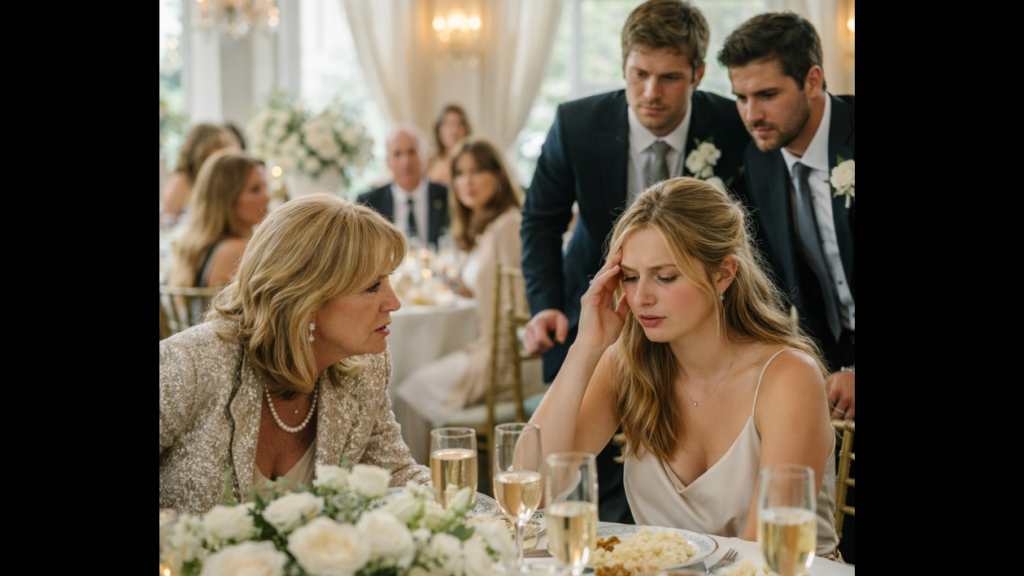
I knew something was wrong before my brain would admit it.
My sister, Felicity, was halfway down the aisle, veil glowing in the afternoon sun, string quartet playing Canon in D like we lived in a bridal magazine. I lifted my champagne flute for a little sip, more out of habit than thirst.
It tasted… wrong.
Bitter. Chalky. With this weird metallic aftertaste that made my tongue feel strangely thick.
I frowned, set the glass on my lap, and tried to convince myself it was just bad champagne. My sister was getting married. This was her moment. I was a bridesmaid in mauve chiffon. I was supposed to be smiling and dabbling at happy tears, not making faces at the drinks.
Then my hands started tingling.
At first it was just my fingertips, like when your hand falls asleep. Then it crept up my arms. My toes went next, then my feet. The quartet sounded like it was underwater. The edges of my vision blurred like someone had smeared Vaseline on my eyeballs.
I looked down at the champagne flute and knew, with cold certainty, that something was seriously wrong.
I tried to stand.
My legs didn’t cooperate.
I managed to lurch halfway into the aisle before a hand clamped around my arm and yanked me back down into my chair hard enough to make the world tilt.
“Sit down,” a voice hissed in my ear. “You’re making a scene.”
Felicity’s new mother-in-law, Diane.
Perfectly blow-dried, sixty-something, wearing pearls and an expression that made me feel six years old and caught doing something shameful. Her fingers dug into my bicep with surprising strength.
“I—I don’t feel…” I tried to say, but my tongue felt heavy, like it didn’t belong in my mouth.
“I know exactly what you’re doing,” she muttered so only I could hear. “You’ve been trying to steal attention from Felicity all week with your little complaints. You will not ruin this for her.”
I tried to tell her that wasn’t it. That my drink tasted wrong. That my vision was closing in like a camera lens. That my hands were going numb and my heart was racing and I couldn’t feel my feet.
The officiant said, “If anyone knows of a reason why these two should not be wed, speak now…”
I tried.
I opened my mouth to shout, Someone poisoned me.
Diane slapped her hand over my mouth so hard my teeth cut my lip. I tasted blood and something else—something chemical, bitter and wrong.
“Be quiet,” she breathed. “You can sleep it off later.”
I thrashed weakly, scratching at her wrist, trying to peel her fingers away. My muscles felt like they were moving through molasses. Sound warped in and out. Felicity’s voice reciting her vows came from a tunnel miles away.
My head lolled to the side.
Felicity glanced back at me, eyebrows pinched in irritation.
She thought I was being dramatic.
She thinks I’m trying to ruin her wedding, I realized, and the unfairness of that hit almost as hard as the fear.
The kiss happened. Applause erupted around us in a muffled roar. At some point, Diane removed her hand. I slumped forward into the person in front of me. They twisted around, ready to snap at me for being rude—then saw my face.
“Hey,” they said, voice shifting to concern. “You okay? You don’t look—”
I slid off the chair.
The grass was hard and unforgiving against my shoulder. The sky spun. Someone said my name distantly. Someone else called for water. I tried to say, Hospital. Poison, but the sounds came out tangled and thick.
Diane’s voice rose above the confused murmur.
“She’s drunk,” she announced. “I told her not to overdo it at the bridal suite. She always has to make it about herself.”
People pulled back, embarrassed on my behalf.
Two groomsmen I didn’t know knelt beside me at Diane’s direction.
“Help her up,” she said. “We’ll put her somewhere quiet to sleep this off. No need to ruin the reception.”
“I… need… help…” I tried to say. “Something… in the… drink…”
The groomsmen laughed awkwardly. “Wow, she’s gone.”
They lifted me under the arms. My feet barely brushed the ground as they half-dragged, half-carried me toward the mansion on the property. Out of the ceremony space. Away from the guests. Away from the string quartet and the cameras and the people who might have noticed how wrong this all was.
They took me up a back staircase and into a small room that smelled like dust and mothballs.
A storage room.
They dropped me onto a sagging couch.
The door closed.
The lock clicked.
Their footsteps retreated.
And I realized, in a bright, icy burst, that Diane hadn’t just dismissed my symptoms.
She had deliberately isolated me.
My phone was in my clutch back at my seat. No windows in here. No one else. Just racks of old decorations and boxes of linens.
I tried to sit up.
My body said no.
Time blurred.
At some point I heard voices outside the door.
“…she just needs to sleep it off,” Diane’s sharp tone said. “We’ll deal with her after the reception.”
“I don’t know,” a man’s voice replied. “She didn’t look okay, Di. Maybe we should—”
“I said we’ll deal with it later,” Diane snapped, voice low and furious. “This is Felicity’s day. I won’t have her sister’s theatrics ruin it.”
Footsteps. Fading.
I tried to scream then. Tried to throw something, bang on the door, anything.
Nothing moved.
My arms twitched uselessly. My chest felt tight, like an elephant was standing on it. Each breath was shallow. My heart fluttered weirdly in my chest.
My mom had died when I was twelve. Undiagnosed heart condition. One minute she was making pancakes, the next she was on the kitchen floor. Gone.
How poetic, some bitter, detached part of me thought. Mom’s heart gave out. Mine gets poisoned at a wedding.
My vision went black at the edges. Then completely.
I let go.
When I came back, the first thing I saw was a light being shined into my eyes.
“Pupils reactive,” someone said.
A paramedic. Blue uniform. Serious face.
“Can you hear me?” he asked. “Squeeze my hand if you can hear me.”
I tried.
My fingers moved a fraction.
“Good. Stay with us. You’re very sick, but we’ve got you.”
Another paramedic was taping an IV line to my arm. I could feel cold fluid entering my vein, making its way up my arm. A blood pressure cuff squeezed my other arm. I heard words like “dangerously low” and “bradypnea” and “charcoal.”
They lifted me onto a stretcher and wheeled me out.
We bumped down stairs. Around corners. The world tilted. My stomach rolled.
When they pushed me through a doorway back into the reception area, everything had changed.
No music.
No happy chatter.
Clusters of guests stood around looking shellshocked. Police officers moved from group to group, notebooks out. Flash of a camera. Evidence tags.
Diane was in handcuffs.
Her updo was unraveling. Her lipstick had worn off. She was screaming at the officers, voice high and shrill.
“I didn’t do anything! This is all a misunderstanding! Check her friends, she probably took something herself—”
They walked her past my stretcher.
Our eyes met.
Her face changed—just for a second—something dark flashing beneath the panicked housewife act. Then she turned away and started sobbing loudly.
My dad stood near the head table, still in his Father of the Bride tux, looking like someone had taken a hammer to his life. Felicity, in her perfect white dress, had black streaks down her cheeks from smeared mascara.
The dessert table was overturned, wedding cake smashed in a sad heap on the ground. White icing and fondant flowers smeared across the floor like it had been murdered too.
Then the doors of the ambulance closed and the scene disappeared.
The ER was fluorescent and cold.
They hooked me up to monitors that beeped relentlessly, measuring my heart rate, oxygen levels, blood pressure. A nurse poured black sludge—activated charcoal—into my IV while another inserted a second port.
“Your tox screen is lighting up,” a doctor explained. “There are very high levels of prescription sedatives in your blood mixed with another agent we’re still identifying. You’re lucky someone noticed you were missing when they did.”
She said “lucky” a lot.
Lucky I hadn’t finished the entire glass.
Lucky the venue coordinator had gone to check the storage rooms when someone mentioned I’d been taken inside and not seen again.
Lucky a server had told the police they’d seen Diane pouring something into a champagne glass.
Lucky.
“It wasn’t alcohol, then,” I managed to croak.
She shook her head. “No. You were drugged, not drunk. And whoever did it knew what they were doing. This was a dangerous mix.”
Detective Foster came in later. Mid-40s, gentle voice, notebook ready.
“I know you’re tired,” he said. “But the sooner we get your statement, the better.”
I told him everything I remembered. The taste of the champagne. The tingling. Diane’s iron grip on my arm. Her hand over my mouth. Being carried. The lock clicking on the storage room door.
He showed me photos of my champagne flute in an evidence bag. Someone had snapped it before the chaos.
All the flutes at the wedding had been custom engraved with the couple’s initials. Mine was the only one with residue on the inner rim.
“We’ve found Rohypnol,” he said, face tightening. “And traces of a veterinary sedative. We’re still waiting on full analysis, but the tox screen is… bad. This combination should have killed you.”
“Then why am I here?” I asked, voice hoarse.
“You didn’t drink all of it,” he said. “And they found you in time.”
They.
Not Diane.
Dad arrived sometime after midnight.
His tuxedo jacket was gone. His bow tie hung limp around his neck. His eyes were red and empty.
He sat beside my bed and held my hand carefully—like I might break.
“How are you feeling?” he asked.
“Like I got hit by a truck,” I said. “And then backed over.”
He tried to smile. It failed.
We stayed in silence for a while.
Then he said, quietly, “They found pills in her purse. Sleeping tablets. And GHB.”
Date-rape drug.
“She says she just wanted to make you sleepy,” he continued, voice breaking. “That you were making drama, that you’d ruin the day. She says she didn’t mean to… do this.”
We both knew that was bullshit.
“What did I ever do to her?” I whispered.
He looked so old in that moment.
“She thought you were jealous,” he said. “She thought you’d overshadow Felicity somehow. She’s been talking about it for months. I ignored it. I thought she’d just… calm down once the wedding was over.”
If the wedding had been over.
I wasn’t sure yet if I’d lived long enough to count.
Felicity came the next morning.
The last time I’d seen her, she’d been radiant at the altar, annoyed with me for “making a scene.” Now she looked wrecked. Wedding makeup gone, hair half fallen out of its updo, wearing sweats with “BRIDE” across the chest like a joke.
She sat on the edge of the bed and took my hand.
We both cried for a while.
“She was in my ear for months,” Felicity said eventually. “About how you’d try to make it about you. How you’d show up in something inappropriate. How you’d complain or pick a fight. I told her to stop. I thought she was just being a controlling mother-of-the-groom.”
She shook her head.
“I didn’t realize she was setting you up.”
The toxicology report came back three days later.
Rohypnol.
Prescription sedatives.
A veterinary tranquilizer Diane had access to from a part-time job at an animal clinic.
The doctor told me flatly, “If you’d drunk the whole glass, you would be dead. No question.”
The police found searches on Diane’s computer for “make someone seem drunk,” “slip sleeping pill into drink without taste,” and “how long until someone dies from overdose.”
They also found texts to her sister:
We have to keep an eye on Felicity’s annoying little sister. She’ll ruin the photos if she starts drama. Might be better if she’s not around during the important parts.
Her lawyer tried to spin it in court.
“She was under stress.”
“She misjudged the dose.”
“She never intended harm.”
The evidence didn’t care about spin.
Security footage showed her picking up a champagne flute from a server’s tray, stepping behind a column with it, then putting it back in the exact place that would be handed to me based on the seating chart.
Witnesses testified.
Servers.
Guests.
Even one of the groomsmen who’d carried me.
“I thought she was drunk,” he said on the stand. “Then I saw the footage. I… I helped move her instead of calling 911. I’ll live with that.”
Diane sat at the defense table, face slack.
When the judge read “guilty” on all counts—attempted murder, aggravated assault, false imprisonment—she didn’t flinch. Not once.
It felt surreal.
Nothing about what had happened felt like justice.
Just… less injustice.
Recovery wasn’t linear.
The nerve damage from the drugs meant my hands shook all the time. Simple things like holding a fork or writing my name became skills I had to relearn in physical therapy.
Sometimes my legs just… forgot how to cooperate. I’d be walking, and suddenly I’d veer sideways like a drunk sailor.
So I dropped out of community college for a semester. Then another.
Felicity, with her master’s degree and six-figure salary, could have easily made me feel small.
She never did.
“You survived a murder attempt,” she’d say when I got frustrated with myself. “You don’t have to prove anything to anyone.”
Social media turned it into a circus.
Local news picked up my story. National outlets grabbed it for a slow news day. “Bridesmaid Poisoned at Sister’s Wedding” made for great clickbait.
Strangers dissected my life in comment sections.
Some believed me.
Some said I must have done something to provoke Diane.
Some said I’d faked it for attention.
Some said I was obviously angling for a lawsuit payout.
I read too many of those comments.
Dad eventually blocked the news sites on the home Wi-Fi because I couldn’t stop doomscrolling.
“We know the truth,” he’d say. “Let them scream into the void.”
Sentencing day, the courtroom was packed.
Trauma porn sells.
The prosecutor asked for the maximum. Twenty-five years.
My victim impact statement shook in my hands as I read.
“I can’t hold a cup of coffee without thinking about that champagne flute,” I told the judge. “I still wake up thinking I’m locked in a dark closet with my lungs filling up with cement. I avoid weddings. I don’t drink anything I haven’t opened myself. I jump when someone walks up behind me. This doesn’t end just because the headlines stop.”
Diane’s lawyer asked for leniency.
“She’s a respected member of the community. No prior record. This was a moment of poor judgment. She has expressed remorse.”
Had she?
She sent me a letter from jail a few years later about how Jesus had forgiven her and so should I. It felt more like she was sorry about being caught than about me almost dying.
The judge called her actions “chilling in their calculation” and sentenced her to eighteen years in prison, with parole possible after twelve.
Diane cried then. For herself.
She turned to look at Jeffery, her son—Felicity’s husband.
He stared back at her like she was a ghost.
Then stood and walked out.
It’s been years now.
The tremors are better, but they never fully went away. I’ve learned to type through them, to sign my name despite the jitter, to tell new people, “No, I’m not nervous. Just… rewired.”
I went back to school. Changed my major to criminal justice.
It felt right to stand on the other side of the courtroom eventually.
I interned with the DA’s office during law school. Helped prep cases. Met victims whose stories made my skin crawl in familiar ways.
I never told most of them why I cared so much.
They didn’t need to know I understood how it felt to have your trauma questioned by strangers, by lawyers, by systems happier to poke holes in your story than to hold harm accountable.
Felicity and Jeffery moved away. They had twins they named after everyone but Diane. Their kids know me as the aunt who always asks to see the juice box opened first. Who laughs it off and says she’s just picky.
One day, my mail brought another envelope from a corrections department.
Diane’s first parole hearing.
We had the right to attend, to speak, to support or oppose.
Felicity and I decided we’d send statements but not sit in the same room as her.
I wrote my letter slowly.
Explained that what happened wasn’t a “mistake,” it was a choice. That my life had been permanently altered. That her actions had radiated out—through my health, my education, my relationships, my sense of safety.
The parole board denied her.
“Lack of genuine remorse,” the report said. “Failure to fully acknowledge harm caused.”
She’ll reapply again in two years.
We’ll write the letters again.
It’s a second sentence layered on top of my own.
People love to ask victims about forgiveness.
“Do you forgive her?” they’ll say, eyes soft with a kind of voyeuristic hunger.
Still others will lean on faith language. “Forgiveness is for you, not for them.”
I’ve thought about it a lot.
What I usually say now is this:
I don’t owe her forgiveness.
She planned to kill me. She drugged me. She locked me in a room and tried to let me die so her son’s wedding photos would be unblemished.
Her choices are hers.
My healing is mine.
Some wounds close. Some become part of the architecture of who you are—scar tissue and all.
I didn’t choose to be the girl whose sister’s wedding turned into a crime scene in under twenty minutes.
But I did choose what came after.
Law school.
Victim advocacy.
Boundaries as thick as steel.
A life where I get to help other people stand up in court and say, “This happened to me, and it matters.”
That’s the part of the story that belongs to me—and that no one ever gets to poison.
Leave a Reply