The text came on a Thursday afternoon while I was standing in the grocery store checkout line, balancing a basket on my hip and trying to calculate whether the name-brand cereal was worth the extra two dollars when Mason would eat it in three mornings and ask for something else by Wednesday. The fluorescent lights hummed above me, and the conveyor belt squeaked every time the woman in front of me nudged her items forward. A toddler somewhere near the pharmacy aisle was crying with the kind of stamina that made you wonder if they ever got tired, and the cashier’s scanner beeped in a steady rhythm that felt like a metronome keeping time for everybody’s small, ordinary decisions.
I had two boxes of cereal in my basket: one with a smiling cartoon tiger promising “extra crunch” and “whole grain goodness,” and the other in plain packaging with a picture that looked like the photographer had taken it with a sigh. The generic one cost less and tasted like it knew it. I was staring at them like they were philosophical arguments instead of breakfast when my phone buzzed.
I thought it might be Jake asking if we needed anything else, or maybe a school email reminding me about spirit day, or even one of those automatic pharmacy texts telling me my prescription was ready. Instead, it was my mother.
“Elena, honey, we can’t make Mason’s birthday. Really tight month financially. I’m so sorry.”
For a moment, the grocery store fell away. The toddler’s crying went muffled, the beeping scanner turned distant. I read the message once, then again, slower, like the meaning might rearrange itself if I stared hard enough. I could feel my pulse in my fingertips, especially the one holding the phone. I could smell the harsh scent of hand sanitizer and the ripe sweetness of bananas in my basket, and I remember thinking—ridiculous, automatic—how my mother always used the word “honey” when she needed something.
Mason was turning seven.
Seven is old enough to count candles without help. Old enough to memorize the shape of a promise and notice when it breaks. Old enough to stand at a window and wait for a car that never turns into the driveway. Old enough to feel the absence of people who are supposed to show up simply because they love you.
I typed back what I always typed, the response so practiced it seemed to come from muscle memory rather than thought.
“No worries, Mom. We understand.”
And that was the problem. We always understood. We understood when they couldn’t visit. We understood when they “had a lot going on.” We understood when they forgot Mason’s preschool graduation because Dad had a “rough day.” We understood when they didn’t call for weeks and then suddenly called on a Tuesday night because something was “urgent.” We understood when the guilt was planted softly, like a seed, in the middle of a casual conversation: “Utilities are just outrageous these days,” or “We didn’t expect the medication to jump like that,” or “It’s so hard on a fixed income, sweetheart, you have no idea.”
For three years, I had been sending my parents eight hundred dollars every single month. Thirty-six months. Twenty-eight thousand eight hundred dollars. I knew the number because I had done the math more than once, usually at night when the house was quiet and sleep would not come, when the ceiling looked too close and my mind replayed old conversations like a film stuck on a loop. Sometimes I would open the calculator app just to see the number again, like confirming it would change something.
Jake thought I was being naive. He never said it like an insult. Jake wasn’t that kind of man. If anything, his honesty was his most consistent habit. He would sit at the kitchen table with the budget spreadsheet open, his reading glasses pushed up on his forehead, and he would tap his pen against the paper in that way he did when he was trying not to sound harsh.
“They own their house outright,” he would say gently, not accusing, just practical. “Your dad has a pension. Your mom has Social Security. What are we actually covering?”
And I would lift my shoulders, as if uncertainty could be shrugged off. I would say what daughters say when they want to keep the world intact, when they want their parents to remain parents and not become something smaller.
“Dad’s medication,” I’d remind him. “They said it’s gone up.”
Jake would sigh. “Medication costs don’t jump by eight hundred dollars a month every month for three years.”
“Utilities,” I’d say, because my mother had said it with that weary, helpless tone. “And groceries are expensive.”
Jake would look at me, eyes steady. “So are ours.”
But they were my parents. They raised me. They gave me a childhood full of the kind of stability you don’t recognize until you’re older and realize other people didn’t have it. They drove me to soccer practice. They came to my school plays. Dad built a treehouse in the backyard with my name carved into one plank, the letters slightly crooked because he’d rushed and then pretended he hadn’t. Mom packed lunches with little notes on napkins. When I was ten and broke my arm falling out of that same treehouse, my father carried me to the car like I weighed nothing at all, his hands shaking in a way I didn’t understand until I had a child of my own.
So when they said they needed help, I believed them. I believed the story of rising medication costs and unexpected bills because the alternative was something uglier: that they didn’t need the money, they just wanted it. That they were using me.
Because daughters are conditioned to believe. Conditioned to keep the peace, to smooth the edges, to make sacrifices quietly and then call them love.
Mason’s party was simple. Twelve kids in our backyard, which meant twelve pairs of shoes kicked off in a messy pile by the porch, twelve shrieking voices ricocheting off the fence, twelve sticky hands reaching for juice boxes. I put up dollar-store decorations after the kids went to bed the night before, stringing cheap plastic banners between the patio posts while mosquitos found every inch of exposed skin. The banner sagged in the middle, but I told myself it looked festive. I made a homemade chocolate cake that leaned slightly to one side because I misjudged the frosting thickness, and I told myself Mason would remember the taste, not the angle.
That morning, I woke up early and watched my son sleeping. His hair was messy, one arm flung over his head in a dramatic pose like he had already lived too many adventures in his dreams. He looked so big to me in that moment. Seven. I remembered when he was born, the way his tiny fist had wrapped around my finger, the way I had stared at his face and felt the world shift into a new shape. Back then, I had promised him silently that he would never doubt he was loved.
He asked three times when Grandma and Grandpa were coming.
The first time, he asked while I was laying out paper plates and counting them like it mattered. “Are Grandma and Grandpa coming before the kids?”
“They’re busy today, buddy,” I told him, smiling too hard. “But they love you.”
He nodded, accepting it the way children accept most things when they trust you.
The second time, he asked when he was putting on his new shirt, the one with a dinosaur wearing sunglasses. “Will Grandpa come later?”
“They couldn’t make it,” I said, and I reached out to straighten his collar even though it was already straight. “But you’re going to have so much fun.”
He nodded again, but his eyes flicked toward the driveway, like his hope had a habit of checking anyway.
The third time, he asked right before we lit the candles. The kids were gathered around the table, their faces flushed from running, their fingers already twitching toward the cake. Mason leaned close to me and whispered, “Are they coming at all?”
The question had a softness that hurt. Like he was offering me one last chance to change the answer.
“They’re busy,” I whispered back, and my throat tightened. “But look at all your friends. Make a big wish, okay?”
He nodded every time, but his smile dimmed a little more each hour, like someone turning down a light.
The party ended in the late afternoon with wrapping paper scattered across the grass like confetti after a parade. Kids left with goodie bags and sugar highs. I watched them tumble into cars, watched their parents wave, watched the quiet settle back into our yard like dust. Jake gathered trash bags, humming absentmindedly. I scraped frosting off plates and tried not to think about who wasn’t there.
That night, after Mason brushed his teeth and crawled into bed, he hugged me tight and said, “It was the best day ever.”
His voice was sincere. It made me want to cry and smile at the same time.
I tried to hold onto that. I tried to wrap it around me like a blanket: best day ever, best day ever, best day ever. I told myself that was enough.
Then, the next morning, my phone lit up with a notification. Instagram. A story from my sister Veronica.
“Best auntie ever. Threw my babies the party of their dreams.”
At first, my brain didn’t connect the words to anything. It was just Veronica being Veronica—always dramatic, always declaring something as “the best” or “the cutest” or “literally perfect.” I clicked without thinking, because a part of me still wanted to feel close to my family, even through a screen.
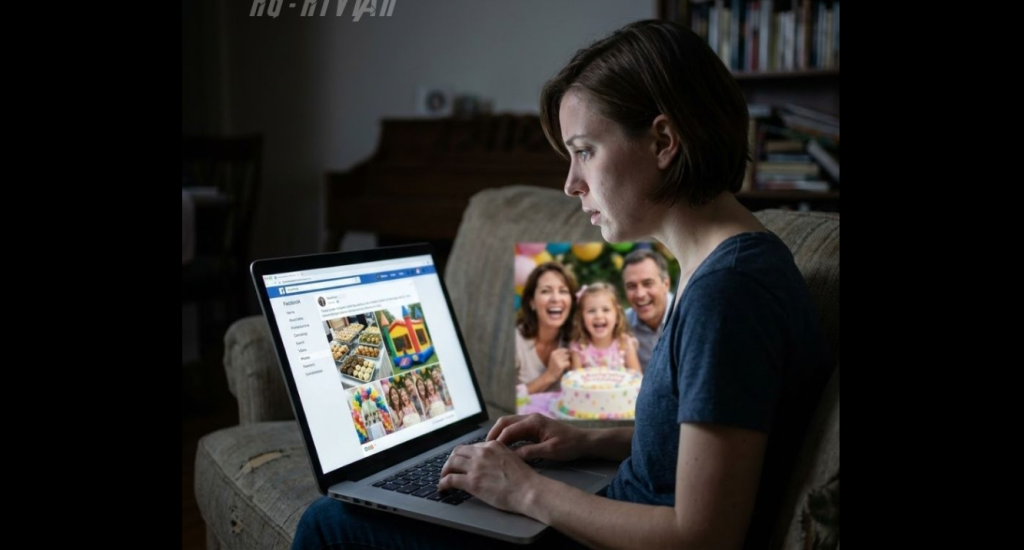
There were twenty-three photos.
A massive bounce house that looked like a small inflatable castle, its bright colors shouting joy. Professional catering with a taco bar—little metal trays of seasoned meat, bowls of guacamole, stacks of tortillas. Designer decorations that didn’t sag, that didn’t look like they’d been bought under fluorescent lights at the dollar store. Balloon arches spelling out “Happy 5th Birthday” in rose gold, each balloon glossy and perfect. Stacks of wrapped presents arranged like an intentional display instead of a pile of love.
And in the middle of photo number seven—my mother, smiling wide, holding my niece. My father beside her, laughing like nothing in the world weighed on him.
The date stamp was the day after Mason’s party.
The day after they were too financially tight to attend.
My hands started shaking so hard I nearly dropped the phone. I sat down on the couch because my knees suddenly didn’t feel like they could hold me. My stomach did that strange hollow flip, like I had missed a step on the stairs. I stared at the photo, zoomed in on my mother’s face, on my father’s expression. They looked happy. Not tired, not worried, not burdened by a “tight month.” Happy. Like they were exactly where they wanted to be.
Mason padded into the living room, still in pajamas, dragging his favorite blanket behind him like a tail. He climbed beside me, leaning into my shoulder the way he always did in the morning.
“What are you looking at?” he asked, voice sleepy.
I didn’t answer fast enough. My silence became an invitation, and he looked at the screen.
He didn’t say anything at first. His eyes moved over the photos with a slow, careful attention that made him seem older than seven. He saw the bounce house. The taco bar. The balloon arch. He saw Grandma and Grandpa smiling like they had no trouble showing up when they wanted to.
Then, quietly, like he was stating a fact he had already accepted and learned to carry, he said, “They always have money for them.”
It wasn’t angry. It wasn’t dramatic. He didn’t throw a tantrum or demand fairness the way I might have at his age. It was tired.
That’s what broke me.
Not the photos. Not even the lie. It was the weariness in my child’s voice, the resignation. The sense that he had already begun adjusting his heart to fit the shape of disappointment.
I closed the laptop like snapping shut a door, but the image stayed behind my eyes anyway. Mason got down from the couch and wandered toward the kitchen to ask Jake for pancakes, and I sat there, hands trembling, feeling like someone had peeled back a layer of my life and exposed something raw underneath.
That night, I cried into my pillow like I hadn’t cried since Mason was born. Those first weeks postpartum when hormones and exhaustion had turned everything into a storm, I had cried because I was overwhelmed and terrified. This time, I cried because I finally understood something that made me feel small and foolish.
Jake held me and didn’t offer solutions. He didn’t rush into action or tell me what I “had to do.” He just wrapped his arms around me, his hand steady on my back, and he asked one question into the dark.
“What are you going to do?”
The question hung in the air. It wasn’t a demand. It was a doorway.
The next morning, I opened my banking app with the kind of calm that comes when a decision has been made somewhere deep, before you can talk yourself out of it. The recurring transfer glowed on the screen, cheerful and neutral as if it weren’t tied to the sick feeling in my stomach. $800. Scheduled for the first of every month.
Thirty-six completed transfers.
I stared at the line item and felt time stretch behind it like a long road. Three years of telling myself it was temporary. Three years of handing them part of our life—part of Mason’s life—because I thought that was what love required.
My thumb hovered.
I tapped “cancel recurring transfer.”
The app asked if I was sure.
Yes.
I pressed confirm.
I expected guilt to flood in immediately, like it always did when I said no to anyone. I expected to feel like a bad daughter. Instead, something inside me felt strangely weightless, like I had been carrying a heavy bag for so long I didn’t realize how much it bent my spine until I put it down.
For five days, nothing happened.
Those five days were oddly quiet. I kept checking my phone, waiting for the call, the text, the guilt-soaked voicemail. I imagined my mother’s voice: “Sweetheart, there must be a mistake.” I imagined Dad’s stern disappointment. I imagined the extended family whispers. I braced myself the way you brace for a storm, watching the sky.
Jake watched me watching. He didn’t say much. He made coffee in the morning and kissed my forehead and asked Mason about school and kept our life moving, as if steadiness could anchor me.
On the sixth morning, at 8:47 a.m., someone began pounding on our front door so hard the windows rattled.
Not a polite knock. Not the hesitant tap of a neighbor. This was force, anger made physical.
Mason froze at the kitchen table mid-bite of pancake, syrup glistening on his lip. His eyes went wide, and for a second he looked like the toddler in the grocery store aisle, startled by noise and not sure if it meant danger.
Jake glanced at me over the coffee mug in his hand, his jaw tightening.
I stood up slowly and walked to the door. My heart was beating hard, but my mind felt sharp, like it had been waiting for this moment.
I looked through the peephole.
Dad.
Red-faced. Furious. His mouth was already moving like he couldn’t hold the words inside.
“Elena Marie Thompson!” he shouted, and the sound of my full name hit me like a slap. It was the name he used when I was a teenager and had broken curfew, when I had dented the car, when I had argued too loudly and needed reminding that he was the authority. It carried the weight of ownership.
I opened the door, keeping my body between him and the inside of our home.
“What the hell do you think you’re doing?” Dad demanded, not even pretending to greet me.
“Good morning, Dad,” I said, because something in me refused to give him my fear.
“Don’t you good morning me. Where’s the transfer?”
“It’s gone.”
For a second, his face went blank, like his brain couldn’t process the words. Then his expression twisted.
“Gone? What do you mean, gone?”
“I canceled it,” I said simply.
Behind him, tires squealed in the driveway. A familiar car—my mother’s—came in too fast, gravel spraying. She rushed up the walkway, already crying, her hands flapping at the air as if tears needed somewhere to land.
“Elena, sweetheart, what’s happening? Are you in trouble?” she asked, as if my canceling the transfer must mean I was the one in crisis.
I looked from her to Dad, and something in me hardened, like wet clay drying into shape.
“I saw the photos,” I said.
They both stilled. It was subtle, but I saw it: the quick flash in my mother’s eyes, the tightness at the corners of my father’s mouth.
“What photos?” Mom asked, but the question was thin. She already knew.
“From Veronica’s party,” I said. “The one you could afford to attend the day after you couldn’t afford Mason’s.”
Dad’s jaw tightened so hard I could see the muscle jump.
“That’s different,” he said.
“How?” My voice didn’t rise; it didn’t need to. “Explain how it’s different.”
“Veronica is going through a divorce,” Dad snapped, as if that ended the argument. “Those kids need stability.”
“And Mason doesn’t?” I said.
Dad glanced past me and noticed Mason standing behind my leg, half-hidden, his small hand clutching the hem of my shirt. He had come to the hallway without making a sound, drawn by the pounding. His eyes were wary, watching his grandparents like you watch a dog that might bite.
My father’s face shifted, his anger momentarily rearranging itself into something like caution.
“Elena, let’s talk privately,” he said, lowering his voice.
“No,” I said. The word landed firm. “Mason deserves to hear this. He’s the one you hurt.”
Mom sobbed louder, making a noise that used to trigger my instinct to comfort her. For most of my life, my mother’s tears had been a weather system I learned to navigate: avoid storms, calm the sky, keep things peaceful. This time, her crying felt like a tactic, a reflex that expected me to bend.
“We love all our grandchildren equally,” she said, wiping her face, her mascara smudging.
“Do you?” I asked.
Dad’s voice hardened. “It’s our money once you give it to us.”
And there it was. The truth, stripped down.
Something in me went cold and clear.
“You’re right,” I said calmly. “It was. And now it isn’t.”
“You can’t cut us off,” Mom gasped, like I had threatened to turn off oxygen.
“We depend on that money,” Dad said, and the indignation in his voice surprised me, as if he had the right to it.
“For what?” Jake’s voice came from behind me. Calm. Steady. He stepped into the hallway, his presence like a wall at my back. “The house you own free and clear?”
Dad’s eyes flicked to him, and I saw irritation flare—he didn’t like being challenged by my husband, as if Jake had stepped out of his role. My father had always treated Jake politely, but there was a quiet hierarchy in his mind: fathers above sons-in-law, older men above younger. This was new territory.
Silence stretched.
Jake continued, still calm. “We checked property records. No mortgage. So what exactly requires eight hundred dollars a month?”
Neither of them answered. My mother’s crying faltered, as if even she couldn’t find a story fast enough.
Mason’s small hand slipped into mine, and I squeezed it.
“I’m done,” I said quietly. “No more money.”
Dad’s face went a deep, dangerous red. For a second, I thought he might shout again, might slam his fist into the doorframe. But he didn’t. He just stared at me with a look I had never seen before—like he didn’t recognize me, like I had stepped out of the script.
My mother made a sound between a sob and a gasp, then turned toward the driveway. Dad followed, muttering something under his breath. They left angry. Humiliated. And I stood there in the doorway watching them go, my body buzzing with adrenaline, my hand still wrapped around my son’s.
Within hours, the extended family grapevine exploded.
The first call came from my aunt Linda, who had always spoken like she was reading from a moral handbook. “Your mother is beside herself,” she said, skipping hello. “How could you do this? They’re your parents.”
Then my cousin Amber texted: You really cut them off?? That’s cold.
Then my uncle Roy called and left a voicemail that started with “Listen” and ended with “family helps family.”
Jake’s phone rang too—Veronica’s number, which he ignored.
I didn’t respond. Every message felt like pressure, like hands trying to push me back into place.
That night, Mason asked in a small voice, “Are Grandma and Grandpa mad?”
I looked at him and felt the familiar urge to shield him, to make everything easy. But I also felt something else: the need to tell him the truth in a way a child could hold.
“They’re upset,” I said. “But sometimes grown-ups make mistakes, and they don’t like being told.”
“Did they make a mistake with my birthday?” he asked.
My throat tightened.
“Yes,” I said softly. “They did.”
He nodded as if adding it to a list of facts about the world. Then he went back to coloring, the tip of his tongue poking out in concentration.
Two days later, my grandmother called.
Grandma Rose didn’t call often. She was in her late seventies and had a voice like crisp paper, sharp and sure. She lived six hours away and hated driving at night. When she called, it was usually to tell me about her garden or ask if Mason was still “that sweet boy with the serious eyes.” Her calls were small gifts.
This one began without pleasantries.
“I heard what happened,” she said in her crisp voice. “About damn time.”
I sat down hard on the couch, my legs suddenly weak.
“What?” I said, because my brain couldn’t fit her words into the shape of what I expected.
“I’ve watched your father manipulate money for thirty years,” she continued. “He borrowed from me the same way. Crisis after crisis. Always something. Always urgent. Always just until next month.”
I stared at the wall, my mouth slightly open.
“Why didn’t you tell me?” I whispered.
“Because you wouldn’t have believed me,” Grandma Rose said, not unkindly. “You loved the idea of him too much. You still do, probably.”
I swallowed. “Do they… do they need it?”
“They don’t need your money,” she said firmly. “They like having it.”
After I hung up, I sat there for a long time. Jake came in and found me staring into nothing. He didn’t ask questions. He just sat beside me, his shoulder touching mine, quiet solidarity.
In the following days, my mind rewound the last three years and began to replay scenes with new lighting. The phone calls that started with “Sweetheart” and ended with “We’re so embarrassed to ask.” The way my father would clear his throat when money came up, as if the words tasted bitter but necessary. The way my mother’s voice would tremble, the pause that invited me to fill it with reassurance. The way they never asked how we were doing financially, as if our stability was assumed and therefore endless.
I thought about the nights Jake and I had sat at the kitchen table deciding whether we could take a vacation this year, deciding whether to replace the aging car now or “make it work” another year, deciding whether Mason could do the extra soccer clinic. I thought about the quiet compromises that had stacked up like plates in a sink, each one manageable alone, heavy together.
Three weeks after I canceled the transfer, Dad showed up alone.
It was a Saturday. The sky was gray, the kind of overcast that makes everything look flatter. Mason was in the backyard kicking a soccer ball against the fence, practicing, counting his kicks out loud. Jake was in the garage trying to fix the lawnmower, swearing softly in a way he thought Mason couldn’t hear.
When the doorbell rang, I expected another relative with an opinion. I opened the door and found my father standing there with his hands shoved into his jacket pockets, his shoulders slightly hunched.
He looked smaller.
Not just older—though he did look older, like the weeks had carved extra lines into his face—but diminished, like the certainty he usually wore had been peeled away.
“Can we talk?” he asked, voice rough.
I hesitated, then stepped aside. “Come in.”
He walked into our living room as if it belonged to someone else, as if he wasn’t sure he had the right to be there. He didn’t sit at first. He stood near the couch, staring at the family photos on the wall: Mason at three, grinning with missing teeth; Jake and me at our wedding, laughing; a picture of Mason with his first soccer trophy.
“I did the math,” Dad said finally.
I crossed my arms. “What math?”
He exhaled, like he had been holding his breath for days. “Where the money went.”
My stomach tightened. “Okay.”
He sat down slowly, his hands clasped between his knees. “Veronica’s car payments,” he said, looking at the floor. “Private preschool. Divorce lawyer retainer. Furniture. Four separate birthday parties.”
Each item landed like a stone.
“None of it was for us,” he admitted, and his voice cracked on the word “us.”
I stared at him, my thoughts moving sluggishly, like my brain was wading through thick water. “So you lied,” I said, because naming it mattered.
He flinched. “Yes.”
“Why?” The word came out as a whisper, like anything louder would shatter something.
He swallowed hard. “Because she asked,” he said. “Because she cried. Because I wanted to fix it.”
“And me?” My voice rose, not into a scream but into something raw. “What about me?”
He looked up then, and his eyes were wet. “You never cried,” he said. “You just paid.”
That hurt more than anything he could have said. It wasn’t just an explanation; it was an indictment of the role I had been assigned. The reliable one. The one who didn’t make trouble. The one who didn’t demand attention. The one whose needs could be assumed to be met because she didn’t complain.
I opened my mouth, but no words came out. My throat closed around them.
The doorbell rang again.
Dad’s head snapped toward the sound, as if he knew. As if he had expected it.
I stood up and walked to the door with a slow dread. When I opened it, Veronica stood there, her eyes blazing, her hair pulled into a tight ponytail that made her look sharper. She had always been beautiful in an effortless way, the kind of woman who could wear leggings and still look like she belonged in a magazine. She also had the kind of charisma that could turn a room toward her without trying. When we were kids, teachers praised her confidence and described me as “so sweet.”
She pushed past me without invitation.
“You’re choosing her?” she demanded, pointing at me as if I were a betrayal made flesh.
“Veronica,” I said, my voice tight. “This is my house.”
She ignored that. She turned to Dad, her face contorting. “After everything, you’re choosing her?”
Dad stood up slowly, his shoulders squaring. “I’m choosing what’s right,” he said.
Veronica laughed sharply. “What’s right? What’s right is you helping your daughter who is falling apart.”
“You’re not falling apart,” I said before I could stop myself. “You’re throwing parties.”
Her eyes flashed toward me, full of fury, then something flickered behind it. Her chin trembled.
And then she broke.
“I can’t keep pretending,” she sobbed suddenly, collapsing into the sound like she had been holding it back for years. “I’m drowning.”
The words hung in the air. Jake came in from the garage, wiping grease off his hands, his eyes taking in the scene quickly. Mason’s soccer ball thumped against the fence outside, the rhythm of his counting faint through the glass.
We went inside. All of us. Like a storm herded into one room.
Veronica sat on the couch, shoulders shaking. Dad stood near the window, staring out as if the outside world could offer an escape route. I sat in the armchair with my hands clenched in my lap, feeling like my body was both numb and buzzing.
Veronica admitted she’d been compensating for her failing marriage with appearances. Big parties. Expensive things. Trying to look stable when she wasn’t. She talked about her ex-husband’s coldness, his constant criticism, how she felt like she was failing as a mother and a wife, how she tried to plug the holes in her life with glitter and balloon arches.
“It sounds stupid when I say it out loud,” she whispered, wiping her nose. “But when everyone was looking at the party, when people were taking pictures and saying it was amazing, I felt… I felt like maybe I wasn’t falling apart. Like maybe I could still be the girl who has it together.”
Dad admitted enabling her. “I thought I was helping,” he said, voice thick. “I thought I was protecting her from more pain.”
“And you used me to do it,” I said, because it needed to be said.
He nodded, shame etched into his face.
Veronica looked at me, her eyes red. “I didn’t know it was your money,” she said quickly. “I thought it was… I thought it was Mom and Dad’s savings.”
I stared at her. “You never asked?”
Her cheeks flushed. “They told me they could help,” she said, and her voice shifted into defensiveness again. “They said it was fine.”
Something about that—how easily she accepted help without looking for the cost—made anger flare in me. But beneath the anger was a dull ache. This was the family pattern laid bare: Veronica’s needs loud, urgent, constantly addressed; my needs quiet, therefore optional.
The conversation lasted until Mason came inside, cheeks pink from playing, and asked, “Can I have a snack?” in the middle of Veronica’s confession. The normality of his request punctured the heaviness like a needle. Jake got him apple slices. Mason looked at the adults’ faces, sensed the tension, and retreated to his room with his snack, the door clicking shut.
After Dad and Veronica left that day, my house felt like it had been through a windstorm. It was still standing, but everything inside had shifted.
I thought that was the end, or at least the beginning of an end. I thought the truth—Dad admitting the money wasn’t for them—was the last layer. I didn’t know there were deeper layers still.
Three days later, Veronica called me panicked.
Her voice was breathless, brittle. “I found something in Mom’s email.”
My stomach dropped. “What do you mean?”
“I was looking for something else,” she said quickly, like she needed me to know she wasn’t snooping for sport. “Mom asked me to print a school form for the kids from her computer because her printer works better, and she left her email open. And there were… there were messages. About you.”
About me.
The phrase made my skin go cold.
“What messages?” I asked.
Veronica swallowed audibly. “They refer to your transfers as… as ‘guilt money.’”
The room tilted slightly. I gripped the kitchen counter hard enough to feel the edge bite into my palm.
“Guilt money?” I repeated.
“There are emails joking about how ‘easy’ it was,” Veronica said, her voice cracking. “About how you always pay because you feel guilty if you don’t. There are emails discussing investments. And—Elena—there’s something about an Alaskan cruise.”
My vision went white, like a camera flash had gone off inside my head. The sound of the refrigerator hum turned loud and distorted. For a moment, I couldn’t breathe properly.
An Alaskan cruise.
While I stood in grocery store lines debating cereal.
While Mason waited for grandparents who were “too tight financially.”
I didn’t say goodbye. I just ended the call. My hands were shaking so hard I could barely grab my keys. Jake asked what was wrong, and I said, “I have to go,” without explaining, because if I tried to explain, I would fall apart on the kitchen floor.
I drove to my parents’ house without knocking.
The drive felt both too fast and too slow. Every red light felt like an insult. My mind replayed my mother’s “honey” and my father’s stern “where’s the transfer” like a soundtrack. When I pulled into their driveway, my chest was tight, and my hands were slick on the steering wheel.
I walked up to their front door and opened it with the spare key that still hung on my keyring out of habit, out of the belief that I belonged there.
Mom was in the kitchen, stirring something in a pot. Dad sat at the table reading the paper like it was any ordinary day. The domestic normality made my anger spike.
They looked up in surprise.
“Elena?” Mom said, startled. “What are you doing here?”
I didn’t take off my shoes. I didn’t sit. I stood in the doorway like a storm.
“Guilt money?” I asked.
Mom’s face shifted—first confusion, then annoyance, then something like caution. Dad’s paper lowered slowly.
“What are you talking about?” Dad asked, but his voice lacked conviction.
“I’m talking about the emails,” I said. “The ones where you call my money ‘guilt money.’ The ones where you joke about how easy it is to get it from me. The ones where you discuss investments and a cruise.”
Mom’s mouth tightened. Then, unbelievably, her expression settled into irritation.
“You weren’t supposed to see that,” she said.
No denial. No shock. Just irritation at being caught.
It was like a door inside me slammed shut.
Dad broke first. Real sobbing. Not the controlled, dignified tears I had seen once at his father’s funeral. This was messy, choking grief.
“We justified it,” he choked, pressing his hand to his face. “We thought you could afford it. We thought—God, we thought it wasn’t hurting you. We thought… we thought it was just a way to help Veronica without admitting we were doing it.”
Mom crossed her arms, staring at the countertop like it offended her. “It felt powerful,” she said finally, as if confessing a small indulgence rather than a betrayal.
Powerful.
That was the moment I stopped seeing them as my parents in the way I had always seen them. The protective aura of “Mom” and “Dad” cracked and fell away, and underneath were just people. Flawed. Greedy. Small. People capable of cruelty wrapped in familiarity.
I felt strangely calm.
“I want you to tell everyone,” I said.
Mom’s head snapped toward me. “Tell everyone what?”
“The truth,” I said. “All of it. The lies. The emails. The investments. The cruise. The fact that you used me and then laughed about it.”
Dad looked up, his eyes red, horror and shame battling in his expression. Mom’s jaw clenched.
“No,” she said automatically. “That’s private.”
“No,” I said back, and my voice was steady in a way that surprised even me. “You made it public the moment you let the family call me cruel. The moment you let them think I cut you off when you were struggling. The moment you painted me as the selfish daughter. You tell them, or I will.”
Dad’s shoulders slumped. “Elena,” he whispered, like my name was a plea.
I stared at him and felt the old pull of compassion, the old desire to fix, to smooth. Then I thought of Mason’s tired voice: They always have money for them.
And I held my ground.
Two days later, Grandma Rose drove six hours and forced a confession at a family meeting.
The meeting happened at my aunt Linda’s house, because she had the biggest living room and also because she loved hosting gatherings where she could control the narrative. Folding chairs were set up in a half circle like a support group. People brought casseroles no one touched. The air smelled like coffee and tension.
I arrived with Jake and Mason. Mason clung to my hand, sensing the strange energy. He asked why everyone was there, and I told him it was “grown-up stuff,” though I knew he would absorb more than I wanted.
Mom and Dad sat on the couch, stiff. Veronica sat in a chair near the corner, her face pale, eyes swollen from crying. Grandma Rose sat front and center like a judge, her purse on her lap, her spine straight, her gaze sharp.
When the accusations started—How could you cut them off? They’re your parents—Grandma Rose lifted one hand.
“Shut up,” she said, and the room actually went silent. It was the kind of authority that didn’t require volume.
She turned to my parents. “Tell them,” she said.
Mom’s lips pressed together. Dad’s hands trembled.
“What is this?” Aunt Linda demanded, offended.
“This,” Grandma Rose said, “is the truth catching up.”
My parents admitted everything.
The lies about needing the money for medication and utilities.
The fact that the house was paid off.
The fact that the money went to Veronica’s car payment, preschool, lawyer, furniture, parties.
The emails calling it “guilt money.”
The jokes about how easy it was.
The investments.
The Alaskan cruise.
Gasps rippled through the room. Aunt Linda’s face went through several shades of disbelief. Uncle Roy sat back hard in his chair like someone had punched him. Cousin Amber stared at her phone like she wished she could disappear into it.
People turned toward me with new expressions—some shame, some sympathy, some confusion. I felt no triumph. I felt hollow.
Veronica started crying again, covering her face, and one of the cousins moved to comfort her out of habit. Then stopped, uncertain, as if realizing comfort was not automatically owed.
Grandma Rose looked around the room. “That girl,” she said, pointing at me with a gnarled finger, “has been paying for their choices for three years. And you all had the nerve to call her selfish.”
No one spoke.
After the meeting, people approached me in awkward clusters. Some apologized. Some muttered excuses about not knowing. Some avoided eye contact altogether.
Mom and Dad didn’t look at me much. Dad cried quietly. Mom looked angry at everyone for knowing now, as if exposure was the true offense.
Three days after that, they showed up at my door with a carved wooden race car.
It was small, smooth, clearly handmade. The kind of toy my father used to make when I was little, back when his hands built things for love instead of for leverage. The sight of it hit me with a strange ache, like nostalgia and grief tangled together.
Dad held it like an offering. Mom stood behind him, hands clasped, her face guarded.
Mason came to the hallway when he heard them, peeking from behind Jake’s leg. His eyes narrowed slightly the way they did when he was trying to decide if something was safe.
Dad knelt in front of him.
“I wasn’t a good grandpa,” Dad said.
Mason stared at him, his brow furrowed in concentration. Then he asked the question I had heard in my own head a hundred times but never wanted my child to say out loud.
“Why didn’t you like me as much?”
Dad’s face crumpled. His voice broke. “I did,” he said, and it sounded like the truth and the apology fighting in his throat. “I do. I just made terrible choices. I hurt you, and I’m sorry.”
Mason glanced at the race car, then at me, as if checking for cues. I wanted to scoop him up, to protect him from disappointment forever, but I knew I couldn’t. All I could do was stand beside him and let him learn, with care, that adults can fail and still try to do better.
Healing wasn’t instant.
It was awkward.
Fragile.
At first, their visits were stiff. My mother would hover in the kitchen, offering to help with dishes like she was auditioning for redemption. My father would talk too loudly about Mason’s soccer games, asking questions in an overly enthusiastic tone that didn’t match his usual calm. It was as if they were trying to make up for years of absence with volume.
Mason was wary. He accepted the race car, turning it over in his hands, testing the wheels. He didn’t hug his grandparents right away. He didn’t run to them. He watched. He listened. He measured them with the seriousness of a child who has learned that love can be uneven.
They came to Mason’s soccer game two weeks later.
I nearly told them not to. I nearly protected the simplicity of our Saturday mornings from the complication of their presence. But Jake squeezed my hand and said, “Let them show up if they’re going to. Mason deserves to see effort.”
So they came. They arrived early and sat in folding chairs near the sideline, bundled in jackets even though the sun was out. Dad held a sign—an actual sign—made from poster board that read GO MASON! with a badly drawn soccer ball. The letters were uneven. It was adorable and ridiculous.
When Mason saw them, his face tightened for a second. Then he looked away and jogged onto the field, his small body full of nervous energy.
Dad cheered too loudly. “That’s my boy!” he shouted, and several parents glanced over. Mom clapped enthusiastically, her hands moving fast as if applause could rewrite history.
Mason scored a goal, a messy scramble that ended with him kicking the ball past the goalie. He looked toward the sideline and—just for a second—his eyes found Grandpa’s sign. Something flickered in his expression. Not joy exactly, but recognition. Like a door cracking open a fraction.
After the game, Dad hurried over, almost tripping on the grass.
“You were amazing!” he boomed.
Mason shrugged, trying to act cool, but his mouth twitched. “Thanks.”
Mom leaned down and said, “You’re so much better than—” and stopped herself mid-sentence, catching the old habit of comparison that had always put Veronica and me on a scale. She swallowed and corrected, “You’re getting so good. I love watching you.”
It was small, but it mattered.
Veronica downsized.
It didn’t happen overnight. At first, she fought the humiliation, the loss of image. She complained about how unfair it was that she had to give up “everything” when she was “already suffering.” She cried to Dad on the phone, and I heard about it through family whispers. But something had shifted. Dad, for the first time, didn’t rush to rescue her with money.
Veronica sold the big house with the perfect kitchen and moved into a smaller place that didn’t photograph as well but felt quieter. She put her kids in a different preschool. She got a job that wasn’t glamorous but paid reliably. She stopped throwing parties like performances.
The first time she invited me over after the move, I expected awkwardness. I expected resentment. Instead, she opened the door with red eyes and said, “I’m sorry,” like the words weighed a ton.
We sat at her small table and drank coffee out of mismatched mugs. Her kids played in the living room. The place was cluttered but real.
“I kept thinking if everything looked perfect, I could make it perfect,” she said, staring into her cup. “I didn’t realize I was building the lie with Mom and Dad. I didn’t realize… I didn’t want to realize.”
I watched her, my feelings complicated. Part of me wanted to stay angry, because anger felt protective. Another part of me recognized the desperation underneath her choices. I didn’t excuse what she had benefited from, but I could see the shape of her drowning now, the way she had grabbed at anything that looked like air.
“I don’t know if I can forgive you fast,” I said honestly.
“I don’t deserve fast,” she replied. “I just… I want to be better.”
Money never returned.
The recurring transfer stayed canceled. I never sent another monthly payment. I didn’t offer “just this once” help. Jake and I set boundaries like stakes in the ground. If my parents needed something essential—true medical emergencies, basic needs—we would consider it with transparency. But no more blank checks. No more emotional invoices disguised as love.
At first, my mother tested the boundaries. She would sigh dramatically during phone calls. She would mention bills in passing. She would say, “It’s just hard, you know,” in a tone designed to stir guilt. But I had learned to hear the manipulation in the music of her voice. I responded with neutral sympathy and no action.
“That sounds stressful,” I’d say. “I’m sorry you’re dealing with that.”
And then I would let the silence sit without filling it with money.
Dad, on the other hand, changed more visibly. He apologized repeatedly, sometimes clumsily, sometimes with genuine remorse. He started calling Mason not to ask about money but to ask about school, to ask about his favorite dinosaur, to ask if he wanted to come over and help Grandpa plant tomatoes. He began showing up in ways he hadn’t before, as if he realized presence was what he should have offered all along.
Mom’s progress was slower. She struggled with the loss of control, the loss of the power she had admitted enjoying. But even she began to adjust, if only because reality required it. When she slipped into old patterns—comparing Mason to his cousins, talking about Veronica’s kids as if they were the standard—she corrected herself more often now, catching the words before they could land.
Trust rebuilt slowly.
Not in grand gestures. Not in perfect apologies. In small, consistent choices.
A call on a Tuesday just to say hi, not to ask for anything.
A visit that didn’t end with subtle hints.
A birthday card that arrived on time.
A soccer game attended without complaint.
A holiday spent focused on the kids instead of the adults’ drama.
Mason began to soften. He started waving when his grandparents arrived. He started telling Grandpa about his day without being prompted. He started laughing at Grandpa’s silly jokes, the ones that made Dad’s eyes crinkle the way they used to when I was little.
One evening, months later, I found Mason in the living room pushing the carved wooden race car across the rug. Grandpa sat beside him on the floor, his stiff knees bent awkwardly, making engine noises with exaggerated seriousness. Mason giggled, the sound bright and unguarded.
I stood in the doorway and watched, my chest tight. Jake came up behind me and wrapped an arm around my waist. He didn’t say anything. He didn’t have to. We both knew we were witnessing something fragile but real: repair happening in small increments.
Later, after Grandpa left, Mason climbed into bed and asked, “Do you think Grandpa will come to my next game?”
“Yes,” I said, brushing his hair back. “I think he will.”
Mason nodded, then hesitated. “He’s actually funny,” he said, like he was surprised by the discovery.
I smiled softly. “He is.”
Mason’s eyes drifted toward sleep. Just before he closed them, he murmured, “They always had money for them,” and my heart clenched because I thought he was going back to that tired truth. Then he finished, barely audible, “But now they show up for me.”
Tears burned behind my eyes, quick and sharp. I kissed his forehead and whispered, “Yes, baby. They do.”
After he fell asleep, I sat on the edge of the bed for a long time, listening to the steady rhythm of his breathing. I thought about the grocery store line and the cereal boxes and the text that had finally snapped something inside me. I thought about how easy it is to normalize a slow betrayal when it comes wrapped in family language. I thought about how daughters are taught to sacrifice until sacrifice feels like identity.
I also thought about how boundaries are not punishments. They are definitions. They are lines that say, This is where I end and you begin. This is where love stops being an excuse for harm.
The months that followed were not a fairy tale. There were still awkward family gatherings. There were still moments when I caught my mother looking at me with a mixture of resentment and regret. There were still times Veronica called me crying, and I had to decide how to be a sister without becoming a bank. There were still days when Dad’s shame surfaced as defensiveness, when he snapped and then apologized, when he struggled with the fact that he couldn’t undo three years with three good months.
But there was also growth. There was honesty. There was the slow, stubborn work of becoming a family again—not the same family, not the one we pretended to be, but a new one built on clearer truth.
One Sunday, almost a year after the day I canceled the transfer, we hosted a small dinner. Nothing fancy. Just spaghetti, salad, bread. Mason ran around the backyard with Veronica’s kids, shrieking with laughter. The adults sat at the patio table, the air warm, the evening light soft.
Dad watched the kids with a look that was part joy and part grief. Mom poured lemonade, her movements quieter than they used to be. Veronica sat beside me, her shoulders less tense, her smile more genuine.
Grandma Rose couldn’t make the drive, but she called and demanded updates. “Are they behaving?” she asked, and I laughed despite myself.
As the sun dipped lower, Mason ran up to Grandpa and said, “Watch this!” Then he performed a ridiculous dance move he’d invented, something between a robot and a chicken, his arms flapping, his feet stomping. Grandpa laughed so hard he wheezed, clutching his stomach.
Mason beamed, basking in the attention.
In that moment, I saw my son receiving what he had deserved all along: not money, not extravagance, but presence. Recognition. Joy that wasn’t conditional.
I glanced at Jake, and he met my eyes. He smiled, small and steady. The kind of smile that said, We did the hard thing. We didn’t let guilt write our story. We protected our child.
Later, after everyone left and the house was quiet again, I cleaned the kitchen alone, rinsing plates and stacking them, letting the warm water soothe my hands. Jake put Mason to bed, and I could hear their voices upstairs, Jake’s low rumble and Mason’s high, earnest replies.
My phone buzzed on the counter.
A text from Mom.
“Thank you for tonight. We had a good time. Mason’s laugh is everything. I’m sorry again.”
I stared at it, feeling the old ache and the new strength living side by side in my chest. I didn’t suddenly trust her completely. I didn’t suddenly forget the emails, the jokes, the cruise. But I also didn’t deny the effort, the visible shift in their choices.
I typed back slowly.
“Good night, Mom. He had fun. We’ll see you at the game next Saturday.”
I hit send, then set the phone down.
Upstairs, Mason’s laughter drifted down the hallway. For the first time in a long time, it didn’t have that shadow behind it. It didn’t carry resignation. It was just laughter, pure and present.
And sometimes, that’s enough.
Leave a Reply