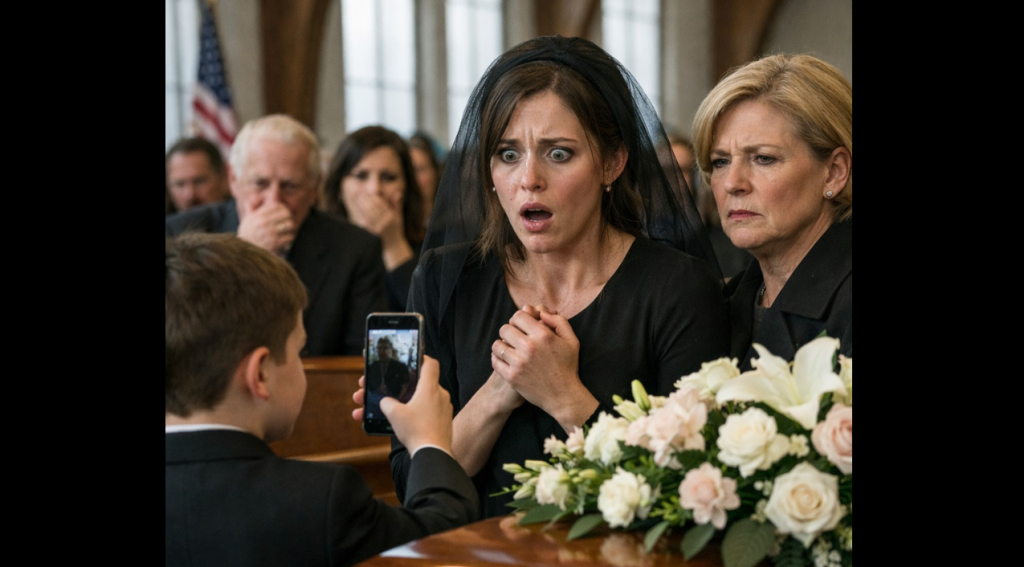
The funeral home smelled like lilies and burnt coffee.
Not fresh coffee—the kind poured with care for guests. This was the stale, reheated kind that had sat too long on a hot plate in the corner, thick and bitter in the air. It mixed with the sweetness of white flowers until the scent became suffocating.
Emily Harper stood at the front of the viewing room, her fingers digging into the worn leather strap of her black purse. She held it like an anchor, like if she loosened her grip even slightly, the floor would tilt and the world would slide away from her completely.
Before her stood a sealed casket—dark mahogany, polished so perfectly it reflected the lights above. Towering wreaths crowded around it, ribbons cascading in gold script:
Forever Remembered.
With Eternal Love.
Your Family Honors You Always.
Family.
The word burned.
Her husband’s name—Daniel Harper—was engraved on a silver plaque resting above the casket lid. Thirty-nine years old.
Gone.
At her side stood her eight-year-old son, Noah, stiff in a black suit that was slightly too large in the shoulders. It had belonged to a cousin; they’d borrowed it because buying something new for a single day felt obscene.
Noah hadn’t cried once.
Not at the hospital.
Not when they told him.
Not when he saw his father’s empty side of the bed.
His jaw was tight now, eyes forward, posture rigid.
Emily had told him three things before they walked inside:
Stay close.
Don’t listen to the whispers.
Don’t respond.
She hadn’t accounted for her mother-in-law.
Margaret Whitmore stood just far enough away to appear respectful—but close enough to dominate the space. Her black lace veil framed her sharp features like something out of an old oil painting. Pearls circled her neck, immaculate and deliberate.
She had always known how to position herself.
Her gaze slid over Emily slowly, cold and calculated.
Then, loud enough for half the room to hear, Margaret said:
“It’s better this ended now… than for him to keep living with the disgrace she brought into his life.”
A murmur rippled through the relatives gathered behind her.
Someone scoffed.
Someone whispered, “She had it coming.”
Heat flooded Emily’s face, but she didn’t move.
Not here.
Not in front of Daniel.
Not in front of her child.
Margaret tilted her head slightly.
“If you’d been a proper wife,” she continued smoothly, “my son wouldn’t have had to carry your baggage. Or your… relationships.”
The word was a blade.
Relationships.
For weeks, it had hung in the air like smoke.
Anonymous screenshots.
Blurry photos.
Messages that looked incriminating but made no sense.
Daniel had confronted her about them two weeks before his death—not with rage, but confusion.
“I know you,” he’d said quietly. “This isn’t you.”
They had been in the middle of untangling it when the aneurysm struck.
Sudden. Violent. No warning.
He collapsed in their kitchen.
Emily never got the chance to clear her name.
Margaret made sure of that.
The whispers spread fast—through extended family, through Daniel’s colleagues, through the church.
An unfaithful wife.
A distracted husband.
A stressed heart.
And now a sealed casket.
Emily inhaled slowly, preparing to speak—
A chair scraped softly behind her.
Noah stood up.
Emily turned sharply.
He held Daniel’s phone in both hands—the one Emily had collected from the hospital. The screen was cracked down the center like a fault line.
“Noah,” she whispered urgently.
But he stepped forward.
Small. Straight-backed.
Facing his grandmother.
“Grandma,” he said calmly, his voice carrying farther than anyone expected, “would you like me to play the recording Dad made about you last week?”
The room froze.
Margaret blinked.
“What nonsense is this?” she demanded.
Noah unlocked the phone.
His thumb hovered over the screen for a heartbeat—long enough for the tension to coil tight around the room.
Then he pressed play.
Daniel’s voice filled the air.
Hoarse. Tired. Unmistakable.
You could hear the scrape of a chair before he began.
“If you’re hearing this,” he said slowly, “it means I didn’t get the chance to fix what you tried to break… Mom, I know exactly what you’ve done.”
Gasps fluttered through the room like startled birds.
Margaret lunged forward, but two distant relatives instinctively stepped into her path.
Noah didn’t flinch.
“You went into my office while I was at my neurology appointment,” Daniel’s voice continued. “You used the spare keys I trusted you with. You searched through my documents. You contacted my attorney and told him Emily was mentally unstable. You said Noah would be safer with you.”
Emily’s stomach dropped.
It wasn’t paranoia.
It wasn’t imagination.
It was proof.
“I recorded the call,” Daniel said. “I saved the email where you instructed him to draft temporary guardianship papers without my wife’s knowledge.”
A sharp gasp broke from Daniel’s aunt.
Someone whispered, “Oh my God.”
Margaret’s mouth opened, but no words came.
“And I have screenshots,” Daniel continued, “of messages sent from my phone—pretending to be Emily—so it would look like I was involved with someone else.”
The air felt thin.
Heavy.
“You did it because you wanted control. Of the company. Of the house. Of Noah. Of everything. I told you—Emily is my wife. She is not your enemy. And Noah is my son, not your trophy.”
Emily’s throat burned.
He had known.
He had seen through it.
He had tried to protect them.
“If I’m gone,” Daniel’s voice continued, softer now, “Emily will find a USB drive behind the tea box in the kitchen drawer. It contains my will, signed and notarized. The house belongs to her. My shares are placed in a trust for Noah. And Mom—” his voice hardened slightly—“you will not access a single dollar unless you return what you took from the company account and agree to professional mediation.”
A ripple of shock swept the room.
“Took money?”
“From the business?”
“How much?”
Margaret straightened, color draining from her face.
“It’s a lie!” she cried. “He was confused! That woman poisoned him against me!”
Emily stepped forward.
“No,” she said, her voice low but steady. “You poisoned this family. And today, you don’t get to hide behind his funeral.”
Noah looked down at the phone.
“Dad’s not finished,” he said quietly.
He pressed play again.
Daniel exhaled on the recording.
“Mom, if you’re going to talk about shame, start with your own. You called my marriage a mistake. You tried to pay Emily to leave. You threatened to ‘take Noah away’ if I didn’t sign what you wanted. That’s not protection. That’s control.”
Margaret swayed slightly.
“I just wanted what was best,” she whispered weakly.
The recording ended.
The silence afterward was crushing.
Then the funeral home doors opened.
A woman in a charcoal suit stepped inside, briefcase in hand.
“My name is Rachel Bennett,” she said calmly. “I’m Daniel Harper’s attorney. He asked me to be here today.”
She opened her folder.
“There is a notarized will dated ten days ago. There is documentation of unauthorized withdrawals from the company account. And yes—the USB drive is exactly where Daniel said it would be.”
Margaret’s lips trembled.
“I was protecting my son,” she said again, but this time it sounded smaller.
Rachel didn’t raise her voice.
“You don’t protect someone by dismantling their marriage. And you certainly don’t protect a child by trying to use him as leverage.”
Noah’s composure finally cracked.
A single tear slipped down his cheek.
Emily knelt, pulling him into her arms.
“You did exactly what Dad asked,” she whispered. “He would be so proud of you.”
Around them, relatives shifted—not away from Emily this time, but away from Margaret.
Authority dissolved not with shouting, but with truth.
Margaret walked out alone.
No one followed.
Emily didn’t feel victorious.
She felt something quieter.
Relief.
Daniel couldn’t come back.
But he had left them a shield.
That night, Emily found the USB drive behind the tea box.
She plugged it into her laptop.
The will was there.
Signed.
Clear.
Unshakable.
She looked at Noah.
“From today on,” she said softly, “no one silences us again.”
Outside, the house felt different.
Still heavy with grief.
But no longer heavy with fear.
The drive was smaller than Emily expected.
A plain black rectangle, no label, no charm, no dramatic flourish—just a sliver of plastic and metal that had been wedged behind the tea box like it belonged there. Like it had always been part of the kitchen drawer’s clutter: twist ties, coupons, a half-empty roll of tape, a bottle opener shaped like a guitar Daniel had won at a work party.
Emily held the USB between her fingers and stared at it for a long moment, as if it might start vibrating with answers.
Noah stood beside her in socked feet, too quiet, eyes fixed on her hands.
“You okay?” he asked, voice small.
Emily swallowed.
She had been answering that question for days—asked by nurses at the hospital, by the funeral director, by distant cousins who smelled like perfume and pity.
This time, it landed differently. Because Noah wasn’t asking out of politeness. He was asking because he’d been carrying something heavier than his suit.
“I’m here,” she said. It was the closest thing to honest she could manage. “And you’re here. That’s what matters.”
Noah nodded, like he was trying to accept that as enough.
Emily plugged the drive into her laptop at the kitchen table. The house was quiet in the way a house becomes quiet after a life leaves it—too many spaces where a voice used to be.
A folder opened automatically.
Inside were neatly labeled files:
WILL_FINAL_NOTARIZED.pdf
TRUST_NOAH_HARPER.pdf
EMAILS_NOTARY.pdf
SCREENSHOTS_MESSAGES.pdf
AUDIO_CALL_WITH_MOM.mp3
Emily’s stomach tightened.
Daniel had organized it like a man who knew there wouldn’t be time later.
She clicked the will first.
It loaded slowly, the spinning wheel taunting her, then the text appeared—dense, formal, and devastating.
Daniel Harper, sound mind, voluntarily executed—
Emily scanned for her name.
There it was.
Primary Beneficiary: Emily Harper
Residence: 129 Cedar Lane transferred in full to Emily Harper
Business Equity: 62% transferred into irrevocable trust for Noah Harper, with Emily Harper as trustee until Noah reaches age 25
Her breath caught.
A trust.
A wall.
Something Daniel had built so no one could bulldoze their way through.
She scrolled further down.
There was a clause—unmistakable in its bluntness:
Margaret Whitmore is excluded from direct inheritance and is barred from accessing business accounts or property ownership rights.
Emily read it twice, then a third time, just to make sure she wasn’t hallucinating.
Noah leaned closer.
“Does it say we can stay?” he asked.
Emily looked at him.
“Yes,” she whispered. “We can stay.”
A sound left Noah’s throat—half breath, half broken hiccup. He turned away fast, like he didn’t want her to see his face, but Emily saw his shoulders tremble anyway.
It wasn’t the relief of money.
It was the relief of stability.
A home.
A place where grief could exist without the added terror of being uprooted and thrown out by people who were supposed to love Daniel.
Emily reached out and held Noah’s hand.
He gripped back hard.
The next file Emily clicked was EMAILS_NOTARY.pdf.
The first page showed an email chain.
The language was polite, professional, but the content made Emily’s skin crawl.
Margaret had written:
I’m concerned about my daughter-in-law’s mental state. My son is overwhelmed and unable to see clearly. We need to protect the child.
Beneath it was the notary’s response:
Mrs. Whitmore, I cannot take instructions without Mr. Harper’s direct authorization. If you have documentation of incapacity…
And then Margaret’s reply:
He is in decline. He forgets things. Please draft temporary guardianship paperwork and I will have him sign while he is still lucid.
Emily’s hands began to shake so hard she had to set the laptop down flat so it wouldn’t wobble off the table.
Noah stared at the screen.
“That’s Grandma?” he asked.
Emily nodded.
“She was trying to take you,” Noah said, not as a question, but as a statement.
Emily couldn’t speak for a moment. Her throat had closed around something hot.
“She wanted control,” Emily managed.
Noah’s face hardened with a maturity that didn’t belong on an eight-year-old.
“She doesn’t get it,” he said quietly. “Dad didn’t want that.”
Emily’s eyes burned.
“No,” she whispered. “He didn’t.”
The screenshots were worse.
There were messages sent from Daniel’s phone—messages Emily recognized as not hers, written in a tone she’d never use. Flirty. Suggestive. Reckless. Carefully constructed to look like betrayal.
Another set of screenshots showed Margaret messaging herself from Daniel’s number—creating a trail, manufacturing “evidence.”
It was so calculated Emily felt sick.
Then there was the audio file.
Emily hovered the cursor over it.
Noah watched her, jaw tight again.
“Do we have to listen?” he asked.
Emily hesitated.
She didn’t want Noah absorbing more poison. But she also knew Daniel hadn’t left this here to be ignored.
“We can stop anytime,” she said.
Noah nodded once.
Emily clicked play.
Daniel’s voice came through the laptop speakers, steadier than the funeral recording. This one sounded like he’d recorded it sitting at his desk, forcing himself to be calm.
“Mom,” he said, “I’m recording this because you keep denying what you said. You keep acting like you don’t remember. So here it is.”
There was a pause.
Then Margaret’s voice, sharp and dismissive.
“You’re being dramatic, Daniel. I’m trying to protect you.”
“From my wife?” Daniel asked, disbelief threaded through his exhaustion.
“She’s not who you think,” Margaret snapped. “You can’t see it because you’re—because you’re weak right now.”
“I’m not weak,” Daniel said, voice firm. “I’m sick. And sick doesn’t mean stupid.”
A rustle, like papers shifting.
“I saw the drafts you tried to push through my notary,” Daniel continued. “I saw the messages sent from my phone.”
Margaret scoffed.
“That woman put ideas in your head.”
“I watched you do it,” Daniel said. “I watched you take my phone when you thought I wasn’t paying attention.”
Silence on the recording.
Then Margaret’s voice softened, manipulative.
“I’m your mother. I’m all you’ve ever had.”
“You’re not,” Daniel said quietly. “I have Emily. I have Noah.”
“You have a mistake,” Margaret hissed.
Emily’s breath hitched.
Noah’s hand tightened on hers.
Daniel’s voice in the recording grew colder.
“You will not speak about my wife that way.”
Margaret’s tone sharpened again.
“You want to leave everything to her? Fine. When you’re gone, I’ll take Noah. The court will see she’s unstable. I’ll make sure of it.”
Daniel didn’t shout.
He didn’t curse.
His response was worse—calm, final.
“If you try,” he said, “you’ll lose me completely. Even in death.”
The audio ended.
Emily sat frozen at the table.
Noah stared at the laptop like he wanted to punch it.
For a moment, all Emily could hear was the refrigerator hum and the distant car on the street outside. Ordinary sounds. The kind that continued no matter what betrayal happened inside a home.
“She said she’d take me,” Noah whispered.
Emily turned toward him and pulled him into her arms.
“She won’t,” she said fiercely. “She can’t. Not anymore.”
Noah’s breath shuddered against her shoulder.
“I didn’t want to play it at the funeral,” he confessed suddenly. “I… I didn’t want to.”
Emily’s heart clenched.
“Then why did you?” she asked, soft.
Noah swallowed hard.
“Because she kept saying you were bad,” he whispered. “And Dad said… Dad said she would do that.”
Emily pulled back enough to see his face.
His eyes were glossy but determined, like tears were something he’d been negotiating with.
“He told you?” she asked.
Noah nodded.
“He said if Grandma tries to hurt you, I have to be brave. He said, ‘Noah, I’m not going to be there to stop her, so you might have to.’”
Emily pressed her forehead to Noah’s.
“Oh, baby,” she whispered.
Noah’s lips trembled.
“He shouldn’t have had to,” he said.
Emily closed her eyes.
No child should have to be brave like that.
But Daniel had known Margaret.
He’d known his illness might leave Emily exposed.
So he’d done the only thing he could.
He’d prepared.
Rachel Bennett arrived the next morning.
She didn’t come with drama.
She came with a folder, a laptop, and the kind of calm that made Emily feel like she could breathe again.
They sat at the kitchen table—the same table where Emily and Daniel had eaten cereal together on Sunday mornings, where Noah had built LEGO towers, where Daniel had once spread out blueprints for a home office expansion.
Rachel opened the folder and laid out papers.
“Daniel anticipated a challenge,” she said simply. “That’s why he left so much documentation.”
Emily nodded, throat tight.
Rachel continued, “The will has been notarized and filed properly. The trust is established. There are safeguards. Margaret can make noise, but she cannot legally override this.”
Emily exhaled shakily.
“What about… custody?” she asked, unable to say the word without fear.
Rachel’s gaze softened.
“She can try to file something,” she said. “But the evidence in that drive—especially the recording—would destroy any attempt. Judges don’t like manipulation. They really don’t like using a child as a weapon.”
Emily glanced at Noah, who was sitting quietly at the end of the table, drawing on a sheet of paper with a pencil Cameron had once left behind at a trivia night—though Noah didn’t know whose pencil it was, just that it wrote smoothly and didn’t squeak.
Rachel lowered her voice.
“That said, grief makes people reckless. And Margaret is… used to power.”
Emily swallowed.
“What do we do?” she asked.
Rachel tapped the folder.
“First,” she said, “we file the will in probate and formally notify Margaret. Not to provoke her—just to end the guessing. Second, we file a report regarding unauthorized access to Daniel’s office and any financial discrepancies. Third…” Rachel paused, choosing her words carefully, “…we establish boundaries. No unsupervised contact with Noah. No access to your home. No access to documents.”
Emily nodded, each word settling like a brick in a wall.
“What if she comes here?” Emily asked.
Rachel’s answer was immediate.
“Call the police,” she said. “And call me.”
Emily blinked.
Just like that?
Rachel leaned back slightly.
“Emily,” she said, “Daniel’s mother has relied on intimidation for years. She expects you to fold to keep the peace. But peace built on fear isn’t peace.”
Emily looked down at her hands.
She thought of the funeral.
Of Margaret’s voice cutting through the room.
Of Noah standing up.
Of Daniel’s voice taking over the air, refusing to let lies remain unchallenged.
“You’re right,” Emily said quietly.
Rachel nodded once.
“We’ll move quickly,” she said. “Not because you’re in danger of losing what’s yours. But because speed prevents her from creating her own narrative.”
Emily’s stomach twisted at the idea.
But she understood.
Margaret didn’t fight fair.
So they wouldn’t fight slow.
Margaret showed up two days later.
Emily knew it the moment she heard the car door slam outside.
Noah was in the living room, watching a cartoon at low volume, but the sound of the slam made his head snap toward the window.
Emily’s chest tightened.
She told herself she’d expected this.
She told herself she was ready.
She wasn’t.
Margaret’s knock was not the polite tap of someone asking.
It was the sharp, confident pounding of someone who believed the door belonged to her.
Emily walked to the entryway and looked through the peephole.
Margaret stood on the porch in black, eyes bright with fury, lips pressed into a thin line. She had no veil today. No performance.
Emily placed her hand on the doorknob but didn’t open it.
“What do you want?” she called through the wood.
Margaret’s voice came instantly, loud enough for Noah to hear even from the living room.
“You will open this door,” she demanded. “We need to talk.”
“We have nothing to talk about,” Emily replied, voice shaking despite her effort.
“You manipulated my son,” Margaret snapped. “You stole his phone. You staged that recording.”
Emily’s fingers tightened on the doorknob.
“You’re lying,” Emily said.
“I’m his mother,” Margaret hissed. “And I’m Noah’s grandmother. I have rights.”
Emily’s heart hammered.
She glanced over her shoulder.
Noah had crept into the hallway, silent, watching.
Emily lifted a finger to her lips—stay back.
Noah didn’t move.
Margaret’s voice sharpened.
“You will let me see my grandson.”
Emily’s breath came slow.
She remembered Rachel’s words: Speed prevents her from creating her own narrative.
She remembered Daniel’s voice: You will not speak about my wife that way.
Emily straightened.
“No,” she said clearly. “You will not come into my home.”
Margaret’s laugh was cold.
“You think you can keep him from me? I’ll go to court. I’ll tell them what kind of woman you are.”
Emily swallowed.
Then she did something she didn’t think she was capable of.
She spoke without fear.
“Go ahead,” she said. “And I’ll bring the recordings, the emails, and the screenshots.”
Silence.
Just a beat.
Then Margaret’s voice cracked—not into sadness, but rage.
“That phone—”
“Was Daniel’s,” Emily cut in. “And he left it for Noah. Not for you.”
Behind Emily, Noah’s small hand touched the back of her sweater—an anchoring gesture.
Margaret changed tactics fast.
Her voice turned syrupy again, almost pleading.
“Emily,” she said, “you’re overwhelmed. You’re grieving. Let me help.”
Emily stared at the door like she could see through it.
Help.
Margaret’s version of help had always come with strings—tightening, choking, controlling.
Emily’s voice came out low.
“You don’t help by destroying,” she said.
Margaret’s breath sounded sharp on the other side.
“You’re turning him against me,” she snapped.
“No,” Emily replied. “You did that yourself.”
She could almost hear Margaret’s teeth grind.
Then the knocking stopped.
Emily waited, barely breathing, listening for footsteps.
A moment later, Margaret’s heels clicked down the porch steps.
A car door slammed.
The engine roared.
And she was gone.
Emily’s knees felt weak.
She slid down the wall inside the entryway before she realized she was doing it.
Noah crouched beside her.
“Is she coming back?” he asked.
Emily forced herself to meet his eyes.
“Maybe,” she admitted.
Noah’s expression didn’t collapse.
It hardened.
“Then we’ll be ready,” he said.
Emily’s throat burned.
She pulled him into her arms.
“Yes,” she whispered. “We will.”
That night, Emily didn’t sleep.
She sat at the kitchen table with the USB drive beside her laptop, Daniel’s voice echoing in her mind.
Not the funeral recording.
Not the confrontation.
Something else.
The fact that Daniel had seen his own mother clearly enough to plan against her.
The fact that he’d trusted Emily enough to leave her the power to protect Noah.
And the fact that he’d asked Noah—an eight-year-old—to be brave when adults failed.
Emily stared at the will again.
The language was clinical.
But the intent beneath it was love.
Protection.
A refusal to let control win.
Noah padded into the kitchen in the early hours, dragging his blanket behind him.
“Mom?” he whispered.
Emily looked up.
Noah climbed into the chair beside her.
He didn’t ask questions.
He just leaned his head on her arm.
Emily placed her hand gently on his hair.
Outside, the world kept moving.
Cars. Streetlights. Distant rain.
Inside, Emily made herself a promise she didn’t speak aloud yet.
Not because she doubted it.
But because she was letting it take root.
From now on, truth would be their shield.
And silence would no longer be their prison.
The official notice went out on a Friday.
Rachel Bennett handled it the way she handled everything—clean, fast, and impossible to misinterpret. A formal copy of Daniel’s will. A formal summary of the trust. A formal letter instructing Margaret Whitmore that any future contact with Noah would need to go through counsel.
Emily didn’t see Margaret’s reaction, but she felt it anyway—like a change in air pressure before a storm.
By Monday morning, the storm arrived in the form of a court filing.
Rachel called at 7:18 a.m., her voice calm but brisk.
“She filed for emergency custody,” Rachel said.
Emily sat up so fast her spine popped. Noah was still asleep down the hall, curled around his blanket like it was a life raft.
“On what grounds?” Emily asked, already knowing the answer wouldn’t make her feel better.
“Allegations of instability,” Rachel replied. “A claim that you’re emotionally unfit due to grief. She also alleges—” Rachel paused briefly “—that Daniel’s recordings were ‘coerced’ and that you manipulated Noah.”
Emily’s stomach lurched.
“That’s—”
“I know,” Rachel said, cutting in gently. “It’s also predictable.”
Emily stared at the kitchen wall, the pale paint Daniel had chosen because it made the room feel brighter.
“She’s trying to take him,” Emily whispered.
“She’s trying to scare you,” Rachel corrected. “She’s trying to force you into a negotiation. But the evidence is on our side.”
Emily’s hands began to shake, anger and fear tangling together until she couldn’t tell where one ended and the other began.
“What do I do?” she asked.
Rachel didn’t hesitate.
“You do exactly what you’ve been doing,” she said. “You take care of Noah. You don’t engage with her directly. And you meet me at my office at ten. We’re going to organize the digital evidence, file a response, and request that the judge hear the recording.”
Emily swallowed.
“And Noah?” she asked.
Rachel’s voice softened.
“Noah does not need to be in the courtroom,” she said firmly. “He’s been through enough. I’ll request he be excluded unless absolutely necessary.”
Emily exhaled shakily.
“Okay,” she managed.
“Okay,” Rachel echoed. “You’re not alone in this, Emily.”
After the call ended, Emily sat at the table for a long moment, listening to the house. The refrigerator hum. A faint creak from the hallway as the house settled.
Then she stood and walked to Noah’s room.
She didn’t wake him.
She just watched him sleep and felt the full truth of what Margaret was attempting.
Not custody.
Control.
The same hunger Daniel had described in his recording.
Of the business. Of the house. Of the child… of everything.
Emily pressed her fingertips lightly to Noah’s hair, then turned away before her emotion spilled over him.
In the kitchen, she opened the drawer and touched the tea box.
It was still there. Ordinary. Innocent.
Behind it had been Daniel’s entire plan.
He had left her what she needed.
Now she had to use it.
Rachel’s office was modest—glass walls, neutral art, the quiet hum of printers and steady professionalism. It felt like the opposite of the funeral home: no flowers, no performance, no suffocating sentiment. Just truth in paper form.
Emily sat across from Rachel with her laptop open and the USB drive beside it like a witness.
Rachel clicked through the files with practiced ease.
“We’re going to do three things,” she said. “First, we’ll submit the notarized will and trust documents—those alone establish your legal standing. Second, we’ll submit the emails from the notary proving Margaret attempted to interfere. Third—” she paused, looking directly at Emily “—we will submit the audio recording from Daniel and the separate call where Margaret threatens to take Noah.”
Emily swallowed, her throat tight.
“She’ll say it’s fake,” Emily said.
Rachel nodded. “She can say it’s fake. But we can authenticate it. Metadata. Device history. Chain of custody. The fact that Daniel told multiple parties where the USB would be. She can claim the earth is flat too—doesn’t make it persuasive.”
A weak, involuntary laugh escaped Emily’s chest—surprising, but real.
Rachel’s mouth softened into something almost like a smile.
“Also,” Rachel added, “we’re going to ask the judge for a protective order restricting her contact with you and Noah until this is resolved.”
Emily sat straighter.
“That’s possible?” she asked.
“It’s appropriate,” Rachel replied. “Her behavior is escalating. She showed up at your house. She’s using court filings as intimidation. The judge will take that seriously, especially with evidence.”
Emily nodded slowly.
It felt strange—this sensation of being defended by systems Daniel’s family had always treated like tools meant for them alone.
Rachel leaned forward slightly.
“I need you to hear me,” she said. “This is going to be unpleasant. Margaret will likely behave theatrically. She’ll paint you as unstable. She may try to provoke you.”
Emily’s jaw tightened.
Rachel continued. “Your job is to stay calm and let the documents speak.”
Emily’s eyes burned.
“My husband is dead,” she said quietly. “And she’s still trying to punish me.”
Rachel’s expression didn’t change, but her tone softened.
“She’s trying to rewrite reality,” she said. “That’s why we move with facts, not emotion.”
Emily inhaled slowly.
“Okay,” she repeated.
Rachel nodded once. “Good.”
Court did not look like television.
No dramatic gavel slams. No shouted objections that turned into monologues. Just fluorescent lights, tired clerks, and a judge who looked like she’d seen every version of human ugliness and wasn’t impressed by any of it.
Emily sat beside Rachel at the petitioner’s table.
She wore a simple black blazer and kept her hands folded. Her palms were sweating.
Margaret sat across the room with her attorney—older, smooth, and confident in the way of someone who’d been paid to project certainty.
Margaret looked immaculate.
Pearls again.
Always pearls.
Her eyes stayed fixed on Emily, not with grief, but with accusation.
Emily didn’t look away.
Rachel touched Emily’s forearm lightly—steadying.
The judge entered. Everyone stood.
When they sat again, the judge looked down at the paperwork.
“Mrs. Whitmore,” the judge said, tone neutral, “you are requesting emergency custody of your grandson, Noah Harper.”
Margaret rose.
“Yes, Your Honor,” she said, voice trembling with well-rehearsed sadness. “I’m deeply concerned. My daughter-in-law has been… unstable since my son’s passing. She’s isolating Noah. She’s preventing contact with family. And I believe my son’s so-called ‘documents’ were created under duress.”
Emily felt anger flare, sharp and immediate.
Rachel’s hand pressed gently on Emily’s arm again.
Rachel stood.
“Your Honor,” she said, “we will be opposing this petition in full. We have a notarized will dated ten days before Mr. Harper’s death. We have a legally executed trust. We have email documentation showing Mrs. Whitmore attempted to interfere with Mr. Harper’s estate planning. And we have audio evidence of Mrs. Whitmore threatening to remove the child from his mother.”
Margaret’s attorney rose quickly.
“Objection, Your Honor,” he began, “audio evidence can be manipulated—”
The judge lifted a hand.
“We’ll determine admissibility,” she said calmly. “Proceed.”
Rachel handed copies forward. The judge read. Her expression didn’t change, but the air shifted anyway—like the courtroom itself knew this wasn’t going to end the way Margaret wanted.
Margaret’s attorney tried to regain control.
“Your Honor,” he said, “even if documents exist, the question is the mother’s fitness. Mrs. Harper has been grieving. She has been—”
“She has been a parent,” Rachel interrupted, polite but firm. “And there is no evidence of neglect, abuse, or incapacity. There is evidence, however, of Mrs. Whitmore attempting to fabricate an affair narrative.”
Margaret’s head snapped up.
“I never—” she started.
The judge’s eyes lifted.
“Mrs. Whitmore,” the judge said evenly, “sit down unless asked to speak.”
Margaret sat, lips pressed tight.
Rachel turned slightly toward the judge.
“Your Honor,” Rachel continued, “with permission, I’d like to present one audio recording—Mr. Harper’s statement regarding his mother’s actions.”
Emily’s pulse thudded in her ears.
The judge nodded. “Play it.”
Rachel connected a small speaker.
The room fell into a silence so complete Emily could hear the ventilation system’s faint hum.
Daniel’s voice came through, steady and worn.
“If you’re hearing this,” he said, “it means I didn’t get the chance to fix what you tried to break… Mom, I know exactly what you’ve done.”
Emily’s throat tightened.
Across the room, Margaret’s face drained.
The recording continued—spare keys, office access, the notary, the claim that Emily was mentally unstable.
Then the line about the messages sent from Daniel’s phone to make Emily look unfaithful.
A ripple moved through the courtroom gallery—quiet, controlled shock.
The judge’s eyes didn’t leave Margaret’s face.
Rachel paused the recording.
“Your Honor,” she said, “we can provide authentication and chain of custody. Mr. Harper told his wife and child where the supporting drive would be. The drive has been secured since retrieval.”
Margaret’s attorney rose again, voice sharper now.
“This is hearsay,” he snapped. “This is a grieving man’s—”
The judge’s gaze turned cold.
“A grieving man who anticipated interference,” she said. “And whose statements align with documentary evidence.”
Margaret’s attorney hesitated, then forced himself into a smoother tone.
“Your Honor, we maintain concern for the child’s wellbeing.”
The judge leaned forward slightly.
“Then we discuss wellbeing,” she said. “Because I am looking at a woman who attempted to secure guardianship paperwork without the parents’ consent and who appears to have interfered with estate planning.”
Margaret stood abruptly.
“I was protecting my son!” she cried, voice cracking—rage or panic, Emily couldn’t tell.
The judge didn’t flinch.
“You don’t protect someone by undermining their marriage,” she said. “And you do not protect a child by trying to remove him from his mother with manufactured allegations.”
Margaret’s mouth opened.
No words came.
Rachel spoke again, calm as a scalpel.
“Your Honor, we are requesting the petition be denied and that a temporary protective order be put in place restricting Mrs. Whitmore from contacting Mrs. Harper and the minor child directly.”
Margaret’s attorney protested, but the judge was already writing.
After a long moment, the judge looked up.
“Petition denied,” she said. “And given the evidence presented, I am granting a temporary protective order pending further review. Any contact must go through counsel. Any attempt to contact the child directly will be considered a violation.”
Emily’s vision blurred—relief hitting so hard it almost felt like nausea.
Rachel’s hand found Emily’s shoulder again, steady.
Margaret’s face tightened into something raw and furious.
This time, she didn’t bother with dignity.
“This is her doing,” she spit, pointing at Emily. “She turned him against me. She stole my son, and now she’ll steal my grandson!”
The judge’s voice cut through the outburst like steel.
“Mrs. Whitmore,” she said sharply, “another word and I will hold you in contempt.”
Margaret stopped, trembling.
Then she turned and walked out of the courtroom without looking back.
The pearls around her neck gleamed as she left, as if they were the last thing she still controlled.
Outside the courthouse, the air felt different.
Colder. Cleaner.
Emily stood on the steps with Rachel beside her, the city traffic moving past like life hadn’t just been decided inside.
Emily’s hands were still shaking.
“It’s over?” she asked, almost afraid to trust it.
“It’s not over forever,” Rachel said honestly. “But her leverage is gone. She tried to win with intimidation. The court saw through it.”
Emily swallowed.
“She’ll hate me,” Emily said, like a confession.
Rachel’s expression was calm.
“She already did,” she replied. “This changes nothing about her feelings. It changes what she’s allowed to do with them.”
Emily let out a breath that felt like it had been trapped in her lungs since the funeral.
“My son shouldn’t have had to do that,” she murmured.
Rachel’s eyes softened.
“He shouldn’t have,” she agreed. “But your husband left you tools. And your son showed courage. Now your job is to give him childhood back.”
Emily nodded, eyes burning.
“I will,” she said, voice stronger than she expected.
At home that evening, Noah sat at the kitchen table with crayons spread out.
He looked up when Emily walked in.
“Did Grandma win?” he asked, blunt as only a child could be.
Emily crossed the room and knelt in front of him.
“No,” she said gently. “She didn’t.”
Noah’s shoulders dropped slightly, like he’d been holding them up for weeks.
“She can’t take me?” he asked.
Emily shook her head.
“No,” she said. “She can’t.”
Noah stared at her for a long moment, as if making sure her words were real.
Then he nodded once and returned to his drawing.
Emily watched him color—slow, careful strokes that looked like someone trying to rebuild calm from scratch.
On the counter, the tea box sat exactly where it always had.
Ordinary.
And yet it was the place Daniel had hidden a line in the sand.
Emily rested her palm against the kitchen drawer.
She didn’t feel victory.
She felt what she’d felt when Margaret walked out of the funeral home alone:
Relief.
Not because Daniel was gone—nothing could relieve that.
But because the truth had landed in the right place.
And because fear no longer got to make decisions for them.
The protective order arrived by email the next morning, then again by certified mail that afternoon—as if the system didn’t trust peace unless it was stamped twice.
Rachel forwarded the paperwork with a short note:
Keep a copy in your purse. Keep a copy by the front door.
Emily printed three.
One went into the kitchen drawer behind the tea box, because that had become the drawer where protection lived. One went into her purse, folded crisp and tight like a prayer. The last went onto the refrigerator under a magnet Noah had made in second grade—an uneven clay star painted blue.
Noah stared at it for a long moment.
“Is that to keep Grandma out?” he asked.
“It’s to keep us safe,” Emily said.
He nodded, but his eyes stayed on the paper like it could suddenly change its mind.
Children understood rules. They trusted rules. Until adults taught them not to.
Margaret didn’t disappear.
She simply changed shape.
For the first week after court, she did what she always did when she didn’t get her way—she attempted to win by narrative.
Emily didn’t hear Margaret’s voice directly because she wasn’t allowed to, but her presence still arrived through cracks: indirect messages, gossip drifting back through extended relatives, and one particularly bold attempt at bypassing the protective order.
It was a card mailed to Noah.
A thick envelope with cartoon dinosaurs on the front—something so cheerful it felt sinister.
Emily opened it first, hands steady despite the tremor in her chest.
Inside was a handwritten note in Margaret’s tidy cursive:
Noah, my sweet boy. I miss you. If Mommy is keeping you from me, you can always call Grandma. I will always rescue you. Love, Grandma.
Emily’s vision blurred.
Not from tears—though those came later—but from rage so clean it felt like ice.
She immediately photographed the card, the postmark, and the note.
Then she called Rachel.
Rachel didn’t sound surprised.
“She’s testing the boundaries,” Rachel said. “Good. It gives us documentation.”
“I hate that she wrote ‘rescue,’” Emily whispered. “Like I’m a threat.”
“She needs you to be a threat,” Rachel replied calmly. “It’s the only way her story works.”
“What do I do with it?”
“Don’t give it to Noah,” Rachel said gently. “And don’t respond. Bring it to me. I’ll file it.”
Emily stared at the dinosaur envelope after the call ended, feeling sick.
This was the part nobody warned you about—how people could keep trying to injure you even after the court told them to stop, how they’d keep reaching for your child because they knew that was where you were most exposed.
She tore the note in half, then realized she shouldn’t have touched it further—evidence mattered.
So she placed the pieces in a plastic zip bag and labeled it with a sharpie:
MAIL TO NOAH – 3 DAYS AFTER ORDER
Then she slid it into the kitchen drawer behind the tea box.
The drawer of truth.
The drawer of the line Daniel had drawn.
Noah asked for his dad’s phone again two nights later.
Emily had kept it on top of the refrigerator, out of reach—not as punishment, but as preservation. The phone had become something sacred and dangerous at the same time.
“You can have it,” Emily said carefully, “but only with me here.”
Noah climbed onto a chair, reached up, and took the phone with both hands like it weighed more than plastic.
He stared at the cracked screen for a long time before speaking.
“I didn’t want to do it,” he said suddenly.
Emily’s throat tightened.
“I know,” she said.
Noah’s voice came out flat, like he was trying to keep it from shaking.
“I felt like… like I was being mean to Grandma.”
Emily sat down at the table across from him. She didn’t rush to correct him. She let the feeling exist, because children deserved that respect.
“You weren’t being mean,” she said quietly. “You were being honest.”
Noah’s eyebrows pinched together.
“But she looked scared,” he whispered.
Emily nodded.
“She did.”
Noah picked at the edge of the phone case with his fingernail.
“I don’t like making people scared,” he said.
Emily leaned forward.
“Noah,” she said gently, “you didn’t scare Grandma. The truth did.”
He looked up.
“She did the bad stuff,” he said, more certain now.
“Yes,” Emily replied. “And when people do bad things and get away with it for a long time, they start believing they’ll never be stopped. When they finally are… it feels scary to them.”
Noah absorbed that slowly, like it was a new kind of math problem.
“So… it’s not my fault.”
“No,” Emily said firmly. “It’s not your fault. And it never was.”
Noah’s shoulders eased the tiniest bit, as if a knot had loosened.
He set the phone down carefully.
“Can I hear Dad again?” he asked.
Emily’s heart clenched.
He didn’t mean the recording about Margaret.
He meant Daniel’s voice—any piece of it.
Emily opened the phone and scrolled until she found something else Daniel had saved: a short voicemail Daniel had left Noah months earlier when Noah had stayed home sick from school.
It was simple.
“Hey buddy. I’m thinking about you. I’m bringing soup. And we’re gonna watch that shark documentary you like, okay? Love you. Be brave.”
Noah listened with his lips pressed tight.
When it ended, he didn’t cry. He just stared at the screen like he wanted to climb through it.
Emily reached across the table and covered his small hand with hers.
“Dad meant that,” she whispered.
Noah nodded once.
“I’ll be brave,” he said.
Emily closed her eyes for a moment.
“You don’t have to be brave all the time,” she told him softly. “Sometimes you can just be eight.”
Noah didn’t answer right away.
Then he said, almost in a whisper, “I don’t remember how.”
Emily swallowed hard.
“Then we’ll learn again,” she said.
Rachel moved fast.
Margaret’s card went into the court file with a formal notice: Attempted Contact in Violation of Order.
Margaret’s attorney responded with predictable deflection: It was a misunderstanding. The child’s grandmother was merely expressing love.
Rachel’s reply was sharper: The note implies parental kidnapping. It is manipulation.
Emily didn’t attend those exchanges. She didn’t want her days swallowed by Margaret’s voice, even secondhand.
Instead, she focused on routines—boring, beautiful routines.
Breakfast at 7:10. Toothbrush timer. School drop-off.
Homework. Dinner. Baths. Bedtime.
She taped a small calendar to the fridge and let Noah place stickers on it each day they made it through without a new crisis.
Some days, Noah chose stars.
Some days, he chose dinosaurs.
Emily didn’t correct the symbolism.
She let him reclaim it.
The first time Noah laughed after Daniel’s death, it happened on a Thursday.
Emily remembered because it startled her so much she nearly dropped a plate.
Noah was in the living room building a tower out of old cereal boxes, and the tower collapsed in a ridiculous way—like it had tried to stand up, reconsidered, then folded like a cartoon character fainting.
Noah stared at the mess.
Then he snorted.
Then, like his body remembered joy before his mind could stop it, he laughed.
It wasn’t loud.
It wasn’t long.
But it was real.
Emily froze in the kitchen doorway.
The sound hit her like sunlight.
Noah looked up and saw her expression.
He immediately tried to shut it down, embarrassed.
“What?” he mumbled.
Emily walked over and sat on the carpet beside him, gently touching his shoulder.
“That,” she said softly, “is the best sound I’ve heard in a long time.”
Noah stared at the boxes again, cheeks pink.
“I didn’t mean to,” he said.
Emily smiled through the ache in her chest.
“You don’t have to mean to,” she replied. “It’s allowed.”
Noah hesitated.
Then he built the tower again.
This time, he made it fall on purpose.
He laughed a second time.
And Emily laughed too—quietly, like she was relearning it right alongside him.
Three weeks later, Rachel called with news that made Emily’s stomach tighten again.
“The probate hearing is scheduled,” Rachel said. “It’s routine, but Margaret has filed an objection—just to keep pressure on.”
“On what basis?” Emily asked.
“Same as before,” Rachel replied. “Mental instability. Undue influence. Claims Daniel was manipulated.”
Emily’s hand gripped her phone.
“She’s still doing this.”
“She will as long as she thinks you’ll fold,” Rachel said. “But we’re going to end this with finality.”
“What do you need from me?”
Rachel paused.
“I need you to be present,” she said. “Not for drama. For witness. Judges like to see the person behind the paperwork.”
Emily swallowed.
“Okay.”
“And Emily,” Rachel added, voice gentle but firm, “whatever she says in that room—remember: she’s not speaking to you. She’s speaking to the version of you she wants the court to believe exists. Let her talk to that ghost. You stay solid.”
Emily stared out the kitchen window at Noah’s bike leaning against the fence.
“I can do that,” she said.
But her voice didn’t sound convinced.
The probate hearing was smaller than custody court, quieter, but the stakes felt heavier.
This wasn’t just about Noah.
This was about Daniel’s last wishes.
His final act of love.
His refusal to let control win.
Margaret arrived early, of course, in a tailored black suit and pearls that seemed almost mocking in their consistency.
She did not look at Emily.
Not directly.
She looked past her, as if Emily were something unpleasant on the periphery.
Rachel sat beside Emily, papers organized, calm as always.
The judge—different from the custody hearing—flipped through the file with a tired, no-nonsense expression.
“Mrs. Whitmore,” the judge began, “you are contesting the will of your son, Daniel Harper.”
Margaret stood slowly, hands clasped.
“Yes, Your Honor,” she said, voice trembling with controlled sadness. “My son was vulnerable. He was ill. He was not himself. He was manipulated into making decisions that do not reflect his true intentions.”
Emily felt heat rise in her throat.
Rachel’s hand touched Emily’s arm again—steady.
Margaret continued, her voice thickening.
“My son loved me. He would never have cut me out like this unless he was coerced.”
Rachel rose.
“Your Honor,” she said, “we will show that Daniel Harper was of sound mind. We will show he executed his will voluntarily and with legal counsel present. And we will show a pattern of interference by Mrs. Whitmore—including attempts to draft guardianship paperwork behind the family’s back and unauthorized access to business accounts.”
Margaret’s jaw tightened.
“That’s absurd,” she snapped before she could stop herself.
The judge’s eyes lifted, unimpressed.
“Mrs. Whitmore,” he said dryly, “I haven’t ruled yet. Sit.”
Margaret sat, lips pressed together so hard they turned pale.
Rachel proceeded exactly as she promised—facts, not emotion.
Medical letters confirming cognitive clarity.
The notarized will.
The trust documentation.
The email chain with the notary.
The unauthorized transaction report.
Margaret’s attorney objected here and there, but the judge’s patience wore thin with each interruption.
Then Rachel said, “And finally, Your Honor, we have an audio statement from Mr. Harper, recorded before his death, outlining his motivations and confirming his intent.”
Margaret’s attorney stood quickly.
“Objection,” he said. “Hearsay. Highly prejudicial.”
The judge leaned back.
“Everything is prejudicial when it’s inconvenient,” he murmured, then looked at Rachel. “Play it.”
Emily’s pulse thundered.
Daniel’s voice filled the room—steady, exhausted, unmistakable.
Not the funeral recording.
A different one.
This one sounded like it was meant for a judge, not family.
“If you’re hearing this,” Daniel said, “it means I’m not here to speak for myself. So I’m leaving this record of intent.”
Emily’s hands clenched.
“I love my mother,” Daniel continued. “But love does not mean surrender. My mother has repeatedly attempted to interfere in my marriage, my estate planning, and my child’s future. My decisions in this will are deliberate, considered, and made with legal counsel. I am not confused. I am not coerced. I am protecting my wife and my son.”
Silence pressed down on the room.
When the audio ended, the judge looked at Margaret for a long moment.
Margaret’s face had tightened into something sharp and brittle.
Finally the judge spoke.
“Mrs. Whitmore,” he said, “your son anticipated interference. He documented his intent. He took legal precautions. And he did so while medically cleared as competent. Your objection lacks merit.”
Margaret’s attorney started to speak, but the judge raised a hand.
“I’m not interested in further theatrics,” he said. “The will stands.”
Emily’s lungs emptied in one shaky breath.
“The trust stands,” the judge continued. “Mrs. Harper remains trustee. Any harassment or interference will be viewed unfavorably should future petitions arise.”
Margaret’s lips trembled.
“I’m his mother,” she whispered, voice thin.
The judge’s expression didn’t soften.
“And she is his wife,” he replied. “And that child is hers to raise.”
Margaret stared down at the table like the wood might offer her an answer.
It didn’t.
The judge signed the order.
The gavel didn’t slam.
There was no cinematic moment.
Just ink.
And a finality that felt like a door locking.
Outside the courthouse, the sky was low and gray.
Rachel exhaled as if she’d been holding her breath for weeks.
“It’s done,” she said.
Emily’s hands still shook.
Rachel looked at her.
“You did well,” she added. “You stayed solid.”
Emily stared at the courthouse steps.
“I didn’t say anything,” she whispered.
Rachel tilted her head.
“That’s the point,” she said. “You didn’t have to. Daniel already did.”
Emily blinked hard.
For the first time since the funeral, the fight felt like it had an ending.
Not grief—grief didn’t end.
But the war Margaret tried to wage against their life.
Emily’s phone buzzed.
A text from Noah’s teacher:
Noah had a good day. He laughed at recess.
Emily stared at the message until her chest ached.
“I want to go get him,” she said.
Rachel nodded.
“Go be his mom,” she replied.
Emily turned away from the courthouse and walked toward her car feeling—if not free—then at least unchained.
Noah ran to her at pickup like he hadn’t in months.
He barreled into her waist, arms squeezing tight.
“Hey,” Emily breathed, startled and grateful.
“Did you win?” Noah asked immediately, his voice muffled against her sweater.
Emily knelt, cupping his face gently.
“We did,” she said.
Noah searched her eyes like he was looking for hidden clauses.
“Like… really?”
Emily nodded.
“Really.”
Noah’s shoulders dropped, the tension sliding off him in a way she hadn’t realized he’d been carrying every second.
He didn’t celebrate.
He didn’t shout.
He just leaned into her.
“Can we get pizza?” he asked after a moment, as if normal life was the bravest request of all.
Emily laughed softly.
“Yes,” she said. “We can get pizza.”
That night, after Noah fell asleep with pizza grease still faint on his fingertips, Emily stood alone in the kitchen.
She opened the drawer behind the tea box.
She looked at the USB drive.
The folded protective order.
The bagged dinosaur card.
Evidence.
Protection.
A map Daniel had left behind.
Emily didn’t feel triumphant.
She felt tired.
But beneath the exhaustion, something steady was taking root.
The truth hadn’t brought Daniel back.
But it had kept Margaret from using his death as a weapon.
It had kept Noah in his home.
It had kept Emily from being erased.
Emily closed the drawer gently.
She placed her hand on the counter and whispered into the quiet:
“I’m still here.”
And for the first time, that sentence felt less like a fight…
…and more like a promise.
The first morning after the will was upheld, Emily woke up before her alarm.
Not with panic—no sudden bolt upright, no racing heart, no instinctive scan for the next threat.
Just wakefulness.
The kind that came when the body didn’t know what to do with peace yet.
She lay still for a moment, listening.
Noah’s breathing down the hall.
A distant garbage truck.
The soft click of the heater turning on.
Ordinary sounds.
The kind she hadn’t trusted in months.
Emily sat up and looked at the empty side of the bed.
Daniel’s pillow still had the faintest impression of him, though she’d tried to wash the sheets and change the layout and make the room belong to the living instead of the missing.
She pressed her palm against the pillow anyway.
Then she got up, because there was school and breakfast and life, and life was the thing she’d almost forgotten how to carry.
In the kitchen, she opened the drawer behind the tea box and stared at what she’d kept inside like a strange collection:
The USB drive.
The protective order.
The torn dinosaur envelope sealed in plastic.
A printout of the probate ruling.
She had called it the drawer of truth. The drawer of the line Daniel had drawn.
Now, with the court’s finality, she realized something else:
It was also the drawer of grief.
Because every item in it existed only because he was gone.
She closed the drawer gently, like closing a chapter without slamming it.
Noah padded into the kitchen in pajamas, hair sticking up at the back.
“Is today normal?” he asked.
Emily paused.
Normal wasn’t a switch.
Normal was a road.
But she understood what he meant.
“Today,” she said softly, “we’re going to try.”
Noah considered that.
Then he nodded.
“Okay,” he said, like trying was a plan he could accept.
Margaret didn’t stop being Margaret just because a judge told her no.
But something had changed.
She’d lost the weapons that mattered most.
She could still gossip, still hiss, still try to poison the edges of Emily’s reputation—but now the truth lived in legal documents and recorded files. It wasn’t vulnerable to her version of events.
For two weeks, Emily heard nothing.
No calls through third parties.
No surprise appearances.
No cards.
A silence settled that felt almost unnatural.
Rachel explained it simply when Emily asked.
“She’s regrouping,” Rachel said. “She’s deciding what her new angle is.”
“And what if she finds one?” Emily asked, dread flickering again.
Rachel’s voice was steady.
“Then we respond with the same thing we’ve used every time,” she said. “Facts. Boundaries. Documentation.”
Emily hung up and stared at her phone.
It was strange—to be told that her safety depended on paper and procedure, but also relieved, because paper and procedure didn’t get tired the way people did.
The first time Emily saw Margaret again was at the grocery store.
It happened in the cereal aisle.
Emily had taken Noah shopping after school, letting him choose a box with extra sugar as a small act of reclamation.
He was comparing cartoon mascots when Emily felt a shift behind her—like the air tightened.
She turned.
Margaret stood two aisles away, a basket on her arm, dressed in a crisp coat as if groceries were a photo shoot.
Her eyes locked on Emily’s.
For a moment, no one moved.
Noah glanced up and followed Emily’s gaze.
His posture changed instantly—shoulders stiff, face hardening.
Emily’s chest tightened.
She had dreamed of this moment, rehearsed it in her mind. The confrontation. The words.
But when it happened, it wasn’t dramatic.
It was quiet.
Margaret took a single step forward, stopping at the edge of the aisle.
Emily didn’t move toward her.
She didn’t move away.
She simply stood between Margaret and Noah.
Margaret’s lips parted.
“Emily,” she said, voice smooth.
Emily’s throat tightened, but she kept her tone calm.
“You’re not allowed to contact us,” she replied.
Margaret’s eyes flicked to Noah.
“My grandson,” she said softly, like a plea.
Noah’s fingers curled around the cereal box.
He didn’t speak.
Emily’s voice stayed even.
“The court order still applies in public,” she said. “If you speak to him directly, I’ll call the police.”
Margaret’s expression tightened.
“You would involve law enforcement,” she murmured, as if Emily were the one being unreasonable.
“I already did,” Emily replied. “When you tried to take my child.”
Margaret flinched—almost imperceptible, but real.
Noah shifted closer to Emily’s side.
Margaret’s eyes returned to Emily, sharpening.
“He would be ashamed of what you’ve become,” she whispered.
The words hit like they were designed to.
They were.
Emily felt heat flare behind her eyes—but she didn’t let it rise into her voice.
“Daniel knew exactly who I am,” she said. “And he knew exactly who you are. That’s why he left what he left.”
Margaret’s jaw tightened.
For a second, it looked like she might lunge, like she had at the funeral.
But this wasn’t a funeral home full of paralyzed relatives.
This was a grocery store full of strangers.
And strangers didn’t tolerate drama the way family sometimes did.
Margaret took a small step back.
Then another.
Her pride tried to hold her upright, but her control was gone.
She turned and walked away without another word.
Noah exhaled sharply.
Emily realized she’d been holding her breath too.
Noah looked up at her.
“You didn’t yell,” he said, surprised.
Emily knelt beside him, keeping her voice low.
“Because yelling is what she wants,” she said. “She wants me to look unstable. She wants me to be the story.”
Noah nodded slowly.
“So you stayed… solid,” he said, repeating Rachel’s word like it had become part of his vocabulary.
Emily smiled faintly.
“Yes,” she whispered. “We stayed solid.”
Noah stared down the aisle where Margaret had disappeared.
“She can’t take us,” he said, not asking this time.
“No,” Emily replied. “She can’t.”
Noah held the cereal box out.
“Can we still get the dinosaur one?” he asked.
Emily’s chest tightened with something that felt like laughter and grief woven together.
“Yes,” she said. “We can.”
In the months that followed, the house changed.
Not physically—same creaking stairs, same scuffed baseboards from Noah’s toy cars, same paint Daniel had chosen.
But emotionally.
It stopped feeling like a battlefield.
Emily put Daniel’s photo back on the mantle after keeping it in a drawer for too long.
Noah started leaving his school backpack by the front door without flinching every time the doorbell rang.
Emily stopped checking the window every time a car slowed down outside.
Small things.
Quiet things.
Healing rarely arrived in speeches.
It arrived in afternoons where nothing bad happened.
One evening in late spring, Rachel called.
“Emily,” she said, “I have something.”
Emily’s stomach tightened automatically.
“What kind of something?” she asked.
“Not a legal threat,” Rachel replied quickly. “I’m at Daniel’s storage unit. The one attached to the company office lease. He left a box for you. It’s labeled—” Rachel paused, voice softening, “—For Emily. After everything is done.”
Emily’s hand flew to her mouth.
“I didn’t know there was a storage unit,” she whispered.
“Neither did Margaret,” Rachel said simply. “Daniel was… thorough.”
Emily’s eyes burned.
“When can I get it?”
“Whenever you’re ready,” Rachel replied. “But I figured you might want it now that the court is finished.”
Emily stared at the kitchen counter.
Noah was in the living room, building a LEGO set, humming to himself—an unconscious sound of safety.
“Bring it,” Emily said.
Rachel arrived the next day with a plain cardboard box sealed with packing tape.
No legal stamps.
No official seals.
Just Daniel’s handwriting on the top, messy and familiar:
For Em. If you made it through.
Emily set the box on the kitchen table.
Noah circled it like it was a treasure chest.
“Is it from Dad?” he asked, voice careful.
Emily nodded, swallowing hard.
“It is.”
Noah reached out to touch the top, then hesitated, looking at Emily for permission.
Emily placed her hands on the tape.
“Let’s open it together,” she said.
Noah nodded.
Emily peeled the tape back slowly, as if rushing would break something.
Inside, the box was packed neatly.
On top was an envelope.
Not legal.
Personal.
Emily recognized Daniel’s handwriting again:
Read this last.
Beneath it were three things:
A small blue ceramic mug—chipped on the rim.
Their mug.
The one Daniel always called lucky, even though they hadn’t owned it long.
Emily’s breath caught.
Noah picked it up gently.
“The lucky mug,” he whispered, smiling.
Emily nodded, eyes wet.
Under the mug was a thin binder labeled:
Noah’s Trust — Plain English
Emily let out a shaky laugh through tears.
Of course Daniel had done that.
Of course he’d written a human version of the legal mess so Emily wouldn’t drown in paperwork.
And beneath the binder was a second phone.
Old-fashioned compared to Daniel’s usual sleek devices.
A note taped to it said:
Backup. For you. Not for court.
Emily stared at it, heart pounding.
Rachel had been right.
Daniel was thorough.
Noah looked at the phone.
“Is there more Dad stuff on it?” he asked.
Emily swallowed, palms sweating.
“I don’t know,” she admitted.
She turned it on.
It was charged.
The screen lit up.
A single folder sat on the home screen, labeled:
For Em & Noah
Emily clicked it.
Inside were videos.
Dozens of them.
Daniel sitting in their kitchen.
Daniel in Noah’s room.
Daniel in the backyard in a hoodie, looking tired but smiling anyway.
Short videos, each titled with dates and simple notes:
Noah’s 9th Birthday
First Day of Middle School
When You Feel Like You Miss Me
Emily’s vision blurred so completely she had to blink hard to see.
Noah reached for her hand.
“Mom?” he whispered.
Emily squeezed his fingers.
“It’s okay,” she managed, though it didn’t feel okay. It felt like being handed sunlight after living underground.
She opened one video at random.
Daniel appeared on screen, sitting at the kitchen table—the same table where the box now sat.
He looked directly into the camera.
“Hey,” he said softly. “If you’re watching this, it means you made it past the worst part.”
Emily’s breath shook.
Daniel smiled faintly.
“Emily,” he continued, voice gentle, “if my mom did what I think she might… I’m sorry. I’m sorry you had to fight while you were grieving. I tried to leave you shields instead of burdens.”
Noah’s grip tightened.
Daniel’s eyes flicked down slightly, like he was checking notes, then back up.
“You are not crazy. You are not weak. You are the strongest person I know. And if anyone tries to rewrite who you are—don’t argue with them. Don’t beg. Just let the truth stand.”
Emily pressed her knuckles to her lips.
Daniel’s voice softened.
“Noah,” he said, “buddy, if you’re watching with Mom—listen to me. You don’t have to be brave for everybody. Just be honest. If something feels wrong, tell Mom. If you miss me, tell Mom. If you’re scared, tell Mom. That’s what family is.”
Noah’s eyes filled.
Daniel swallowed on the video, blinking faster than usual.
“And Mom—” he continued, and Emily could hear the strain behind the steadiness, “if you ever feel guilty for standing up to her, don’t. You’re not taking something from her. You’re protecting what we built.”
Daniel breathed out.
“I love you,” he said. “Both of you. And if I can’t be there… let this be my voice when you need it.”
The video ended.
The kitchen was silent except for Noah’s shaky breathing.
Noah wiped his face quickly, furious at the tears.
Emily pulled him into her arms.
“It’s okay,” she whispered. “It’s okay to cry.”
Noah clung to her.
“I miss him,” he whispered.
“I know,” Emily said, voice breaking. “I miss him too.”
They stayed like that for a long time, holding grief without letting it turn into fear.
When Noah finally pulled back, he looked at the phone again.
“Can we watch the birthday one?” he asked, voice small.
Emily nodded.
“Whenever you want,” she said.
Later that night, after Noah fell asleep with the lucky mug on his nightstand like a guard, Emily sat at the kitchen table alone.
The envelope on top of the box still waited.
Read this last.
Emily’s hands trembled as she opened it.
Inside was a letter, folded carefully.
Daniel’s handwriting slanted slightly, messy in places, like he’d written it on days when his hands weren’t steady.
Emily unfolded it.
Em,
If you’re reading this, then I’m not there, and I hate that. I hate the idea of you walking through this house without me, hearing it creak, and feeling like the creaks are bigger than you.
I did what I could.
I’m sorry I couldn’t do more.
Emily’s eyes burned.
I need you to remember this: my mother’s need for control is not your responsibility. It’s a sickness she refuses to treat. Don’t take it into your body. Don’t carry it for her.
If she comes at you with shame, don’t swallow it. Shame is her language. It isn’t yours.
Emily’s breath hitched.
Noah’s going to be okay because he has you. He’s going to be kind because you’re kind. He’s going to be brave because you showed him what bravery actually is—truth, boundaries, love.
Emily closed her eyes, tears finally falling.
And Em… if one day you laugh again and it feels like betrayal, it isn’t. It’s proof you survived. Laughing doesn’t mean you forgot me. It means you carried me forward without letting grief kill you too.
Emily wiped her cheeks with the heel of her hand, barely able to read.
The last thing I’m leaving you isn’t the house or the trust or the recordings. It’s permission.
Permission to live.
Permission to be free.
Love always,
Daniel
Emily stared at the letter until the words blurred.
Then she pressed it against her chest.
Not because it made the pain vanish.
Because it made the path clear.
The next morning, Emily did something she hadn’t done since Daniel died.
She opened the curtains wide.
Light poured into the kitchen.
Noah shuffled in, rubbing his eyes.
“Morning,” he said sleepily.
Emily smiled.
“Morning,” she replied.
Noah glanced at the refrigerator where the court papers still hung, then at Emily.
“Are we safe?” he asked softly.
Emily nodded.
“Yes,” she said. “We’re safe.”
Noah looked down at his hands, then back up.
“Can we put Dad’s letter in the drawer?” he asked. “With the other… truth stuff?”
Emily’s throat tightened.
“That’s a good place for it,” she said.
Together, they opened the drawer behind the tea box.
Emily placed Daniel’s letter inside carefully, smoothing it flat.
Noah placed the lucky mug’s broken chip—just a tiny piece that had flaked off long ago—beside it like an offering.
Then Noah closed the drawer.
“This drawer,” he said quietly, “is for things she can’t change.”
Emily knelt and kissed the top of his head.
“That’s exactly right,” she whispered.
And in that moment, Emily understood what Daniel had really left behind.
Not money.
Not documents.
Not a courtroom victory.
A family that could not be rewritten by someone else’s control.
Truth.
Boundaries.
Love.
Margaret could still talk.
She could still hate.
But she could no longer take what mattered.
Emily stood up, took Noah’s hand, and walked him to the door for school.
The air outside was crisp and bright.
For the first time in a long time, Emily breathed without fear.
Leave a Reply