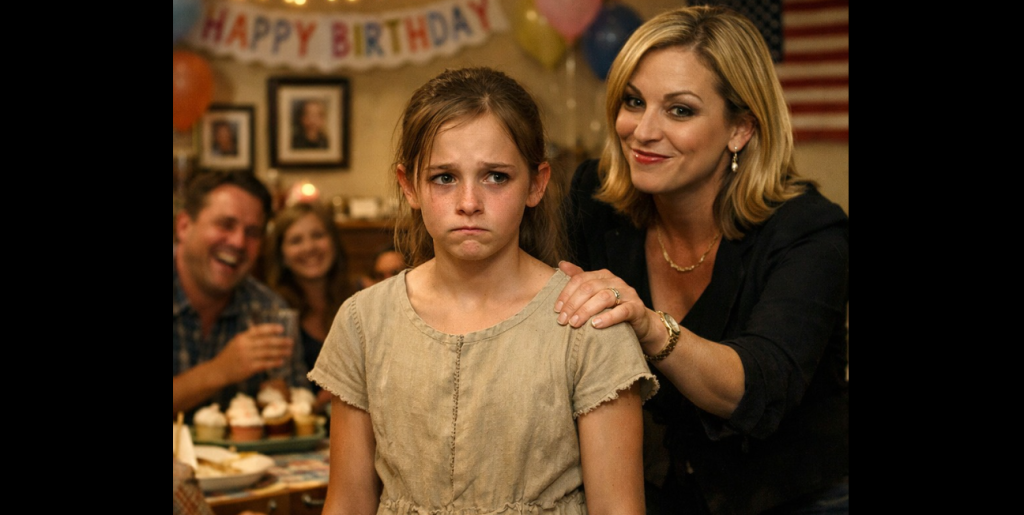
The party was supposed to be low-key.
That’s what my mother said on the phone three weeks earlier.
“Just cake and coffee,” she’d promised. “Seventy-five is a milestone, but we’re not doing anything flashy.”
In my family, “not flashy” usually meant the good china came out instead of the crystal.
Grandma Dorothy’s seventy-fifth birthday was being held at my parents’ house outside Chicago—the same split-level I grew up in, the same living room where every argument had been disguised as banter, every insult wrapped in laughter.

Everything in that house was a performance.
I parked two houses down and turned to look at Ivy in the passenger seat.
She was twelve now—tall for her age, thoughtful, with hands that never stayed still. If she wasn’t sketching, she was pinning fabric; if she wasn’t pinning fabric, she was unpicking it because she believed every mistake could be corrected with patience.
She was wearing a navy dress she had sewn herself. Tiny white flowers dotted the fabric, and the hem was straight and clean because she’d stayed up until midnight perfecting it.
“Is it okay?” she’d asked nervously before we left.
“It’s beautiful,” I told her.
And it was.
The stitching was precise. The waistline fitted perfectly. It wasn’t store-bought glossy—but it was intentional.
I’d learned a long time ago that intention intimidates people who mistake price tags for value.
“Ready?” I asked.
She nodded, but her fingers twisted lightly in the fabric at her hip.
We stepped inside, and the smell of roast chicken and lemon cleaner wrapped around us like memory.
My father was already at the grill outside. My mother stood in the kitchen, arranging flowers as if Martha Stewart might walk in and grade her. A handful of relatives clustered in the living room—cousins, an aunt I only saw twice a year, a neighbor who’d known us since I was a kid.
And then there was my sister.
Kendra Miles arrived ten minutes after us, and she didn’t enter rooms so much as claim them.
Heels clicking. Designer bag swinging. Perfume announcing her before she spoke.
She kissed the air near my mother’s cheek and said, “Happy birthday, Grandma!” like she was hosting a talk show.
Her eyes scanned the room, cataloging outfits, haircuts, perceived flaws.
They landed on Ivy.
“Oh wow,” Kendra said loudly, eyebrows lifting. “Is that homemade?”
The room quieted just enough for the question to feel pointed.
I felt Ivy tense beside me.
“Yes,” I said evenly. “She made it.”
Kendra stepped closer, examining the dress like it was a curiosity from a thrift shop.
“Wow,” she repeated, tilting her head. “That’s… ambitious.”
I saw Ivy swallow.
Before I could reposition us, before I could physically shift her behind me, Kendra reached out and grabbed her wrist.
“Everyone, look!” she called out, dragging Ivy toward the center of the living room like she was presenting a prop. “My embarrassing niece!”
My heart slammed against my ribs.
“Kendra,” I said sharply, stepping forward. “Let go of her.”
But she kept talking, voice bright and sharp enough to cut.
“She makes her own cheap clothes,” Kendra said, laughing lightly. “Honestly? No future.”
A few relatives laughed.
My mother smiled tightly, as if this were harmless entertainment.
Even my father chuckled from the doorway like it was nothing more than a family joke.
Ivy’s chin trembled.
She didn’t cry.
That was the part that gutted me.
She stood there in the center of the room, held in place by a hand that was supposed to be family, absorbing humiliation like she’d already learned that reacting would make it worse.
“Let go of her,” I repeated, louder.
“Relax,” Kendra replied, finally releasing Ivy’s wrist. “It’s a joke.”
“It’s bullying,” I shot back.
The word landed heavy.
The room shifted slightly—uncomfortable, but not enough to stop.
“Don’t be dramatic, Nora,” my mother said from the kitchen. “You know how Kendra is.”
Yes.
I did know how Kendra was.
She’d been “how she is” my entire life.
Confident. Cruel when it amused her. Rewarded for it because she wore it like charisma.
I stepped in front of Ivy, my body between her and the room.
“She worked hard on that dress,” I said evenly. “You don’t get to make her feel small for it.”
Kendra crossed her arms, amused. “Oh please. If she’s that sensitive, she’s not cut out for the real world.”
The phrase was familiar.
I’d heard it before.
About me.
About anyone who didn’t meet the family standard of hard-edged success.
Before I could respond, a chair scraped quietly against the hardwood floor.
It wasn’t loud.
It didn’t need to be.
Grandma Dorothy stood.
She didn’t rush.
She didn’t raise her voice.
But the room shifted immediately.
Even Kendra stopped mid-smirk.
“You really don’t know who she is,” Grandma said calmly.
Kendra laughed awkwardly. “Okay, Grandma.”
“No,” Grandma replied. “You truly don’t know what Ivy has accomplished.”
My mother frowned. “What are you talking about?”
Grandma looked at the entire room, her gaze sweeping across relatives who’d laughed seconds earlier.
“Ivy entered the Midwest Junior Design Showcase under a scholarship program,” she said clearly. “She won.”
The laughter stopped.
The air tightened.
“She’s been invited to a pre-college summer program at the School of the Art Institute of Chicago,” Grandma continued. “On a full scholarship.”
My father blinked. “Full?”
“Yes,” Grandma said. “Full.”
Kendra’s face tightened.
“And she’s already sold two original design patterns to a boutique in Evanston,” Grandma added. “Licensed. Paid.”
“Sold?” my father repeated, incredulous.
“Yes,” Grandma said again. “Licensed.”
I felt Ivy’s fingers curl into the fabric at her side—not shrinking this time, but grounding.
Kendra scoffed lightly, but it didn’t carry the same weight as before.
“That doesn’t mean she’s special,” she muttered.
Grandma turned to her slowly.
“It means she has a future you can’t even see,” she said.
And then Grandma said the sentence that changed everything.
“I’ve updated my will.”
The room went dead quiet.
Not the awkward silence of tension.
The heavy silence of shock.
“I placed my estate into a trust,” Grandma continued, voice steady. “Ivy will be the protected primary beneficiary. Not because she’s a child—but because she has shown character.”
My mother went pale.
My father’s mouth opened slightly.
Kendra stared at her like she’d just been slapped.
“The trustee will be independent,” Grandma added. “Nora will oversee Ivy’s educational and business needs. And any family member who disrespects her or attempts to exploit her opportunities will have their inheritance reduced.”
“You’re serious?” Kendra demanded, voice thin.
“Yes,” Grandma said simply. “Very.”
She turned back to Ivy, her expression softening.
“People who mock what you create,” she said gently, “are afraid of what you might become.”
Ivy stood taller in that homemade dress.
The same relatives who had laughed moments earlier now avoided eye contact.
The house felt different.
Lighter and heavier at the same time.
Because for the first time in that room, someone with authority had chosen the child they’d tried to belittle.
And that choice didn’t just protect Ivy.
It exposed everyone else.
—
The rest of the party unraveled in polite fragments.
Cake was served.
Conversations resumed, but cautiously.
Kendra avoided me. My mother hovered near Grandma, whispering urgently in a way that told me this wasn’t over.
I kept my hand lightly at Ivy’s back, feeling the steady rhythm of her breathing.
When we left that afternoon, Ivy buckled her seatbelt and looked at me carefully.
“Did Grandma mean that?” she asked.
“Yes,” I said.
“About the trust?”
“Yes.”
She stared out the window for a long moment.
“Does that mean they can’t make fun of me anymore?” she asked quietly.
The question cut deeper than anything else that day.
“It means,” I said carefully, “that even if they try, it won’t define you.”
She nodded slowly.
Then she added, “I didn’t cry.”
“I know,” I said.
“I wanted to,” she admitted.
“I know,” I repeated.
At a red light, she looked at me again.
“Mom?” she said.
“Yeah?”
“I think Grandma saw me.”
My throat tightened.
“She did,” I said.
For the first time in that house, the child they had called “no future” became the only person whose future was fully protected.
Because sometimes, the quietest person in the room is the one building something no one else can tear down.
And sometimes, the oldest person in the room is the only one brave enough to say it out loud.
—
But inheritances don’t just change bank accounts.
They change power.
And power shifts rarely happen without resistance.
That Sunday afternoon was not the end of the story.
It was the opening move.
The rest of Grandma Dorothy’s birthday party moved like a car with a broken wheel—still rolling, still making progress, but with a wobble everyone pretended not to notice.
Cake was served. Photos were taken. Someone put on music a little too loud, like volume could fill the silence that had settled after Grandma’s announcement.
But nothing felt normal anymore.
My mother—Marilyn—hovered near Grandma with a smile that looked stapled on. My father—Tom—kept clearing his throat and refilling drinks, as if he could pour everyone back into comfort. And my sister Kendra avoided me at first, then started watching Ivy with a kind of sharp interest that made my skin prickle.
Not admiration.
Assessment.
Like Ivy had turned into a new piece on the board.
I stayed close to my daughter. I didn’t want her separated again, not even by accident. And every time someone complimented her dress now—“Oh, wow, you made that?” “That’s so impressive!”—I saw Ivy’s shoulders lift with a quiet pride that didn’t require applause.
Still, I could feel her processing the humiliation like a bruise under her skin.
When we finally left, Ivy had been silent in the car until we hit the highway.
“Mom,” she said suddenly, staring at the passing trees. “Why did they laugh?”
My hands tightened on the steering wheel.
Because they were comfortable, I thought. Because they’d done it before. Because in that house, there had always been a person designated as safe to pick on.
But I couldn’t say that to my twelve-year-old daughter without breaking something.
“They laughed because they’re used to Kendra being loud,” I said carefully. “And they didn’t stop to think.”
Ivy’s voice was small. “They did think,” she whispered. “They just didn’t care.”
The sentence landed with the clean truth only children can deliver.
I swallowed hard. “Some of them didn’t care,” I corrected quietly. “But Grandma did.”
Ivy nodded once.
Then she surprised me. “You tried,” she said. “You told Aunt Kendra to let go.”
“I should’ve stopped it faster,” I admitted.
“You did,” Ivy said, turning to look at me. “When Grandma stood up. You stood in front of me.”
My throat tightened. “That’s what moms do,” I said.
Ivy looked down at her hands in her lap—hands that had sewn the dress. “So why didn’t Grandma stand up before?” she asked.
I didn’t have a clean answer.
Because sometimes it takes seeing the harm happen to the next generation to wake people up. Because sometimes the line gets drawn only when it threatens someone you can’t pretend is “grown enough” to handle it.
“I don’t know,” I said honestly. “But I’m glad she did today.”
Ivy nodded, then leaned her head against the seat.
When we got home, she went straight to her room and hung the dress carefully in the closet like it mattered.
And it did.
It mattered because she’d made it.
It mattered because someone had tried to make her ashamed of it.
And it mattered because, for the first time, someone with real power had said out loud: This child has a future.
I thought that would be the part that stayed with me.
But what stayed with me, that night, was my mother’s face.
The way the color drained when Grandma said, I’ve updated my will.
It hadn’t looked like surprise.
It had looked like threat recognition.
Two days later, my mother called.
She didn’t ask how Ivy was. She didn’t mention the dress. She didn’t apologize for laughing.
She went straight to business.
“We need to talk about what happened,” she said, voice controlled.
“I agree,” I replied.
There was a pause, as if she hadn’t expected me to agree so quickly.
“Your grandmother was… emotional,” my mother said, like emotion was a diagnosis.
“She wasn’t emotional,” I said. “She was clear.”
My mother exhaled sharply. “Nora, you don’t understand,” she said. “Kendra made a mistake. It was a joke. We don’t need to—”
“It wasn’t a joke,” I cut in, keeping my voice steady. “It was humiliating. And you laughed.”
Silence.
Then my mother’s voice turned sharper. “You always take things personally,” she snapped. “You and Ivy are the same. Sensitive. Everything has to be a big moral crisis.”
There it was.
The familiar phrase.
Sensitive.
The family’s favorite way to turn pain into a personality flaw.
I closed my eyes, forcing myself not to slip into the old role—the appeaser, the peacekeeper, the daughter who apologized for being hurt.
“Mom,” I said calmly, “I’m not debating whether my child deserves basic respect.”
My mother’s tone went colder. “And I’m not going to let you turn this into some crusade,” she said. “Your grandmother can say whatever she wants at a party, but legal things are different.”
Legal things.
My stomach tightened. “What do you mean?”
My mother’s voice softened, too suddenly. “I mean your grandmother is elderly,” she said. “And sometimes elderly people make impulsive decisions. We need to make sure she’s protected from… influences.”
Influences.
I recognized the shape of what she was saying, even without the full sentence.
“You think I influenced her,” I said.
My mother didn’t answer directly. “All I’m saying is, we need to be careful,” she replied. “This family has always handled finances responsibly.”
I almost laughed.
“Mom,” I said, “Grandma didn’t say that because of money. She said it because Kendra humiliated a child.”
My mother’s voice sharpened again. “And now you want to be rewarded for it?” she snapped.
“Rewarded?” I repeated, stunned.
She let out a breath, irritated. “Don’t pretend,” she said. “You’ve always been bitter that Kendra gets more attention. More support.”
That accusation hit like a slap—not because it was true, but because it revealed something ugly:
My mother believed love was distributed like inheritance.
Like chairs at a table.
Like hierarchy.
“This isn’t about me,” I said, voice steady. “It’s about Ivy.”
My mother went quiet. Then she said, carefully, “We’ll see what Mr. Shore says.”
“Who?” I asked.
But she was already ending the call.
That night, I called Grandma.
She answered on the second ring, voice bright and warm like she’d been expecting me.
“Hi, sweetheart,” she said. “How’s my girl?”
“My girl,” she meant Ivy.
It made my throat tighten.
“Ivy’s okay,” I said. “She’s… processing.”
Grandma hummed softly. “She’s strong,” she said. “But she shouldn’t have to be strong in that house.”
I swallowed. “Grandma,” I began carefully, “when you said you updated your will…”
“I meant it,” she said immediately.
“I know,” I replied. “But Mom called. She’s talking about ‘legal things’ and ‘influences.’”
Grandma’s voice went quiet in a way that made me sit up straighter.
“Let her talk,” Grandma said finally. “That’s why I did it the way I did.”
“What do you mean?”
Grandma sighed. “Nora,” she said gently, “your mother has always believed she gets to decide what counts.”
The sentence landed heavy because it felt true in a way I’d never allowed myself to name.
“And Kendra…” Grandma continued, her tone sharpening slightly, “she learned early that cruelty reads as confidence in your family.”
I swallowed hard. “Why didn’t you stop it before?” I asked before I could talk myself out of it. “Not just now. Before. When it was me. When it was… the way things always were.”
There was a long pause.
“I tried,” Grandma said quietly. “More than you know.”
My chest tightened. “How?”
Grandma exhaled. “Your mother didn’t become like this overnight,” she said. “She built a system. And your father supported it because it made life easier. And when I pushed back, she punished me with access. Holidays. Visits. Phone calls. She made it clear: either I stayed quiet, or I’d lose you all.”
I felt a cold wave of realization.
“You let her,” I whispered.
“No,” Grandma corrected gently. “I endured her. Because the only way to stay close enough to protect you sometimes was to not get cut off completely.”
My throat tightened. “So the will…” I said, voice small.
Grandma’s voice steadied. “The will is the one place she can’t cut me off,” she said. “It’s the only language she respects.”
Money.
Power.
Control.
“I didn’t do it to punish anyone,” Grandma continued. “I did it to protect Ivy. And you.”
“Protect me how?” I asked, confused.
Grandma’s voice softened again. “By giving you a shield,” she said. “So when they try to minimize her, you don’t have to beg. You don’t have to bargain. You can simply say: no.”
My stomach churned. “Mom’s going to go after it,” I said.
Grandma’s tone turned firm. “Let her try,” she said. “I updated it properly. Independent trustee. No loopholes. Conditions written clearly.”
“Grandma,” I whispered, “why Ivy?”
Grandma didn’t hesitate. “Because she creates,” she said. “And your family mocks creation because creation is power.”
I blinked, stunned by how direct it was.
“They don’t know what to do with a child who makes something out of nothing,” Grandma continued. “They only understand things you can buy.”
I thought of Kendra’s designer bag swinging like a weapon.
I thought of Ivy’s navy dress stitched carefully with patience and pride.
“I have to tell you something,” I said.
“Yes?” Grandma replied.
“I’m scared,” I admitted. “Not about money. About what this is going to do.”
Grandma’s voice softened. “It’s already done,” she said. “The only question is whether you’re going to let them rewrite it.”
The next week, the family group chat erupted.
Kendra posted first, because of course she did.
Can we talk about Grandma’s little ‘announcement’? Because it’s getting ridiculous.
Then my mother chimed in.
We’re handling this privately as a family. Nora, please call me.
Evan posted nothing.
My father sent a single message.
Let’s not overreact.
Overreact.
That word again—like the harm was imaginary and the reaction was the problem.
I didn’t respond.
Not because I was avoiding conflict.
Because I was done negotiating basic dignity.
Instead, I texted Grandma privately.
Mom is already pushing. What do you need from me?
Grandma replied minutes later.
Be steady. Don’t apologize. And keep Ivy out of the crossfire.
It was the same advice she’d given me when I was a kid and Kendra had shoved me out of the way at a school recital and my mother had called it “sibling stuff.”
Be steady. Don’t apologize.
I realized then how often Grandma had tried to teach me that my discomfort mattered, even when no one else acknowledged it.
I just hadn’t known what to do with that lesson until now.
Two days later, my mother invited us to “a quick meeting.”
At their house.
At the same table where Ivy had been dragged into the room and mocked.
I considered refusing.
But Grandma called me that morning and said, “Go. Not to fight. To witness.”
So I went.
I brought Ivy, but I kept her in the den with a book and headphones while I walked into the dining room alone.
My parents sat at the table like they were waiting for a business negotiation.
Kendra was there too, legs crossed, phone in hand, expression bored.
A man in a suit sat beside my father.
I stopped short. “Who is that?”
My mother smiled tightly. “This is Mr. Shore,” she said. “He’s an attorney. He helps with family matters.”
Family matters.
The phrase made my skin crawl.
Mr. Shore stood and extended his hand. “Nora Carson,” he said smoothly. “Nice to meet you.”
I didn’t shake his hand.
I sat down slowly. “Why is he here?” I asked.
My father cleared his throat. “We’re just making sure everything is… understood,” he said, too polite.
Kendra laughed lightly. “Grandma’s losing it,” she said. “And you’re acting like it’s normal.”
My mother shot her a warning look, then turned to me.
“Nora,” she began, voice controlled, “we’re concerned about Grandma’s capacity.”
My stomach turned. “You’re questioning her mental competence,” I said.
“We’re questioning whether she’s being influenced,” my mother replied quickly. “By you. By Ivy. By—”
“By the fact that you laughed while my daughter was humiliated?” I cut in.
Mr. Shore cleared his throat. “Let’s keep it calm,” he said.
My hands curled into fists under the table.
My mother leaned forward. “Nora, you have to understand,” she said, as if explaining something simple. “Grandma has always had… favorites.”
Kendra smirked. “Finally,” she murmured.
My mother continued, “And she’s prone to dramatic gestures when she feels challenged. This trust idea—this whole ‘inheritance reduction’ threat—could be contested.”
Contested.
There it was.
They weren’t here to apologize.
They were here to erase Grandma’s protection.
And they’d started by trying to discredit her.
My throat tightened, but my voice stayed steady.
“You’re not protecting Grandma,” I said quietly. “You’re protecting yourselves.”
My mother’s eyes flashed. “How dare you,” she snapped.
I didn’t flinch.
Because I finally saw the shape of the system clearly:
They believed power was theirs by default.
And anyone who disrupted that—Grandma, me, Ivy—had to be labeled unstable or influenced.
Kendra leaned back in her chair, bored. “So what’s the plan?” she asked.
Mr. Shore slid a document across the table toward me.
“A voluntary agreement,” he said. “Just to pause any changes while we review—”
“No,” I said immediately.
My mother’s jaw tightened. “Nora—”
“No,” I repeated, louder this time. “I’m not signing anything.”
My father’s face hardened. “Don’t be stubborn,” he said.
“I’m not stubborn,” I replied. “I’m protecting my child.”
Kendra laughed. “Oh my God,” she said, rolling her eyes. “You’re acting like she’s some genius. She sews cheap dresses.”
My blood went hot.
But before I could speak, I heard a voice from the doorway.
“Cheap?” Grandma Dorothy said.
The entire room froze.
Grandma stood there holding her cane, posture straight, eyes sharp.
Behind her, Ivy peeked from the hallway—quiet, wide-eyed, listening.
Grandma’s gaze swept over the table—my parents, Kendra, the lawyer, the document.
“You really thought you’d do this without me,” Grandma said calmly.
My mother stood too fast. “Mom, you shouldn’t—”
“Sit,” Grandma said, and my mother—my mother—actually hesitated.
That’s how heavy Grandma’s voice was when she chose to use it.
Grandma stepped into the room slowly and rested a hand on the back of my chair, grounding me.
“I updated my will,” she said, her tone even. “And I did it while fully competent, fully informed, and fully disgusted.”
Kendra’s face tightened. “Grandma—”
“No,” Grandma cut in. “You don’t get to ‘Grandma’ me now.”
Mr. Shore cleared his throat. “Mrs. Parker,” he began politely, “we’re simply exploring whether—”
Grandma turned her gaze to him like a spotlight. “You’re exploring whether you can intimidate me,” she said. “And the answer is no.”
My father’s face flushed. “Dorothy,” he said, voice tight, “this is family.”
Grandma’s eyes didn’t soften. “Then act like it,” she said.
The silence in the room deepened.
Grandma glanced back toward Ivy and held out her hand.
Ivy stepped forward cautiously, still in her navy dress, shoulders squared.
Grandma’s voice softened just slightly. “Come here, sweetheart.”
Ivy walked to her.
Grandma placed a gentle hand on Ivy’s shoulder and looked around the table.
“This,” she said, “is the future you keep laughing at.”
No one spoke.
Not Kendra.
Not my mother.
Not the attorney.
Because in that moment, the power dynamic shifted again.
Not through money.
Through witness.
And everyone in that room understood something they didn’t want to accept:
Grandma wasn’t bluffing.
And Ivy wasn’t small.
After Grandma showed up at my parents’ house and shut the whole meeting down with one sentence, the family didn’t suddenly become kind.
They became strategic.
That’s the thing people don’t tell you about power shifts inside families: you don’t always get screaming and slammed doors. Sometimes you get quieter voices. Private calls. “Concern.” A sudden interest in legal language. A smile that says we’ll handle this—and the chilling understanding that “handling” means controlling the narrative until you’re back in your place.
We left my parents’ house that night without signing anything.
Grandma rode home with us.
She sat in my passenger seat, cane resting against the door, eyes forward like she was driving a tank. Ivy sat in the back, silent, her headphones on but not playing anything. She stared out the window like she was trying to unsee what she’d witnessed.
When we got to my driveway, Grandma turned to me.
“They’ll try again,” she said.
I didn’t bother asking who “they” was. “I know.”
Grandma nodded once. “Good,” she said. “Because the worst mistake you could make now is thinking that a bully stops when you stand up. A bully stops when standing up costs them something.”
Her gaze drifted toward Ivy through the rearview mirror.
“Sweetheart,” Grandma said gently, “you did nothing wrong.”
Ivy swallowed, her voice small. “I know,” she said, but it came out like she was trying to convince herself.
Grandma reached back slightly, not quite touching Ivy but close enough that Ivy could feel the presence. “People like Kendra,” Grandma said, “they feel important only when someone else feels small. That’s a sickness. Not a truth.”
Ivy blinked hard and nodded once.
When Grandma went inside with us, she didn’t take off her coat. She sat at my kitchen table like she was in a war room, and I realized she wasn’t just angry. She was prepared.
“I’m going to call my attorney in the morning,” she said.
My stomach tightened. “You already updated the will—”
“I did,” she agreed. “But your mother is already trying to frame this as incompetence. She brought an attorney into her house without telling me. That’s not a family conversation. That’s an attack.”
I poured water and sat down. “What do you want me to do?” I asked.
Grandma’s eyes held mine. “Be steady,” she said, repeating the same phrase she’d texted me before. “And do not let them pull you into a shouting match. They’ll bait you into acting emotional so they can call you unstable. You stay calm and let their behavior speak.”
I nodded.
Then I asked the question that had been sitting in my chest all night.
“Grandma,” I said quietly, “are you sure you want to do this?”
Grandma’s expression softened in a way that made her look older. “Nora,” she said, “I should’ve done it sooner.”
The words landed heavy.
Before I could respond, Ivy appeared in the doorway in her pajamas, hair slightly frizzy from pulling her headset off.
“Grandma?” she asked cautiously.
Grandma smiled, gentle now. “Yes, sweetheart?”
Ivy hesitated. “Are… are we in trouble?”
The question broke something in me because it wasn’t about money. It was about the sensation Ivy had in my family—the sensation that existing could cost you.
“No,” I said immediately.
Grandma stood slowly and crossed the kitchen, opening her arms. Ivy stepped into them, careful, like she still didn’t trust hugs to be safe, but she accepted it.
“No trouble,” Grandma murmured. “Just truth.”
Ivy’s face pressed into Grandma’s sweater. “I hate that everyone looked at me,” she whispered.
Grandma’s eyes flicked to mine over Ivy’s shoulder—sharp, understanding. “I know,” she said softly. “It’s not your job to carry adults’ ugliness.”
That night after Grandma went to sleep in the guest room, I sat alone in the living room and stared at the wall.
I kept seeing Ivy’s wrist in Kendra’s hand.
Kept hearing the word stinky.
Kept hearing my parents laugh.
And underneath all of it, I kept hearing Grandma’s sentence in the dining room:
I updated my will.
Power.
Not just money.
Leverage.
The language my mother respected.
I didn’t like that it had come to this.
But I understood why it had to.
The next morning, the calls started.
My mother called first. I let it go to voicemail.
Then my father.
Then Kendra.
When Kendra’s name flashed across my screen, my chest tightened like my body recognized the threat before my brain did. I didn’t answer.
A text came through immediately:
You and Grandma embarrassed me in my own house. Call me. NOW.
Then another:
If you think you can steal the family money through your kid, you’re insane.
That one made my hands shake.
Not because it hurt.
Because it clarified.
This had never been about Ivy’s dress, not truly. The dress was just an excuse to establish dominance. The real issue was that Ivy had a future, and now that future was protected in a way my sister couldn’t control.
And Kendra—despite all her confidence—was terrified of losing her place.
At noon, my mother sent a group text to the entire family.
We are concerned about Dorothy’s mental capacity. We will be taking steps to protect her from exploitation.
My throat went cold.
Exploitation.
As if Ivy sewing dresses was a con.
As if Grandma choosing to protect a child was suspicious.
Evan replied first, and I nearly cried when I read it.
Mom, stop. Dorothy is competent. This is about control, not protection.
There was a long pause in the group chat after that.
Then my father responded.
Evan, don’t be disrespectful.
Disrespectful.
The family’s favorite word for “don’t challenge me.”
I typed one message—short, clean, calm.
Do not involve Ivy. Any legal issues you have are with Dorothy and her counsel.
I didn’t mention Kendra’s humiliation. I didn’t mention the chair-by-the-trash energy of our entire family. I didn’t plead.
I set a boundary in writing.
That alone felt like a revolution.
Natalie—my friend who was a paralegal—called me after work. I’d asked her quietly, just in case, to point me toward resources. She didn’t gossip; she got practical.
“Nora,” she said, “if your mom is talking about ‘capacity,’ she might try to file for guardianship or conservatorship.”
My stomach dropped. “Can she do that?”
“She can try,” Natalie said. “It’s hard if Dorothy is lucid and has counsel. But it’s a tactic. It’s a way to seize control and freeze Dorothy’s decisions.”
I swallowed. “Grandma already has an attorney,” I said.
“Good,” Natalie replied. “Then document everything. Every text. Every voicemail. Especially anything that shows they’re more focused on money than care.”
Money than care.
Yes.
Exactly.
That evening, Grandma met with her attorney—someone she’d used for years, apparently, but whom my mother rarely spoke about. His name was Martin Hale. He came to my house because Grandma didn’t want the meeting on “their” turf.
Martin was calm, older, crisp without being cold. He looked at Grandma with respect, not pity.
“I understand they brought counsel into their home without notifying you,” Martin said.
Grandma nodded. “And they’re calling me incompetent.”
Martin’s expression didn’t change, but his eyes hardened slightly. “Then we respond with medical confirmation of capacity and a written statement of intent,” he said. “We make the record clear now, while you are fully present.”
I looked at Grandma. “You’re okay with that?” I asked.
Grandma smiled wryly. “I’ve been asked to prove I’m ‘okay’ my whole life,” she said. “Let’s make it official.”
Martin explained what would happen: a formal letter sent to my parents’ attorney stating Grandma’s capacity and her refusal to entertain any guardianship petition; documentation of the trust structure; and—most importantly—a statement clarifying her intent: Ivy as protected primary beneficiary, independent trustee, and inheritance reduction clauses for interference.
My mother would hate that clause.
Because it meant consequences.
Martin looked at me next. “Nora,” he said, “you’re mentioned as an educational advocate, correct?”
“Yes,” Grandma said before I could. “Not trustee. Not money handler. Advocate.”
Martin nodded approvingly. “Good structure,” he said. “It reduces vulnerability to claims of undue influence.”
The phrase undue influence made my stomach tighten.
“That’s what they’re trying,” I whispered.
Martin’s tone stayed even. “And it’s a weak argument when the instrument is properly executed and the beneficiary’s protection is rationally tied to documented achievement and character,” he said.
He glanced at Ivy’s portfolio folder on the side table—sketches, photographs of finished pieces, letters from the design showcase.
“That helps,” he added.
Grandma’s eyes flicked to Ivy’s folder too, and her expression softened. “She earned it,” she murmured.
Martin’s letter went out the next day.
The response from my mother’s attorney came faster than I expected—polite language masking a threat:
Our clients maintain concerns about Dorothy Parker’s capacity and the possibility of undue influence. We request Dorothy submit to a third-party evaluation and pause any trust updates pending review.
Grandma read it once, then set it down with a calm that terrified me.
“They want me to pause,” she said.
“They want you to freeze,” I replied.
Grandma nodded. “Because freezing is where they win.”
She looked at Martin. “We don’t pause,” she said.
Martin’s eyes held hers. “Then we file a preemptive statement,” he said. “We document your wishes in court if needed and make it harder for them to twist.”
Grandma didn’t hesitate. “Do it.”
When Martin left, Grandma turned to me. “Your mother will escalate,” she said quietly.
I swallowed. “How?”
Grandma’s mouth tightened. “By going for Ivy,” she said.
The words chilled me.
By going for Ivy didn’t mean physically, not necessarily. It meant socially. It meant reputation. It meant creating an environment so uncomfortable that Ivy would want to shrink again. That I would want to stop. That I would beg for peace.
That was their skill.
I knew it because I’d been trained by it.
It happened the following weekend.
A family gathering at my aunt’s house—supposedly “just cousins and kids.” I didn’t want to go. I didn’t trust the timing. But Evan texted me privately.
Mom’s pushing hard. If we don’t show up, she’ll tell everyone you’re isolating Dorothy. Come. I’ll be there. I’ve got you.
I stared at the message for a long time.
Evan had always been my brother, but he’d rarely been my shield.
Maybe he was learning too.
So I went.
I took Ivy.
And I took Grandma.
Because I was done letting my mother control who got access to whom.
My aunt’s house was crowded. Food everywhere. Kids running through hallways. Adults pretending everything was fine.
Kendra was there, of course.
And the moment she saw Ivy, her eyes lit up with something cruel and bright.
I watched her scan Ivy’s outfit—another homemade piece, this time a simple cream blouse Ivy had sewn with small pleats near the collar. Beautiful and understated.
Kendra waited until the living room filled, until enough relatives were present, until my mother was in the center of the room like a judge.
Then she made her move.
“Hey,” Kendra said loudly, clapping once as if she were calling for attention. “Ivy! Come here!”
Ivy froze.
My chest tightened.
I stood up immediately. “No,” I said, firm.
Kendra smiled like I’d given her exactly what she wanted. “Relax,” she said. “I just want to show everyone her… talent.”
Her tone dripped.
Ivy looked at me, eyes wide.
I leaned down slightly. “You don’t have to,” I whispered.
Ivy swallowed. “I’m okay,” she whispered back, but she wasn’t sure.
Before I could move her behind me, Kendra stepped forward and grabbed Ivy’s elbow—not tight enough to bruise, but enough to claim.
“Come on,” Kendra said, loud. “Don’t be shy. Let’s see what you made.”
My mother laughed lightly.
My father smiled.
The familiar script—the one where Kendra performed cruelty and everyone treated it as entertainment—started to unfold.
And then Grandma Dorothy stood.
Not fast.
Not dramatic.
But the room felt it instantly, like a bass note hitting your chest.
“Kendra,” Grandma said, calm as a blade, “take your hand off her.”
Kendra froze, still smiling. “Grandma, it’s—”
“Now,” Grandma said.
Kendra released Ivy like the air had turned dangerous.
Ivy stepped back toward me, and I placed my hand on her shoulder—grounding her.
Kendra laughed awkwardly. “Everyone’s so sensitive,” she muttered.
Grandma’s gaze swept the room—my mother’s smile, my father’s avoidance, relatives holding plates midair.
“Do you know why she makes her own clothes?” Grandma asked quietly.
No one answered.
“Because she creates,” Grandma continued. “And because she refuses to buy her worth from a rack.”
Kendra rolled her eyes. “Oh my God.”
Grandma’s voice stayed steady. “And because she’s been taught—by this family—that she needs to justify existing.”
The room went very still.
My mother’s face tightened. “Dorothy—”
Grandma didn’t look at her. “You laugh,” Grandma said, voice low, “because cruelty makes you feel safe.”
My father flinched.
Kendra scoffed. “This is ridiculous,” she snapped. “She’s a kid with a sewing kit.”
Grandma’s eyes narrowed. “She’s a kid with a scholarship and a future,” she said. “And she’s also the kid you’re trying to humiliate because you’re threatened by what she can do without money.”
Kendra’s face flushed red. “Threatened?” she repeated, loud. “By a child?”
“Yes,” Grandma said simply. “Because she’s proof that you can’t buy character.”
My mother’s voice rose sharply. “Dorothy, stop,” she snapped. “You’re embarrassing everyone.”
Grandma turned toward her slowly. “Good,” Grandma said. “Maybe embarrassment is what wakes you up.”
My mother’s face drained of color.
Kendra looked around, desperate for someone to laugh, someone to rescue her.
But Evan spoke—quiet, firm.
“No,” he said. “We’re not laughing.”
Everyone stared at him like he’d committed a crime.
Evan’s jaw tightened. “We’ve been laughing at cruelty for years,” he said. “It’s not funny.”
My mother’s eyes widened. “Evan—”
“No,” Evan repeated, and his voice shook but held. “Not anymore.”
The room didn’t explode.
It didn’t turn into a screaming match.
It became something worse for people like my mother and Kendra:
A moment of truth with witnesses.
Kendra’s face twisted. “Fine,” she snapped. “If Ivy is so amazing, why is Grandma giving her everything? Why is Nora suddenly the saint? This is manipulative.”
Grandma didn’t blink. “It’s protective,” she said.
Kendra’s eyes flashed. “Protective from what? From jokes?”
Grandma’s voice dropped lower. “From you,” she said.
Silence.
A heavy, final silence.
Then Grandma added, “And since you’ve chosen to demonstrate—again—exactly why Ivy needs protection, I will be clear.”
My mother’s breath hitched.
Grandma looked around the room and spoke calmly, loudly enough for everyone to hear.
“The trust is already drafted,” she said. “The independent trustee is already appointed. And as of this week, any family member who humiliates Ivy will receive no discretionary distribution from my estate. None.”
My mother stepped forward, voice sharp. “You can’t—”
Grandma’s gaze pinned her. “I can,” she said. “And I will.”
My mother’s mouth opened, then closed.
For once, she didn’t have words that could overpower paper.
Kendra stood rigid, humiliated in the way she’d tried to humiliate Ivy.
Ivy’s fingers curled around mine.
She didn’t look like she was about to cry.
She looked like she was learning something new:
That adults could be stopped.
That cruelty wasn’t inevitable.
That her mother would choose her out loud.
And that someone older—someone with real authority—had decided she was worth defending.
We left shortly after, not because we were running away, but because we didn’t need to stay and soak in the aftermath.
In the car, Ivy stared out the window for a long time.
Finally, she whispered, “Is Grandma… mad?”
I glanced at Grandma in the passenger seat.
Grandma smiled gently. “I’m not mad at you,” she said. “I’m mad at what they tried to make you carry.”
Ivy nodded slowly.
Then she whispered, “I thought I was going to feel small again.”
My throat tightened. “Did you?” I asked.
Ivy hesitated. “At first,” she admitted. “When she grabbed me.”
Grandma’s hand reached back and squeezed Ivy’s knee gently. “And then?” Grandma asked.
Ivy’s voice steadied. “And then you said no,” she whispered. “And Grandma said no.”
She took a breath. “And I didn’t feel small anymore.”
I had to blink hard because my eyes burned.
At home that night, after Ivy went to bed, I checked my phone.
Messages were stacked like bricks.
My mother: Dorothy is out of control.
My father: We need to talk about what Dorothy said.
Kendra: This isn’t over.
And one message from Evan:
I’m with you. I should’ve spoken up years ago. I’m sorry.
I stared at it until my chest loosened slightly.
Not because apologies fix the past.
Because someone else was finally breaking the silence with me.
But I knew—deep down—that the final test was still coming.
Because my mother didn’t lose control gracefully.
She didn’t accept consequences quietly.
And now she’d been humiliated in front of witnesses.
Which meant she would escalate in the only arena she truly trusted:
Paperwork.
My mother didn’t call after that Sunday.
That was how I knew she was dangerous.
When Marilyn Parker was truly furious, she didn’t yell first. She planned. She went quiet the way the sky goes quiet before hail.
Two days after the gathering at my aunt’s house, my father sent a text that would’ve sounded harmless to anyone else:
Your mom is worried about Dorothy. We’re meeting with her doctor. It’s just to make sure she’s okay.
My stomach dropped.
Not because checking on Grandma was wrong, but because I could hear the subtext.
Capacity.
Influence.
Control.
I called Grandma immediately.
She answered on the first ring. “Hi, sweetheart.”
“Dad says they’re meeting with your doctor,” I said.
Grandma’s voice stayed calm. “I know,” she replied.
The steadiness made me pause. “You know?”
“I received a message from your mother this morning,” Grandma said. “Very polite. Very concerned.” She gave a soft, humorless laugh. “That’s how she sounds when she’s sharpening a knife.”
My throat tightened. “What are you going to do?”
“What I should’ve done earlier,” Grandma said. “I’m going to make it airtight.”
Airtight.
I exhaled slowly. “How?”
“Martin is coming tomorrow,” she said, referring to her attorney. “And I scheduled an evaluation with a geriatric specialist on my own. Not because I need to prove anything to your mother—because I want documentation in my file before she tries to create her own story.”
It hit me then how far my mother was willing to go.
She wasn’t just trying to win an argument.
She was trying to take Grandma’s voice away.
“Grandma,” I whispered, “I’m sorry.”
“Don’t be,” Grandma said gently. “This is what power does when it’s challenged. It reaches for the oldest trick: make the person who disagrees with you seem unwell.”
I closed my eyes. “I hate this,” I admitted.
“I do too,” Grandma replied. “But I won’t let them do to Ivy what they did to you. And I won’t let them do to me what they’ve done to the truth for years.”
Martin Hale arrived the next morning with a portable scanner, a thick binder, and the kind of calm that made panic feel embarrassing.
He set up at Grandma’s kitchen table like he was building a legal fortress brick by brick.
“We’re going to formalize everything,” he said. “Trust documents, independent trustee acceptance, your capacity evaluation, and a recorded statement of intent.”
“A recorded statement?” I asked.
Martin nodded. “A video affidavit,” he said. “Not dramatic. Clear. Dorothy speaking in her own words, in her own home, about her wishes and why she made them.”
Grandma’s voice was steady. “Do it,” she said.
I felt Ivy’s presence in the doorway behind me. She stood there in leggings and an oversized sweater, clutching her sketchbook like armor.
“Is something bad happening?” she asked quietly.
I walked to her and knelt down. “Something hard is happening,” I said gently. “But Grandma is protecting you.”
Ivy’s eyes flicked to Grandma, then to Martin’s stack of papers. “Am I… in trouble again?” she whispered.
My heart cracked.
“No,” I said firmly. “You didn’t do anything wrong. You’re not the problem. The way people treated you is the problem.”
Ivy nodded slowly, absorbing it like a lesson she hadn’t asked to learn.
Grandma called her over with a soft voice. “Come here, sweetheart.”
Ivy approached cautiously.
Grandma took Ivy’s hand and squeezed. “You remember what I told you?” she asked.
Ivy nodded. “That people who mock what you create are afraid of what you might become.”
Grandma smiled. “That’s right,” she said. “And now you’re going to see something else.”
“What?” Ivy asked.
Grandma’s eyes held hers. “That adults can’t steal your future if we put it in writing,” Grandma said.
Ivy’s shoulders loosened a fraction.
Martin watched the exchange with quiet approval, then began outlining what would happen:
The trust would be finalized and executed with witnesses and notarization.
The independent trustee—already selected—would sign acceptance documents.
Dorothy’s capacity evaluation would be documented by an independent specialist.
A video statement would be recorded, stored securely, and referenced in legal files.
It sounded like overkill.
But in my family, overkill was sometimes the only way to survive a challenge.
That afternoon, Grandma went to the evaluation.
I drove her. Ivy came too, quiet in the back seat.
The specialist was kind, thorough, and clinical—asking Grandma questions about dates, finances, family, and her reasoning behind decisions. Grandma answered with clarity and calm that made me feel proud and sad at the same time.
Proud because she was strong.
Sad because she needed to prove strength at seventy-five just to be believed.
When the specialist finished, she looked at Grandma and said, “You’re sharp,” with a small smile. “And very clear about your wishes.”
Grandma nodded. “I’ve had practice,” she said.
Ivy whispered from the back seat, “Grandma’s not confused.”
“I know,” I whispered back.
The next day, my mother showed up.
Not at my house.
At Grandma’s.
She didn’t call first. She didn’t ask.
She arrived with my father and Kendra in tow—as if numbers gave her courage.
I was already there because Grandma had asked me to stay nearby.
When I opened the door, my mother stood on the porch with that tight smile she used for church and funerals.
“Nora,” she said sweetly. “We’re here to check on Dorothy.”
I stared at her. “She’s fine,” I said.
My mother’s eyes flicked past me into the house. “We’d like to see her.”
I stepped aside—not because she had permission, but because I didn’t want a porch confrontation.
They walked in like they were the ones hosting.
Kendra’s eyes immediately scanned the room, landing on Ivy’s sketchbook on the coffee table like it offended her.
My father looked uncomfortable, but he followed my mother like he always did.
Grandma was seated in her armchair, hands folded calmly in her lap.
“Dorothy,” my mother said, voice full of syrup. “We’re worried about you.”
Grandma lifted her brows. “Are you?” she asked.
My mother nodded, eyes glossy in a performance of concern. “We’ve heard you’ve been making… unusual decisions.”
Grandma’s voice stayed calm. “You mean decisions you don’t like.”
My mother’s smile tightened.
Kendra stepped forward, arms crossed. “Grandma, this is ridiculous,” she said. “You’re letting Nora manipulate you.”
I felt my chest heat. But before I could speak, Grandma held up a hand.
“No,” Grandma said simply. “Sit down.”
Kendra blinked. “Excuse me?”
“You heard me,” Grandma replied, calm as ever. “Sit down.”
My mother’s eyes flashed. “Dorothy—”
Grandma’s gaze pinned her. “If you want to talk, we talk with respect,” she said. “And we talk with Martin.”
My mother’s face tightened. “We don’t need a lawyer,” she snapped.
Grandma’s expression didn’t change. “Yes,” she said. “You do.”
Martin stepped out of the kitchen then, as if on cue, holding a folder.
“Mrs. Parker,” he greeted politely. “Mr. Parker. Ms. Miles.”
Kendra’s face darkened.
My mother’s voice sharpened. “Martin, this is a family matter.”
Martin smiled faintly. “It became a legal matter when you hired an attorney to discuss capacity,” he said.
My mother’s eyes widened. “We didn’t—”
“Your attorney contacted my office,” Martin said, calm. “We have the emails.”
Silence.
My father’s face flushed slightly, but he didn’t speak.
Grandma leaned forward a little. “Since we’re all here,” she said, “let’s clear something up.”
My mother swallowed hard. “Dorothy, we’re only trying to protect you.”
Grandma nodded once, slowly. “I believe you believe that,” she said. “But the truth is simpler.”
She turned her gaze to my mother, voice steady.
“You’re trying to protect your control,” Grandma said.
My mother’s jaw clenched. “That’s not fair.”
“It’s accurate,” Grandma replied.
Kendra scoffed. “So you’re really doing this?” she snapped. “You’re giving Ivy everything?”
Grandma’s eyes moved to Ivy, who stood quietly near the hallway, shoulders squared.
“I’m protecting Ivy,” Grandma corrected.
Kendra’s voice rose. “Why? Because she sews dresses? That’s not—”
Grandma’s voice cut through, still calm. “Because she creates,” Grandma said. “Because she works. Because she has character. And because you tried to humiliate her to feel powerful.”
Kendra’s face went red. “I was joking.”
Grandma’s gaze didn’t waver. “And you were cruel,” she replied.
My mother’s voice sharpened. “Dorothy, you’re tearing the family apart.”
Grandma’s expression softened slightly—not with pity, but with truth.
“No,” Grandma said. “The family has been torn for years. I’m just refusing to keep it stitched together with silence.”
My mother looked like she’d been slapped.
Then she did exactly what Grandma expected.
She shifted tactics.
“Nora,” my mother said suddenly, turning toward me with wide eyes and a trembling voice. “Do you hear this? She’s being extreme. She’s punishing us. She’s being manipulated.”
I didn’t flinch.
Not anymore.
“I’m not the topic,” I said evenly. “Ivy is.”
My mother’s eyes flashed with frustration. “This is about money,” she hissed, finally letting the mask slip. “You know it is.”
Grandma’s voice dropped lower. “Then you’ve just proven why I’m doing this,” she said.
Martin stepped forward and opened his folder. “Dorothy completed an independent medical evaluation yesterday,” he said. “She is fully competent. We have documentation.”
My mother froze.
Martin continued, “The trust documents have been executed with witnesses. The independent trustee has accepted appointment. Dorothy also recorded a statement of intent, which will be produced if anyone challenges her capacity.”
Kendra’s mouth opened, then closed.
My father swallowed hard.
Grandma looked at all three of them.
“You can’t intimidate me,” she said calmly. “And you cannot touch Ivy.”
My mother’s voice rose, cracking. “You’re choosing her over us!”
Grandma tilted her head. “No,” she said. “I’m choosing what’s right over what’s convenient.”
Kendra stepped forward, furious. “This is insane,” she snapped. “Ivy doesn’t deserve—”
Grandma’s gaze sharpened. “Stop,” she said.
Kendra froze.
Grandma’s voice stayed soft but final. “Leave,” she said.
My mother stared. “Dorothy—”
“Leave,” Grandma repeated.
My father finally moved. He touched my mother’s arm, quietly. “Marilyn,” he murmured, “let’s go.”
My mother jerked away, eyes blazing. “Fine,” she snapped. “But don’t come crying when this ruins us.”
She turned toward Ivy, eyes sharp, searching for an angle.
“You think you’re special?” my mother hissed. “You think sewing makes you—”
I stepped forward instantly. “No,” I said firmly. “We’re done.”
Martin’s voice turned colder. “Mrs. Parker,” he warned, “I suggest you stop speaking.”
My mother’s face twisted with rage and humiliation. She spun and stormed toward the door, Kendra following like a shadow.
My father lingered for one second in the entryway.
He looked at Grandma—tired, conflicted.
Then he looked at me.
His voice was quiet. “This didn’t have to be like this,” he said.
I held his gaze. “It already was,” I replied.
He swallowed, then left.
The door closed.
The house fell quiet.
Ivy’s breath came out shaky.
Grandma reached out and held her hand. “You okay, sweetheart?” she asked.
Ivy nodded, but tears finally spilled—silent, furious, relieved.
“I didn’t do anything,” Ivy whispered. “I just… I just made a dress.”
Grandma squeezed her hand. “Exactly,” she said. “And look how afraid they are of that.”
I sat beside Ivy and pulled her gently into my side.
“You’re safe,” I whispered.
Ivy wiped her cheeks with her sleeve and nodded.
Then she surprised me.
She looked up at Grandma and said, voice steady, “I’m not going to stop making things.”
Grandma’s eyes shone. “Good,” she said softly. “Don’t.”
Two weeks later, Grandma hosted a small celebration at her own house.
Not a party meant to impress anyone.
Just a quiet gathering: me, Ivy, Evan, his wife, and a couple of Grandma’s friends from church who’d known how to keep their mouths kind.
There was cake. There was coffee. There were photos.
And there was a moment that felt like the real ending.
Grandma sat at the table and slid a small envelope toward Ivy.
Ivy hesitated, then opened it.
Inside was a letter—handwritten by Grandma.
Ivy read silently, lips moving slightly as she processed.
Then she looked up, eyes wide.
“What is it?” I asked gently.
Ivy held up the paper. “It’s… a list,” she whispered.
Grandma smiled. “It’s your first business plan,” she said. “It’s not money. It’s steps. Scholarships. Deadlines. Programs. People to email. A roadmap.”
Ivy’s voice trembled. “You made this for me?”
Grandma nodded. “I made it with you,” she corrected. “I watched you. I listened. I asked questions. That’s what you deserved from the start.”
Ivy blinked hard. “Thank you,” she whispered.
Grandma reached over and touched Ivy’s hand. “One more thing,” she said.
Ivy leaned in, listening.
Grandma’s voice was soft but firm. “No one gets to decide your worth,” she said. “Not your aunt. Not your grandparents. Not even me. But I will make sure you have protection while you learn to decide it for yourself.”
Ivy nodded slowly, absorbing every word.
Across the table, Evan cleared his throat.
“I called Mom,” he said quietly. “Told her I’m not doing her games anymore.”
My chest tightened. “And?”
Evan shrugged, a sad smile. “She hung up,” he admitted. “But I said it anyway.”
Grandma nodded approvingly. “That’s how cycles break,” she said. “Not with perfect endings. With people choosing differently.”
Later, when Evan and his wife left, Ivy and I stayed behind to help Grandma wash dishes.
In the warm kitchen light, Ivy stood in front of Grandma’s sink, sleeves rolled up, humming softly.
Grandma watched her with quiet pride.
Then Ivy said something that made my throat tighten.
“Grandma,” she said, casual, “can I sew you a dress sometime?”
Grandma’s eyes filled, just slightly. “I would love that,” she said.
And I realized then what the true victory was.
Not the trust.
Not the inheritance clause.
Not even Kendra’s humiliation.
The victory was that Ivy still wanted to create.
Still wanted to offer something beautiful.
Still believed softness could survive in a family that had tried to crush it.
On the drive home, Ivy sat quietly, staring out the window.
“Mom?” she said.
“Yeah?”
“Do you think Aunt Kendra will always be mean?” she asked.
I thought about my sister—how she’d learned cruelty, how she’d been rewarded for it, how she’d panicked the moment the room stopped laughing.
“I don’t know,” I said honestly. “But her meanness doesn’t get to decide your life.”
Ivy nodded once, satisfied.
Then she looked down at her hands and smiled softly.
“I’m going to make a new dress,” she said. “With bigger pockets.”
I laughed through a sudden sting of tears. “Do it,” I said. “Make the pockets huge.”
She grinned. “I will.”
And as the streetlights flickered past our car windows, I understood something I hadn’t fully understood at Christmas:
Protection isn’t just leaving a room.
Protection is building a world where your child doesn’t have to shrink—ever.
We were building that world.
Stitch by stitch.
Leave a Reply